
Peach Blossoms
Winslow Homer
853 likes103 comments
Paintale uses cookies for essential site functionality and, where enabled, to serve relevant advertising via Google AdSense. You can accept all cookies or reject non-essential ones. See our Privacy Policy for details.
Now viewing
Mount Washington
Winslow Homer
Period
1831-1870
Theme
Power & Politics
Medium
Oil on canvas
Current Location
Art Institute of Chicago, Chicago
The Story
The White Mountains of New Hampshire were celebrated by artists, travel writers, and naturalists for their majestic wilderness. In the mid-19th century, Hudson River School painters reveled in the untamed scenery, but by the time Winslow Homer arrived on assignment from Harper's Weekly in 1868, the region was dominated by tourists and the comforts they demanded: grand hotels, railroads, and well-groomed trails for walking and riding.
Homer depicted the eastern landscape as a stage for human activity, rather than as a sublime paradise fraught with Christian and nationalistic associations, which was a new approach to landscape painting in the years after the Civil War.
Executed in Oil on canvas, measuring 41.3 × 61.8 cm (16 1/4 × 24 5/16 in.), the surface rewards close looking. Winslow Homer builds the composition through layered glazes and a tightly controlled palette, letting cool shadows recede so that the warm, lit passages step forward.
Look closely and the painting opens up. Objects you might pass over — a folded letter, a half-drawn curtain, the angle of a glance — were placed to be read. Crowns, columns, and heraldry quietly insist on legitimacy — this is a painting working hard on behalf of a patron.
Housed at Art Institute of Chicago in Chicago, the painting has passed through the hands of collectors, dealers, and institutions before reaching public view — a provenance that is itself part of the object's story.
“A silence so complete it becomes its own witness.”
The White Mountains of New Hampshire were celebrated by artists, travel writers, and naturalists for their majestic wilderness. In the mid-19th century, Hudson River School painters reveled in the untamed scenery, but by the time Winslow Homer arrived on assignment from Harper's Weekly in 1868, the region was dominated by tourists and the comforts they demanded: grand hotels, railroads, and well-groomed trails for walking and riding. Homer depicted the eastern landscape as a stage for human activity, rather than as a sublime paradise fraught with Christian and nationalistic associations, which was a new approach to landscape painting in the years after the Civil War.
Gift of Mrs. Richard E. Danielson and Mrs. Chauncey McCormick
Inscriptions: Signed, lower right: "Winslow Homer/-1869-".
Williams and Everett, Boston, 1869. Shadrack H. Pearce, Boston, to 1890; by descent to his son William H. S. Pearce and daughter-in-law Miriam B. Pearce (born Badlam), Newton, MA, 1890 [correspondence from Miriam B. Pearce and William H. S. Pearce, copy in curatorial object file]; Doll and Richards Gallery, Boston, by 1912; sold to J. W. Young, Young's Art Galleries, Chicago, 1912 [correspondence from J. Dudley Richards, March 13, 1912, original in curatorial object file]; sold to Marian Montgomery French (1849–1932, Mrs. Nathaniel French), Davenport, IA, 1912 [correspondence from W. H. Downes to Mrs. Nathaniel French, April 3, 1912, original in curatorial object file]. Charles Deering (1852–1927), Chicago and Miami, FL, by 1923; bequeathed to his daughters Barbara Deering Danielson (1888–1982, Mrs. Richard E. Danielson) and Marian Deering McCormick (1886–1965, Mrs. Chauncey McCormick), 1927; given to the Art Institute of Chicago, 1951.
Art Institute of Chicago, Chicago. View on the museum’s official page.
See more works at Art Institute of Chicago or browse the full Winslow Homer collection.
A restrained palette and sculptural lighting create a solemn geometry. The wooden crate and letter anchor the narrative with journalistic precision.
Sources
Keep Exploring
More paintings like this
Winslow Homer
Winslow Homer
James McNeill Whistler
Winslow Homer
John Frederick Kensett American
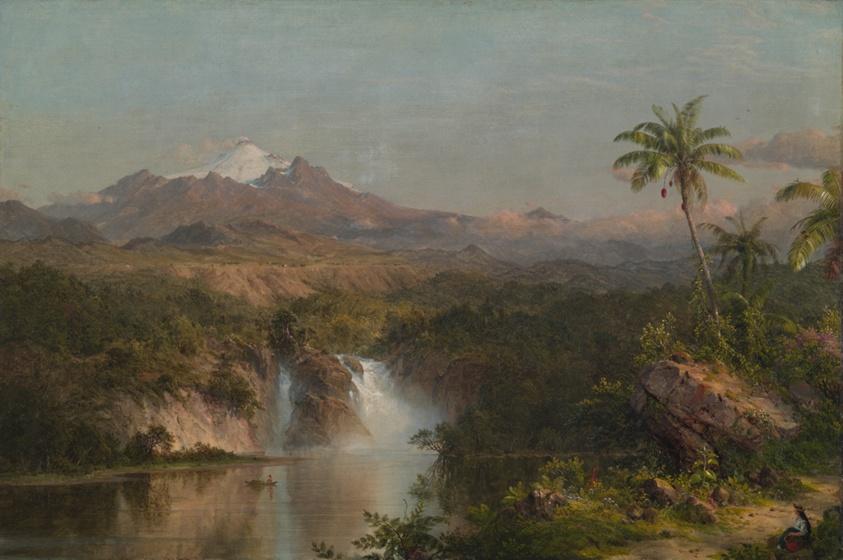
Frederic Edwin Church

Winslow Homer

William Sidney Mount