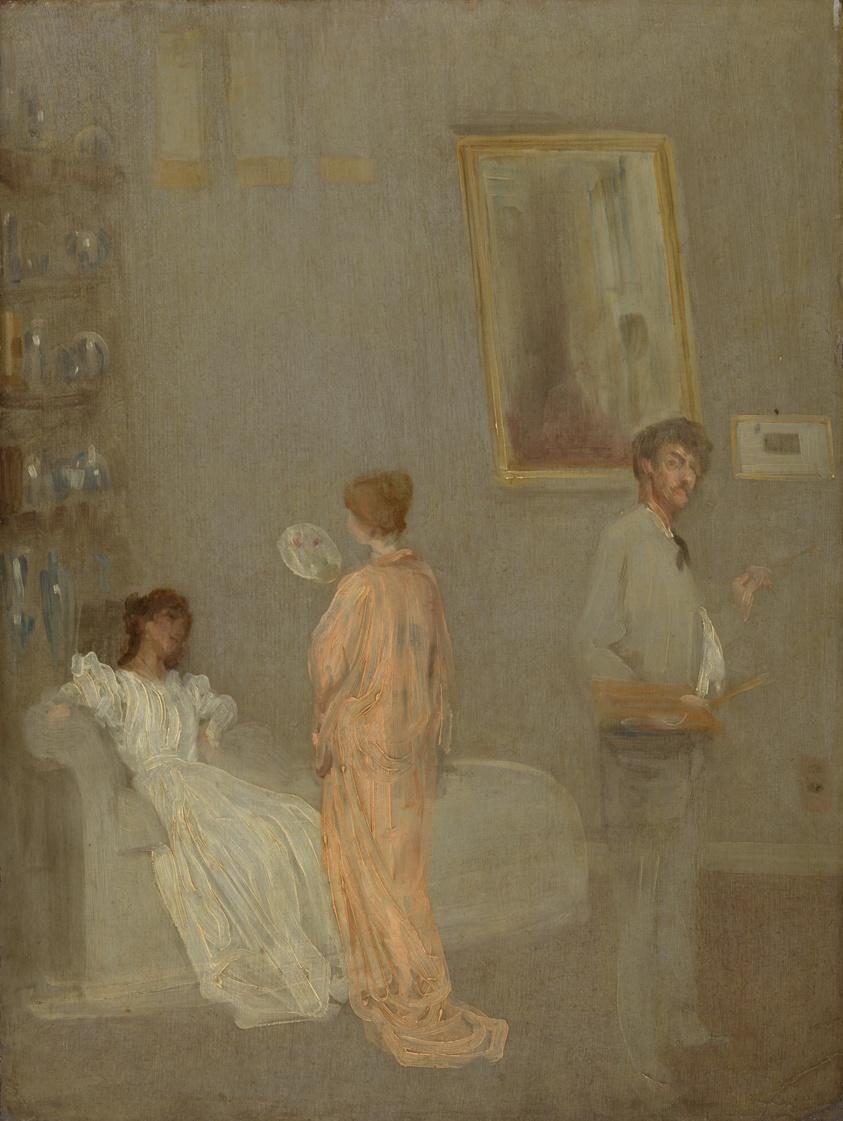
The Artist in His Studio
James McNeill Whistler
1123 likes73 comments
Paintale uses cookies for essential site functionality and, where enabled, to serve relevant advertising via Google AdSense. You can accept all cookies or reject non-essential ones. See our Privacy Policy for details.
Now viewing
Grey and Silver: Old Battersea Reach
James McNeill Whistler
Period
1831-1870
Theme
Power & Politics
Medium
Oil on canvas
Current Location
Art Institute of Chicago, Chicago
The Story
James McNeill Whistler painted marine scenes throughout his career, including this depiction of the Thames River, which was a frequent subject in Whistler’s work when he lived in London. Here, he focused on the river’s industrial elements: boats and barges, laboring men, and smoking chimneys. Whistler unified the composition with deft brushwork and a subtle palette of brown and gray that anticipated his later interest in delicate tonal harmonies.
The painting’s bold realism and thickly painted surface were inspired by French artist Gustave Courbet, whose work Whistler encountered during his stays in Paris in the mid-1850s and 1860s.
Executed in Oil on canvas, measuring 50.8 × 68.6 cm (20 × 27 in.), the surface rewards close looking. James McNeill Whistler builds the composition through layered glazes and a tightly controlled palette, letting cool shadows recede so that the warm, lit passages step forward.
Look closely and the painting opens up. Objects you might pass over — a folded letter, a half-drawn curtain, the angle of a glance — were placed to be read. Crowns, columns, and heraldry quietly insist on legitimacy — this is a painting working hard on behalf of a patron.
Art Institute of Chicago in Chicago now holds the work, where conservators and historians continue to revisit its condition and attribution. Each generation of scholarship adds a layer to how James McNeill Whistler's output from this period is understood.
“A silence so complete it becomes its own witness.”
James McNeill Whistler painted marine scenes throughout his career, including this depiction of the Thames River, which was a frequent subject in Whistler’s work when he lived in London. Here, he focused on the river’s industrial elements: boats and barges, laboring men, and smoking chimneys. Whistler unified the composition with deft brushwork and a subtle palette of brown and gray that anticipated his later interest in delicate tonal harmonies. The painting’s bold realism and thickly painted surface were inspired by French artist Gustave Courbet, whose work Whistler encountered during his stays in Paris in the mid-1850s and 1860s.
Gift of Honoré and Potter Palmer
Inscriptions: Signed recto, bottom-left, on water, in dark paint: "Whistler. 63."..
The artist, from 1863 to about 1889; sold to Mrs. Aglaia Coronio (born Ionides, 1834–1906), London, from about 1889 to 1892 [according to <a href="https://www.whistler.arts.gla.ac.uk/correspondence/recno/display/?cid=07900">letter from James McNeill Whistler to Aglaia Coronio, undated (December 1888?), GUW 07900, note 3</a>; <a href="https://www.whistler.arts.gla.ac.uk/correspondence/recno/display/?cid=00693">letter from James McNeill Whistler to Aglaia Coronio, undated (1889?), GUW 00693, note 3</a>; <a href="https://www.whistler.arts.gla.ac.uk/correspondence/recno/display/?cid=11034">letter from Aglaia Coronio to James McNeill Whistler, undated (1889?), GUW 11034, note 4</a>; <a href="https://www.whistler.arts.gla.ac.uk/correspondence/recno/display/?cid=00691">letter from James McNeill Whistler to Aglaia Coronio, dated June 2 (1889), GUW 00691, note 3</a>]; consigned to Boussod, Valadon & Co., Paris, by May 30, 1892; sold to Mrs. Potter Palmer (Bertha Palmer, born Honoré, 1849–1918), Chicago, May 30, 1892, for £450 [Goupil & Cie / Boussod, Valadon & Co. Stock Books, Livre no. 13, 1891–1895, p. 97, no. 22337, as <em>Old Battersea Chelsea</em>, Special Collections, Getty Research Institute, copy in curatorial object file; <a href="https://www.whistler.arts.gla.ac.uk/correspondence/recno/display/?cid=05742">letter from Boussod, Valadon and Co. to James McNeill Whistler, dated May 28, 1892, GUW 05742</a>]; by descent to her sons, Honoré Palmer (1874–1964) and Potter Palmer II (1875–1943), 1918; given to the Art Institute of Chicago, 1922.
Art Institute of Chicago, Chicago. View on the museum’s official page.
See more works at Art Institute of Chicago or browse the full James McNeill Whistler collection.
A restrained palette and sculptural lighting create a solemn geometry. The wooden crate and letter anchor the narrative with journalistic precision.
Sources
Keep Exploring
More paintings like this
James McNeill Whistler
James McNeill Whistler
James McNeill Whistler
James McNeill Whistler
John Frederick Kensett American
Frederic Edwin Church
James McNeill Whistler
James McNeill Whistler