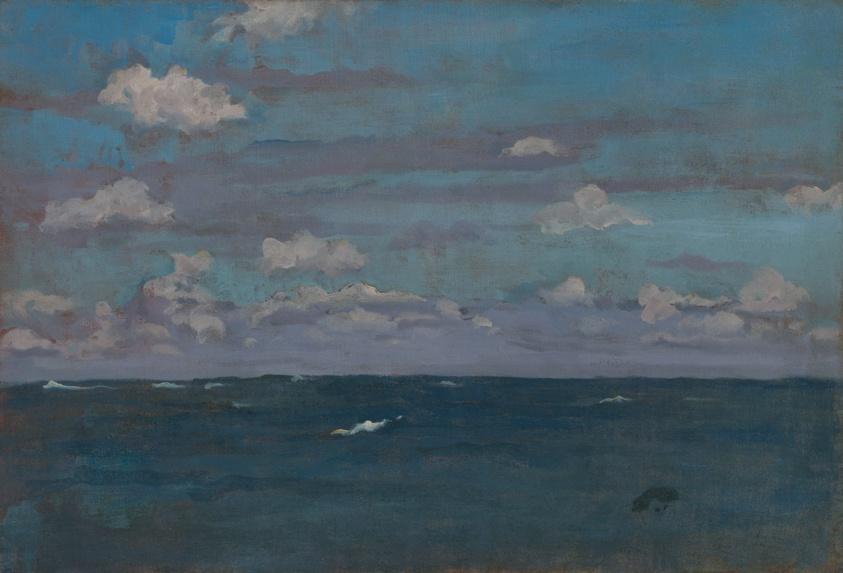
Violet and Silver—The Deep Sea
James McNeill Whistler
1152 likes62 comments
Paintale uses cookies for essential site functionality and, where enabled, to serve relevant advertising via Google AdSense. You can accept all cookies or reject non-essential ones. See our Privacy Policy for details.
Now viewing
Coast Scene, Bathers
James McNeill Whistler
Period
1871-1900
Theme
Landscape
Medium
Oil on panel
Current Location
Art Institute of Chicago, Chicago
The Story
In this intimately scaled seascape, James McNeill Whistler employed the sparest of compositional elements to evoke a coastal atmosphere. Broad horizontal bands of blues and gray suggest sky, ocean, and sand, with dabs of thin pigment giving economical, yet expressive form to around a dozen figures on the windswept beach. Whistler dedicated much of his artistic practice to capturing the mood and color harmonies of marine scenes. Coast Scene, Bathers was painted en plein air, a practice to which the artist returned in the 1880s.
It marked a distinctive shift from his studio-produced Nocturnes of the previous decade.
Executed in Oil on panel, measuring 13.3 × 21.9 cm (5 1/4 × 8 5/8 in.), the surface rewards close looking. James McNeill Whistler builds the composition through layered glazes and a tightly controlled palette, letting cool shadows recede so that the warm, lit passages step forward.
Look closely and the painting opens up. Objects you might pass over — a folded letter, a half-drawn curtain, the angle of a glance — were placed to be read. The scale is the argument: a single, tiny figure against sky and rock does the work of describing nature as something larger than any human claim on it.
Housed at Art Institute of Chicago in Chicago, the painting has passed through the hands of collectors, dealers, and institutions before reaching public view — a provenance that is itself part of the object's story.
“A silence so complete it becomes its own witness.”
In this intimately scaled seascape, James McNeill Whistler employed the sparest of compositional elements to evoke a coastal atmosphere. Broad horizontal bands of blues and gray suggest sky, ocean, and sand, with dabs of thin pigment giving economical, yet expressive form to around a dozen figures on the windswept beach. Whistler dedicated much of his artistic practice to capturing the mood and color harmonies of marine scenes. Coast Scene, Bathers was painted en plein air, a practice to which the artist returned in the 1880s. It marked a distinctive shift from his studio-produced Nocturnes of the previous decade.
Walter S. Brewster Collection
Inscriptions: Butterfly monogram, lower right.
Mrs. J. Cross, by November 1917; sold to P. and D. Colnaghi and Co., London, November 1, 1917 [according to Young, MacDonald, Spencer, and Miles 1980]; partial share sold to M. Knoedler and Co., New York, December 31, 1917; sold to Charles B. Eddy (1872–1951), New York, April 1918 [M. Knoedler and Co. Stock Book 6, Stock No. 14346, copy in curatorial object file]; returned to M. Knoedler and Co., New York, by January 1919; sold to R.C. and N.M. Vose Gallery, Boston, November 1919 [M. Knoedler and Co. Stock Book 6, Stock No. 14561, copy in curatorial object file]; sold to Woodruff J. Parker (1880–1930), Chicago, June 5, 1922. With Chester H. Johnson Galleries, Chicago, by 1926; sold to Walter Stanton Brewster (1872–1954), Chicago, 1926 [according to Young, MacDonald, Spencer, and Miles 1980]; given to the Art Institute of Chicago, 1933.
Art Institute of Chicago, Chicago. View on the museum’s official page.
See more works at Art Institute of Chicago or browse the full James McNeill Whistler collection.
A restrained palette and sculptural lighting create a solemn geometry. The wooden crate and letter anchor the narrative with journalistic precision.
Sources
Keep Exploring
More paintings like this
James McNeill Whistler
James McNeill Whistler
James McNeill Whistler
James McNeill Whistler
James McNeill Whistler
George Inness
George Inness
George Inness