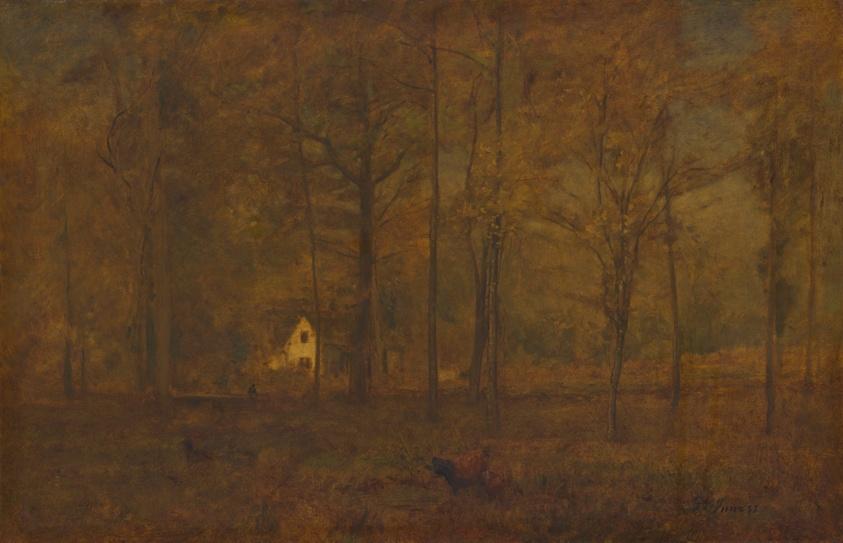
Autumn Woods
George Inness
824 likes94 comments
Paintale uses cookies for essential site functionality and, where enabled, to serve relevant advertising via Google AdSense. You can accept all cookies or reject non-essential ones. See our Privacy Policy for details.
Now viewing
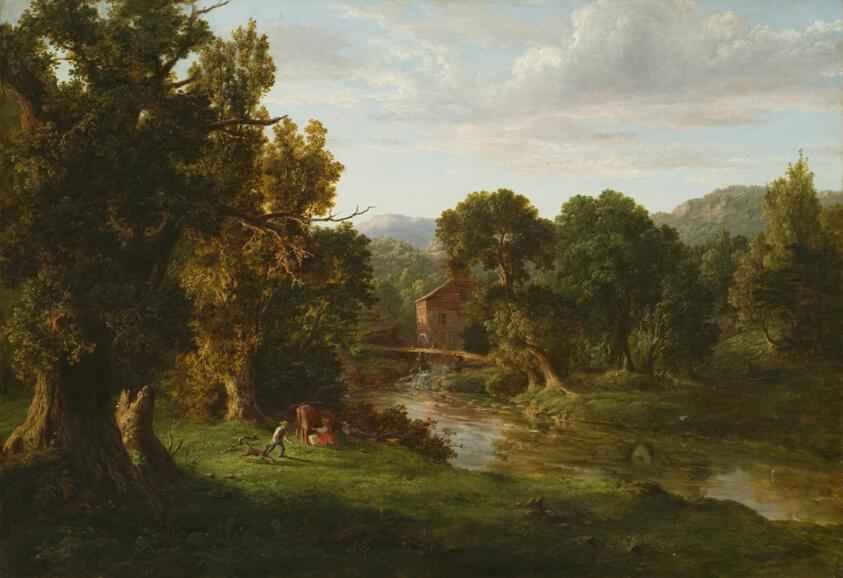
The Home of the Heron
George Inness
Period
1871-1900
Theme
Landscape
Medium
Oil on canvas
Current Location
Art Institute of Chicago, Chicago
The Story
The landscape painter George Inness once explained, “The true purpose of the painter is simply to reproduce in other minds the impression which a scene has made upon him . . ” Inness sought, particularly in his later years, to record not so much the appearance of nature as its poetry. ” For half a century, the artist captured these moisture-laden subjects in all seasons, during all hours of the day and night.
First he made small, quick sketches in the field or wood, and then, in the seclusion of his studio, he used them to create the more than one thousand oils credited to him. Inness completed The Home of the Heron near the end of his career, after he had finally achieved a degree of comfort and success. The painting is characteristic of his late work, with loosely rendered detail and dim objects that seem bathed in an almost incandescent glow.
Working in Oil on canvas at 76.2 × 115.2 cm (30 × 45 in.), George Inness constructs depth through value contrast rather than outline, letting figures emerge from darkness the way they would under candlelight or through a shuttered window.
Look closely and the painting opens up. Objects you might pass over — a folded letter, a half-drawn curtain, the angle of a glance — were placed to be read. Weather and light are the real subject — the artist is tracking a specific, fleeting atmospheric moment rather than an idealized, generic view.
Today the painting is held by Art Institute of Chicago in Chicago, where it remains a touchstone for understanding George Inness's contribution to Western art. It has been studied, copied, restored, and argued over for centuries — proof that great paintings keep generating new readings long after their creators have gone.
“A silence so complete it becomes its own witness.”
The landscape painter George Inness once explained, “The true purpose of the painter is simply to reproduce in other minds the impression which a scene has made upon him . . . to awaken an emotion.” Inness sought, particularly in his later years, to record not so much the appearance of nature as its poetry. To achieve this, he limited his subject matter to, in his words, “rivers, streams, the rippling brook, the hillside, the sky, the clouds.” For half a century, the artist captured these moisture-laden subjects in all seasons, during all hours of the day and night. First he made small, quick sketches in the field or wood, and then, in the seclusion of his studio, he used them to create the more than one thousand oils credited to him. Inness completed The Home of the Heron near the end of his career, after he had finally achieved a degree of comfort and success. The painting is characteristic of his late work, with loosely rendered detail and dim objects that seem bathed in an almost incandescent glow. The picture’s blurred outlines, broad handling, and delicate, subtle tonalities, as well as the solitary presence of the heron, masterfully evoke nature’s stillness and mystery. With more than two dozen canvases by Inness, the Art Institute has one of the most comprehensive collections of the painter’s work.
Edward B. Butler Collection
Technique: oil painting, painting (image making).
Inscriptions: Signed, lower right: "G. Inness 1893".
Estate of the artist (sale, Fifth Avenue Galleries, New York, February 12-14, 1895, no. 69, as "The Sun's Last Reflection"); E.W. Bass, 1895; Emerson McMillin, New York, to 1911; Knoedler & Co., New York, 1911; Reinhardt Galleries, Chicago, 1911; sold to Edward B. Butler, Chicago, 1911; given to the Art Institute of Chicago, 1911.
Art Institute of Chicago, Chicago. View on the museum’s official page.
See more works at Art Institute of Chicago or browse the full George Inness collection.
A restrained palette and sculptural lighting create a solemn geometry. The wooden crate and letter anchor the narrative with journalistic precision.
Sources
Keep Exploring
More paintings like this
George Inness
George Inness

George Inness
George Inness
George Inness
George Inness
George Inness

George Inness