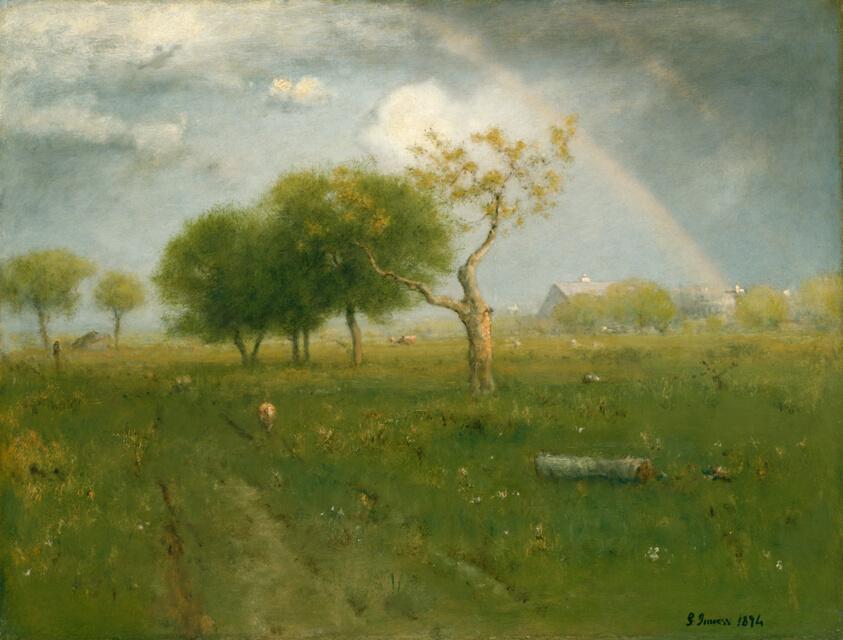
After a Summer Shower
George Inness
887 likes17 comments
Paintale uses cookies for essential site functionality and, where enabled, to serve relevant advertising via Google AdSense. You can accept all cookies or reject non-essential ones. See our Privacy Policy for details.
Now viewing
Early Morning, Tarpon Springs
George Inness
Period
1871-1900
Theme
Religion & Mythology
Medium
Oil on canvas
Current Location
Art Institute of Chicago, Chicago
The Story
The light and landscape of Florida inspired George Inness’s Early Morning, Tarpon Springs. Amid the pale pinks and blues of sunrise, a miniscule figure stands in a grove of trees, harmonizing with the surrounding landscape. The color of his pants mirrors that of the tree trunks, and his red hat suggests a luminous, low sun. Believing that objects in the natural world were suffused with spiritual meaning, Inness incorporated the tenets of Swedenborgian Christianity into his work. Landscape painting, in turn, became a site for contemplation and religious experience.
Created in 1892, this work belongs firmly within the religion & mythology tradition of American painting. George Inness worked at a moment when the young republic was still deciding what its own art should look like — how much to borrow from Europe, how much to invent from its own landscape and daily life. Every gesture, fabric, and gleam of light was pitched at an audience learning to take American subjects seriously.
As Oil on canvas (107.2 × 82.2 cm (42 3/16 × 32 3/8 in.)), the work shows the tool marks and layering choices typical of George Inness's output in this period — decisions about ground, underpainting, and glaze that a photograph can only partly convey.
Look closely and the painting opens up. Objects you might pass over — a folded letter, a half-drawn curtain, the angle of a glance — were placed to be read. Figures and gestures here follow a visual vocabulary contemporary viewers would have read fluently — attributes, poses, and settings that identify who is who and what is at stake.
Today the painting is held by Art Institute of Chicago in Chicago, where it remains a touchstone for understanding George Inness's contribution to Western art. It has been studied, copied, restored, and argued over for centuries — proof that great paintings keep generating new readings long after their creators have gone.
“A silence so complete it becomes its own witness.”
This painting features documented symbols with their own dedicated meaning in art history:
The light and landscape of Florida inspired George Inness’s Early Morning, Tarpon Springs. Amid the pale pinks and blues of sunrise, a miniscule figure stands in a grove of trees, harmonizing with the surrounding landscape. The color of his pants mirrors that of the tree trunks, and his red hat suggests a luminous, low sun. Believing that objects in the natural world were suffused with spiritual meaning, Inness incorporated the tenets of Swedenborgian Christianity into his work. Landscape painting, in turn, became a site for contemplation and religious experience.
Edward B. Butler Collection
Technique: oil painting, painting (image making).
Inscriptions: Signed and dated recto, bottom-left, on ground, in brown paint: "G. Inness 1892"..
Reinhardt Galleries, Chicago, 1911; sold to Edward B. Butler, Chicago, 1911; given to the Art Institute of Chicago, 1911.
Art Institute of Chicago, Chicago. View on the museum’s official page.
See more works at Art Institute of Chicago or browse the full George Inness collection.
A restrained palette and sculptural lighting create a solemn geometry. The wooden crate and letter anchor the narrative with journalistic precision.
Sources
Keep Exploring
More paintings like this
George Inness
George Inness
George Inness
George Inness

George Inness

George Inness
George Inness
George Inness