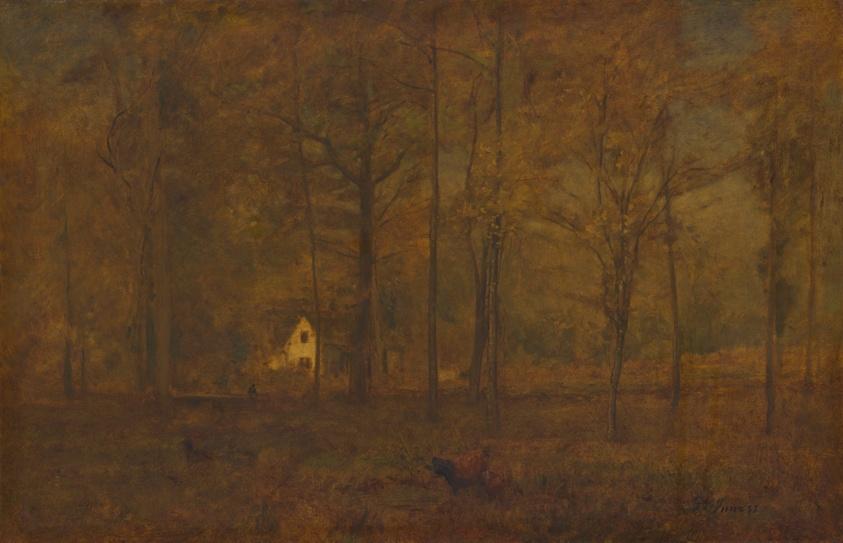
Autumn Woods
George Inness
824 likes94 comments
Paintale uses cookies for essential site functionality and, where enabled, to serve relevant advertising via Google AdSense. You can accept all cookies or reject non-essential ones. See our Privacy Policy for details.
Now viewing
The Mill Pond
George Inness
Period
1871-1900
Theme
Landscape
Medium
Oil on canvas
Current Location
Art Institute of Chicago, Chicago
The Story
A distinctive landscape painter of the 19th century, George Inness excelled at capturing the poetics and mood of his environs, finding spiritual resonances in nature, from its grand vistas to its quiet nooks. The Mill Pond depicts a sylvan setting, in which a small figure rows a boat in the pond at middle distance. Brilliant pigments of orange, green, and blue electrify an otherwise tranquil scene. Through color and atmosphere rather than line or detail, Inness communicated an intensity of vision, fueled by an individual encounter with nature.
Created in 1889, this work belongs firmly within the landscape tradition of American painting. George Inness worked at a moment when the young republic was still deciding what its own art should look like — how much to borrow from Europe, how much to invent from its own landscape and daily life. Every gesture, fabric, and gleam of light was pitched at an audience learning to take American subjects seriously.
As Oil on canvas (95.9 × 75.6 cm (37 3/4 × 29 3/4 in.)), the work shows the tool marks and layering choices typical of George Inness's output in this period — decisions about ground, underpainting, and glaze that a photograph can only partly convey.
Look closely and the painting opens up. Objects you might pass over — a folded letter, a half-drawn curtain, the angle of a glance — were placed to be read. The scale is the argument: a single, tiny figure against sky and rock does the work of describing nature as something larger than any human claim on it.
Today the painting is held by Art Institute of Chicago in Chicago, where it remains a touchstone for understanding George Inness's contribution to Western art. It has been studied, copied, restored, and argued over for centuries — proof that great paintings keep generating new readings long after their creators have gone.
“A silence so complete it becomes its own witness.”
A distinctive landscape painter of the 19th century, George Inness excelled at capturing the poetics and mood of his environs, finding spiritual resonances in nature, from its grand vistas to its quiet nooks. The Mill Pond depicts a sylvan setting, in which a small figure rows a boat in the pond at middle distance. Brilliant pigments of orange, green, and blue electrify an otherwise tranquil scene. Through color and atmosphere rather than line or detail, Inness communicated an intensity of vision, fueled by an individual encounter with nature.
Edward B. Butler Collection
Inscriptions: Signed lower right: "G. Inness 1889".
Thomas B. Clarke (sale, American Art Association, New York, February 14-18, 1899); Emerson McMillin, New York, from 1899 to 1911; Knoedler & Co., New York, 1911; Reinhardt Galleries, Chicago, 1911; sold to Edward B. Butler, Chicago, 1911; given to the Art Institute of Chicago, 1911.
Art Institute of Chicago, Chicago. View on the museum’s official page.
See more works at Art Institute of Chicago or browse the full George Inness collection.
A restrained palette and sculptural lighting create a solemn geometry. The wooden crate and letter anchor the narrative with journalistic precision.
Sources
Keep Exploring
More paintings like this
George Inness
George Inness
George Inness
George Inness
George Inness
George Inness
George Inness

George Inness