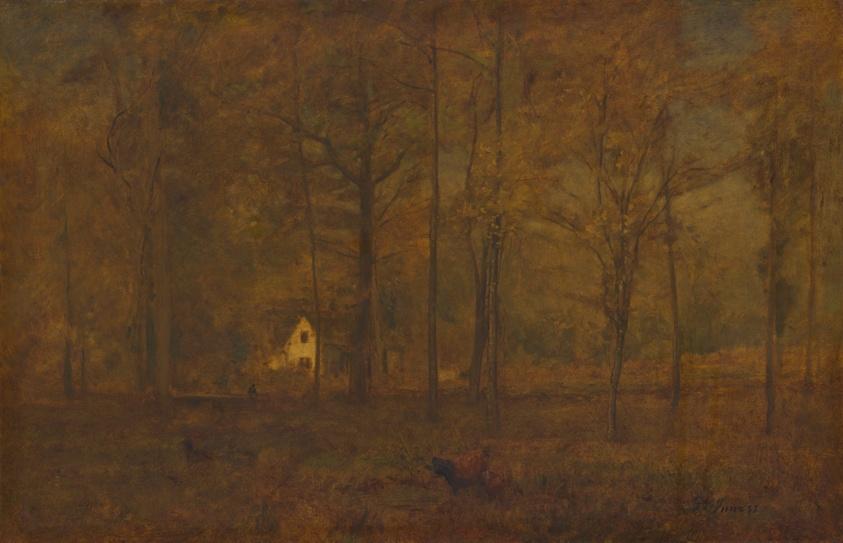
Autumn Woods
George Inness
824 likes94 comments
Paintale uses cookies for essential site functionality and, where enabled, to serve relevant advertising via Google AdSense. You can accept all cookies or reject non-essential ones. See our Privacy Policy for details.
Now viewing
The Old Mill
George Inness
Period
1831-1870
Theme
Landscape
Medium
Oil on canvas
Current Location
Art Institute of Chicago, Chicago
The Story
George Inness began painting landscapes during a period in which the public preferred depictions of the untamed American wilderness; throughout his career, however, he insisted upon the importance of the cultivated landscape as a subject for art. In this work, the brightly lit figures and mill contrast with the shadowy darkness of the trees, suggesting the potential for danger at the edge of the forest. The rundown mill represents a stable, settled area but also points to the changes brought about by industrialization.
Inness thus created a contradictory view of rural life that celebrates its simplicity and safety while hinting at its decline.
Working in Oil on canvas at 75.9 × 107 cm (29 7/8 × 42 1/8 in.), George Inness constructs depth through value contrast rather than outline, letting figures emerge from darkness the way they would under candlelight or through a shuttered window.
Look closely and the painting opens up. Objects you might pass over — a folded letter, a half-drawn curtain, the angle of a glance — were placed to be read. Weather and light are the real subject — the artist is tracking a specific, fleeting atmospheric moment rather than an idealized, generic view.
Today the painting is held by Art Institute of Chicago in Chicago, where it remains a touchstone for understanding George Inness's contribution to Western art. It has been studied, copied, restored, and argued over for centuries — proof that great paintings keep generating new readings long after their creators have gone.
“A silence so complete it becomes its own witness.”
George Inness began painting landscapes during a period in which the public preferred depictions of the untamed American wilderness; throughout his career, however, he insisted upon the importance of the cultivated landscape as a subject for art. In this work, the brightly lit figures and mill contrast with the shadowy darkness of the trees, suggesting the potential for danger at the edge of the forest. The rundown mill represents a stable, settled area but also points to the changes brought about by industrialization. Inness thus created a contradictory view of rural life that celebrates its simplicity and safety while hinting at its decline.
The William Owen Goodman and Erna Sawyer Goodman Collection
Inscriptions: Signed, lower right: "G. Inness 1849".
American Art Union, New York; James P. Kelly, New York, 1849, by distribution from the American Art-Union; (Sale, John Fell O'Brien, Auctioneer, at the Waldorf-Astoria, New York, January 13-14, 1902, no. 108); William Owen and Erna Sawyer Goodman, by 1939; given to the Art Institute of Chicago, 1939.
Art Institute of Chicago, Chicago. View on the museum’s official page.
See more works at Art Institute of Chicago or browse the full George Inness collection.
A restrained palette and sculptural lighting create a solemn geometry. The wooden crate and letter anchor the narrative with journalistic precision.
Sources
Keep Exploring
More paintings like this
George Inness
George Inness
George Inness

George Inness
George Inness
George Inness
George Inness
George Inness