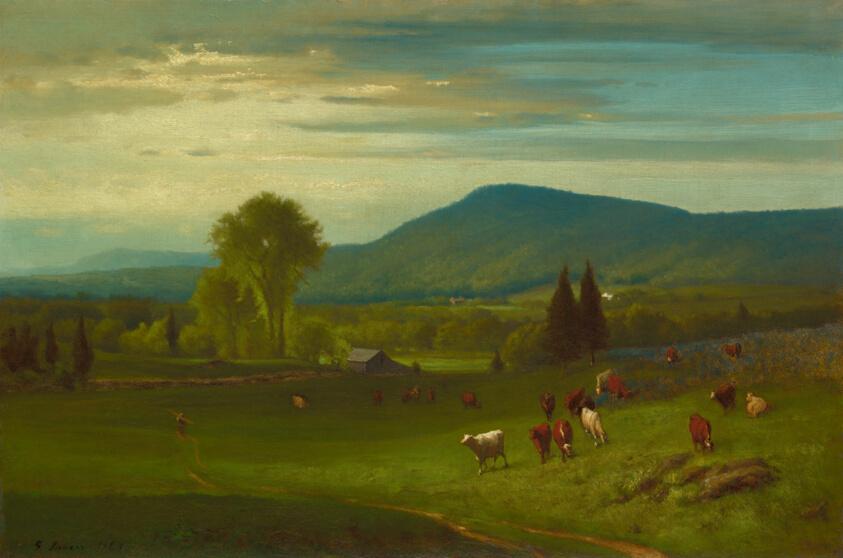
Summer in the Catskills
George Inness
1507 likes57 comments
Paintale uses cookies for essential site functionality and, where enabled, to serve relevant advertising via Google AdSense. You can accept all cookies or reject non-essential ones. See our Privacy Policy for details.
Now viewing
Catskill Mountains
George Inness
Period
1831-1870
Theme
Portrait
Medium
Oil on canvas
Current Location
Art Institute of Chicago, Chicago
The Story
George Inness’s Catskill Mountains depicts a land tamed by human presence. The church, the carefully tended fields, and the hayrick on the right are all finely delineated in a manner typical of Inness’s early style. Although the artist’s reverent handling of color and light in this image has often been linked to his interest in Swedenborgian spirituality, it also relates to his admiration for this particular expanse of the American landscape. During the mid-19th century, the Catskill Mountain range was America’s premiere tourist site.
The region’s close proximity to urban centers and abundant spectacular views made the Catskills a popular destination for those who wanted to escape from the bustle of modern life.
Executed in Oil on canvas, measuring 123.8 × 184.5 cm (48 3/4 × 72 5/8 in.), the surface rewards close looking. George Inness builds the composition through layered glazes and a tightly controlled palette, letting cool shadows recede so that the warm, lit passages step forward.
Look closely and the painting opens up. Objects you might pass over — a folded letter, a half-drawn curtain, the angle of a glance — were placed to be read. Every prop in a portrait like this is a decision — jewelry, fabric, and hand position were negotiated between painter and patron to shape how the sitter would be remembered.
Housed at Art Institute of Chicago in Chicago, the painting has passed through the hands of collectors, dealers, and institutions before reaching public view — a provenance that is itself part of the object's story.
“A silence so complete it becomes its own witness.”
George Inness’s Catskill Mountains depicts a land tamed by human presence. The church, the carefully tended fields, and the hayrick on the right are all finely delineated in a manner typical of Inness’s early style. Although the artist’s reverent handling of color and light in this image has often been linked to his interest in Swedenborgian spirituality, it also relates to his admiration for this particular expanse of the American landscape. During the mid-19th century, the Catskill Mountain range was America’s premiere tourist site. The region’s close proximity to urban centers and abundant spectacular views made the Catskills a popular destination for those who wanted to escape from the bustle of modern life.
Edward B. Butler Collection
Inscriptions: Signed, lower left: "G. Inness 1870".
Mrs. Henry E. Dalley, New York, New York; with M. Knoedler & Co., New York, 1911-12; W. H. Dicks, Chicago, 1912; with W. Scott Thurber, Chicago, 1912; Edward B. Butler, Chicago, 1912; given to the Art Institute of Chicago, 1912.
Art Institute of Chicago, Chicago. View on the museum’s official page.
See more works at Art Institute of Chicago or browse the full George Inness collection.
A restrained palette and sculptural lighting create a solemn geometry. The wooden crate and letter anchor the narrative with journalistic precision.
Sources
Keep Exploring
More paintings like this
George Inness
George Inness
George Inness
George Inness
James McNeill Whistler
George Inness
George Inness
George Inness