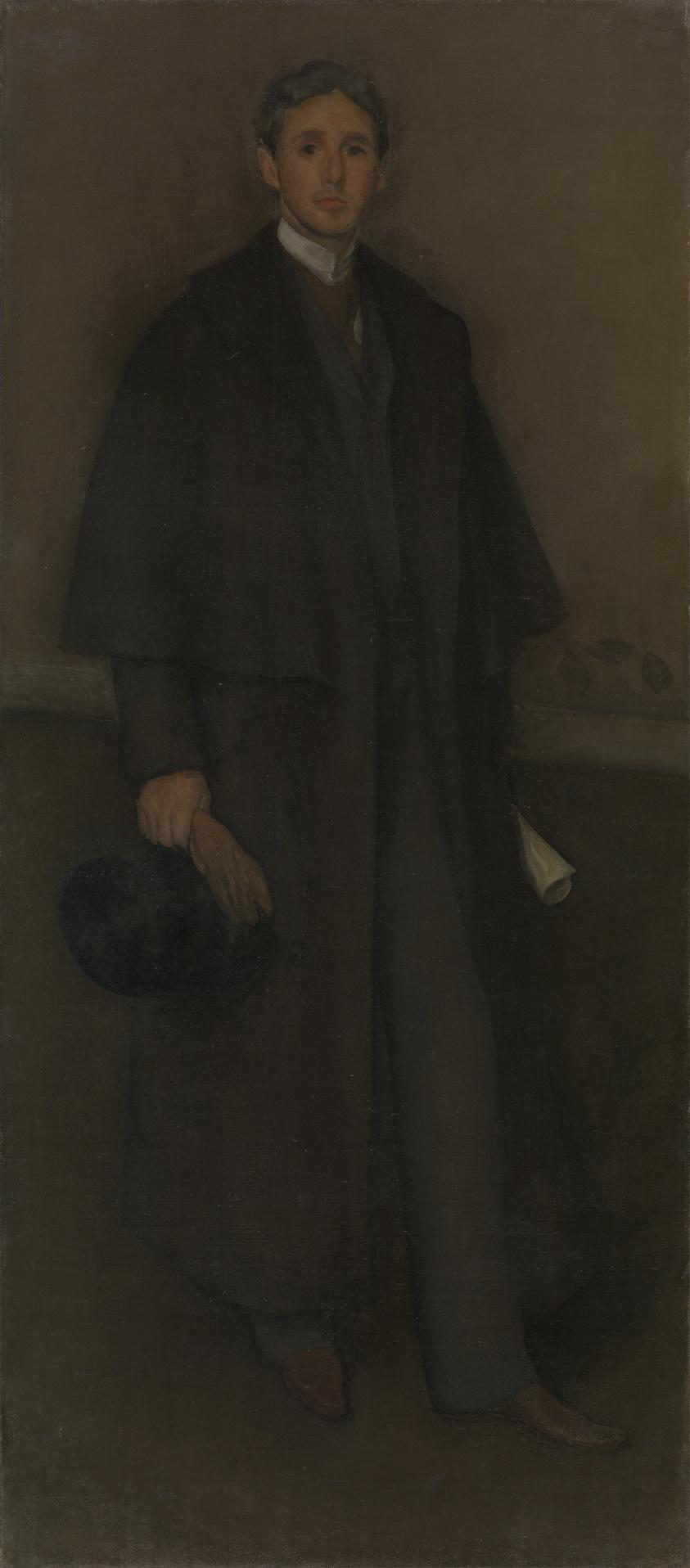
Arrangement in Flesh Color and Brown: Portrait of Arthur Jerome Eddy
James McNeill Whistler
936 likes146 comments
Paintale uses cookies for essential site functionality and, where enabled, to serve relevant advertising via Google AdSense. You can accept all cookies or reject non-essential ones. See our Privacy Policy for details.
Now viewing
The Artist in His Studio
James McNeill Whistler
Period
1831-1870
Theme
Portrait
Medium
Oil on paper mounted on panel
Current Location
Art Institute of Chicago, Chicago
The Story
By the mid-1860s, the London-based, American artist James McNeill Whistler was increasingly fascinated with the aesthetics of Asian art. In The Artist in His Studio, Whistler stares out at the viewer with palette and paintbrush in hand, surrounded by works from his collection: three Japanese scrolls hang on the wall and Chinese porcelain adorns shelves on the left. He applied thin layers of paint in muted tones to evoke the flattened appearance of Japanese woodblock prints.
The composition also recalls the work of the Spanish Baroque painter Diego Velázquez, who likewise included a self-portrait at his easel in Las Meninas (1656, Museo Nacional del Prado, Madrid). Whistler harmonized Western and Eastern artistic elements, placing himself at the center of such an enterprise.
Executed in Oil on paper mounted on panel, measuring Board: 62 × 46.5 cm (24 7/16 × 18 5/16 in.); Overall: 63 × 47.3 cm (24 13/16 × 18 5/8 in.), the surface rewards close looking. James McNeill Whistler builds the composition through layered glazes and a tightly controlled palette, letting cool shadows recede so that the warm, lit passages step forward.
Look closely and the painting opens up. Objects you might pass over — a folded letter, a half-drawn curtain, the angle of a glance — were placed to be read. Every prop in a portrait like this is a decision — jewelry, fabric, and hand position were negotiated between painter and patron to shape how the sitter would be remembered.
Housed at Art Institute of Chicago in Chicago, the painting has passed through the hands of collectors, dealers, and institutions before reaching public view — a provenance that is itself part of the object's story.
“A silence so complete it becomes its own witness.”
By the mid-1860s, the London-based, American artist James McNeill Whistler was increasingly fascinated with the aesthetics of Asian art. In The Artist in His Studio, Whistler stares out at the viewer with palette and paintbrush in hand, surrounded by works from his collection: three Japanese scrolls hang on the wall and Chinese porcelain adorns shelves on the left. He applied thin layers of paint in muted tones to evoke the flattened appearance of Japanese woodblock prints. The composition also recalls the work of the Spanish Baroque painter Diego Velázquez, who likewise included a self-portrait at his easel in Las Meninas (1656, Museo Nacional del Prado, Madrid). Whistler harmonized Western and Eastern artistic elements, placing himself at the center of such an enterprise.
Friends of American Art Collection
Inscriptions: Artist insignia recto, right-bottom, on wall, in dark paint: [butterfly in cartouche]..
The artist, Paris, then London; consigned to Goupil Gallery, London, December 1896; sold to Douglas William Freshfield (1845–1934), London, by October 1897; with Brown & Phillips, London, sold to P. & D. Colnaghi and Obach, London, by 1911; partial share sold to M. Knoedler & Co., New York, August 24, 1911; probably consigned to Henry Reinhardt Galleries, New York and Chicago, 1911; sold to the Friends of American Art, Art Institute of Chicago, 1912; given to the Art Institute of Chicago, 1912.
Art Institute of Chicago, Chicago. View on the museum’s official page.
See more works at Art Institute of Chicago or browse the full James McNeill Whistler collection.
A restrained palette and sculptural lighting create a solemn geometry. The wooden crate and letter anchor the narrative with journalistic precision.
Sources
Keep Exploring
More paintings like this
James McNeill Whistler
James McNeill Whistler
James McNeill Whistler
James McNeill Whistler
James McNeill Whistler
Albert Schindler
John Frederick Kensett
George Inness