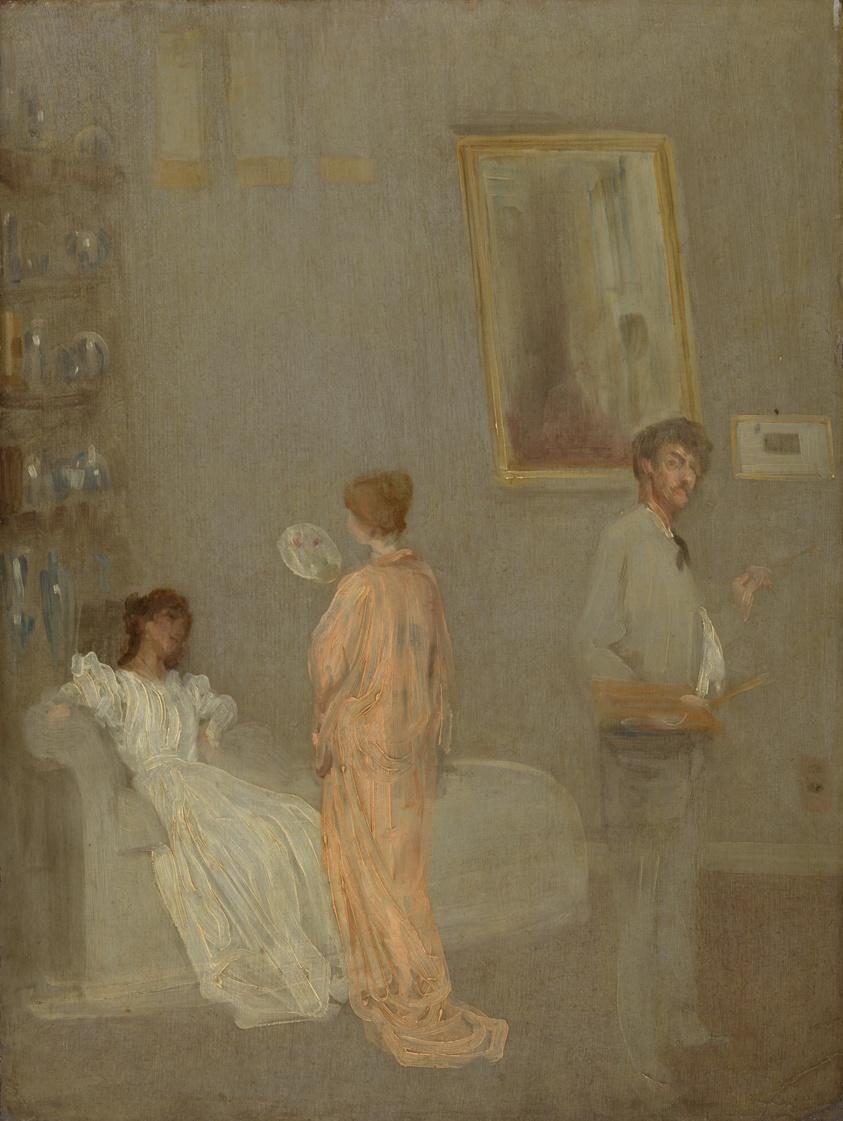
The Artist in His Studio
James McNeill Whistler
1123 likes73 comments
Paintale uses cookies for essential site functionality and, where enabled, to serve relevant advertising via Google AdSense. You can accept all cookies or reject non-essential ones. See our Privacy Policy for details.
Now viewing
Portrait of Emmanuel Rio
Albert Schindler
Period
1831-1870
Theme
Portrait
Medium
Oil on panel
Current Location
Art Institute of Chicago, Chicago
The Story
Previously known only as “a gardener and horn player,” recent research has identified the figure in this painting as Emmanuel Rio, an enslaved Brazilian man of African descent who was sent to Emperor Francis I in Vienna around 1820. About ten years old when he arrived in Vienna, Rio was enrolled in an elite private school, where he excelled in French, Italian, drawing, and especially music. Francis fostered his talent, gifting Rio a French horn on the occasion of his graduation.
Despite his aptitude for music, Rio was assigned to work in the imperial garden. In this portrait, produced a year after the emperor’s death, Rio holds his favored instrument while looking at an image of Francis, beneath which hangs a gold watch given to him by the monarch. The painting’s sentimentality does little to suggest the precariousness of its subject’s situation in Vienna, which only worsened after Francis died.
Executed in Oil on panel, measuring 39 × 31.7 cm (15 3/8 × 12 1/2 in.); Framed: 57.2 × 49.6 cm (22 1/2 × 19 1/2 in.), the surface rewards close looking. Albert Schindler builds the composition through layered glazes and a tightly controlled palette, letting cool shadows recede so that the warm, lit passages step forward.
Look closely and the painting opens up. Objects you might pass over — a folded letter, a half-drawn curtain, the angle of a glance — were placed to be read. Likeness was only part of the job; the painting also had to argue for the sitter's place in the world.
Today the painting is held by Art Institute of Chicago in Chicago, where it remains a touchstone for understanding Albert Schindler's contribution to Western art. It has been studied, copied, restored, and argued over for centuries — proof that great paintings keep generating new readings long after their creators have gone.
“A silence so complete it becomes its own witness.”
Previously known only as “a gardener and horn player,” recent research has identified the figure in this painting as Emmanuel Rio, an enslaved Brazilian man of African descent who was sent to Emperor Francis I in Vienna around 1820. About ten years old when he arrived in Vienna, Rio was enrolled in an elite private school, where he excelled in French, Italian, drawing, and especially music. Francis fostered his talent, gifting Rio a French horn on the occasion of his graduation. Despite his aptitude for music, Rio was assigned to work in the imperial garden. In this portrait, produced a year after the emperor’s death, Rio holds his favored instrument while looking at an image of Francis, beneath which hangs a gold watch given to him by the monarch. The painting’s sentimentality does little to suggest the precariousness of its subject’s situation in Vienna, which only worsened after Francis died. For the rest of his life, Viennese officials moved Rio to various positions throughout Europe, threatened him with forced military service when he resisted, and, by the late 1840s, discussed sending him back to Brazil or to Africa.
Henry Tiefenbronner Endowment
Technique: oil painting, panel painting, painting techniques, painting (image making), painting.
Inscriptions: Inscribed lower right: Alb. Schindler 1836.
Family of the artist; sold Dorotheum, Vienna, January 30–February 4, 1922, lot 670 as Der patriotische, musikalische Mohr. Oskar Tuschek, Baden bei Wien [according to the invoice from Shepherd & Derom Galleries, in curatorial file]; by descent to his daughter Heidemarie Platzer, Vienna [according to invoice referenced above]. Giese & Schweiger, Vienna [according to invoice referenced above]. Shepherd & Derom Galleries, New York, by 2005; purchased by the Art Institute of Chicago through the Henry Tiefenbronner Endowment, 2005.
Art Institute of Chicago, Chicago. View on the museum’s official page.
See more works at Art Institute of Chicago or browse the full Albert Schindler collection.
A restrained palette and sculptural lighting create a solemn geometry. The wooden crate and letter anchor the narrative with journalistic precision.
Sources
Keep Exploring
More paintings like this
James McNeill Whistler
John Frederick Kensett
George Inness

Eastman Johnson
Anonymous
Albrecht Dürer
Albrecht Dürer
Albrecht Dürer