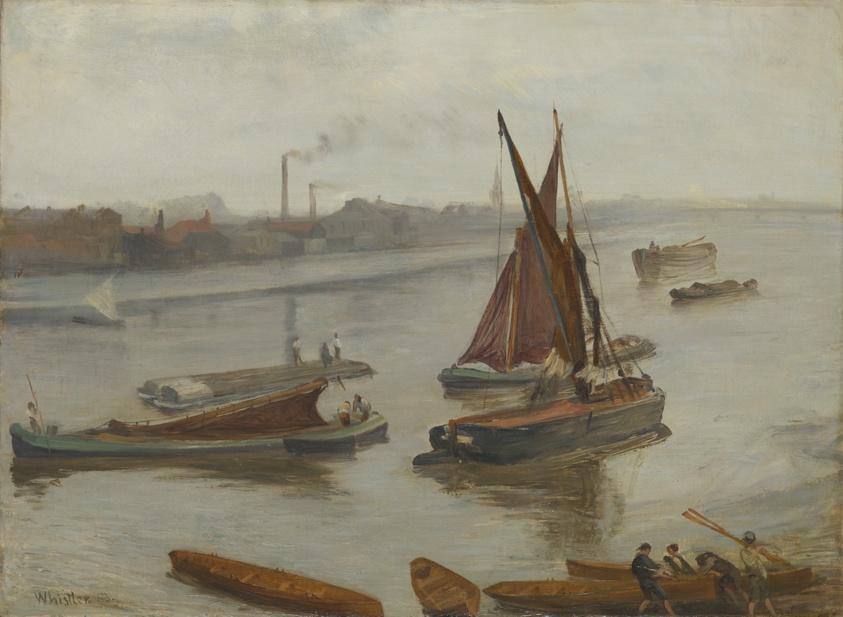
Grey and Silver: Old Battersea Reach
James McNeill Whistler
555 likes105 comments
Paintale uses cookies for essential site functionality and, where enabled, to serve relevant advertising via Google AdSense. You can accept all cookies or reject non-essential ones. See our Privacy Policy for details.
Now viewing
Trouville (Grey and Green, the Silver Sea)
James McNeill Whistler
Period
1831-1870
Theme
Daily Life
Medium
Oil on canvas
Current Location
Art Institute of Chicago, Chicago
The Story
In the early 1860s, James McNeill Whistler began to develop an art-for-art’s-sake aesthetic, eschewing narrative or naturalistic details to focus more intently on formal concerns. In 1865 the artist traveled to Trouville, a French resort town, where he painted with Gustave Courbet and experimented with a series of increasingly simplified seascapes. The high horizon line and broad expanses of muted color in this spare composition reveal Whistler’s interest in Japanese woodblock prints.
The sweeping, horizontal brushstrokes and restrained palette, limited to pale greens and soft grays, reinforce the painting’s innovative, flattened perspective.
Working in Oil on canvas at 51.5 × 77.2 cm (20 1/4 × 30 3/8 in.), James McNeill Whistler constructs depth through value contrast rather than outline, letting figures emerge from darkness the way they would under candlelight or through a shuttered window.
Look closely and the painting opens up. Objects you might pass over — a folded letter, a half-drawn curtain, the angle of a glance — were placed to be read. Scenes like this were prized precisely because they made ordinary labor and leisure worth painting at all.
Art Institute of Chicago in Chicago now holds the work, where conservators and historians continue to revisit its condition and attribution. Each generation of scholarship adds a layer to how James McNeill Whistler's output from this period is understood.
“A silence so complete it becomes its own witness.”
In the early 1860s, James McNeill Whistler began to develop an art-for-art’s-sake aesthetic, eschewing narrative or naturalistic details to focus more intently on formal concerns. In 1865 the artist traveled to Trouville, a French resort town, where he painted with Gustave Courbet and experimented with a series of increasingly simplified seascapes. The high horizon line and broad expanses of muted color in this spare composition reveal Whistler’s interest in Japanese woodblock prints. The sweeping, horizontal brushstrokes and restrained palette, limited to pale greens and soft grays, reinforce the painting’s innovative, flattened perspective.
Gift of Honoré and Potter Palmer
Inscriptions: Signed recto, lower right: "Whistler".
Mrs. Charles W. Deschamps (Christina Deschamps, born Dodds, 1845–1926), London, by November 1873 [lent to London 1873]; sold back to the artist, April 1891 [<a href="https://www.whistler.arts.gla.ac.uk/correspondence/recno/display/?cid=833">letter from Charles W. Deshamps to James McNeill Whistler, dated April 8, 1891, GUW 00803</a>]; consigned to Boussod, Valadon & Cie/Goupil Gallery, Paris, by July 1892 [<a href="https://www.whistler.arts.gla.ac.uk/correspondence/recno/display/?cid=05753">letter from David Croal Thomson to James McNeill Whistler, dated July 12, 1892, GUW 05753</a>; <a href="https://www.whistler.arts.gla.ac.uk/correspondence/recno/display/?cid=08332">letter from Whistler to Thomson, July 1892, GUW 08332</a>; and <a href="https://www.whistler.arts.gla.ac.uk/correspondence/recno/display/?cid=05754">letter from Thomson to Whistler, dated July 23, 1892, GUW 05754</a>]; sold to Théodore Duret (1838–1927), Paris, 1892; consigned to Thomas Agnew & Sons, London, by July 1901; sold to Mrs. Potter Palmer (Bertha Palmer, born Honoré, 1849–1918), Chicago, July 1901 [according to Young, MacDonald, Spencer, and Miles 1980; lent to Boston 1904 and Paris 1905]; by descent to her sons, Honoré Palmer (1874–1964) and Potter Palmer II (1875–1943), 1918; given to the Art Institute of Chicago, 1922.
Art Institute of Chicago, Chicago. View on the museum’s official page.
See more works at Art Institute of Chicago or browse the full James McNeill Whistler collection.
A restrained palette and sculptural lighting create a solemn geometry. The wooden crate and letter anchor the narrative with journalistic precision.
Sources
Keep Exploring
More paintings like this
James McNeill Whistler
James McNeill Whistler
Rosa Bonheur
David Dalhoff Neal
Edouard Manet
Eugène Delacroix
George Inness
Antoine Wiertz