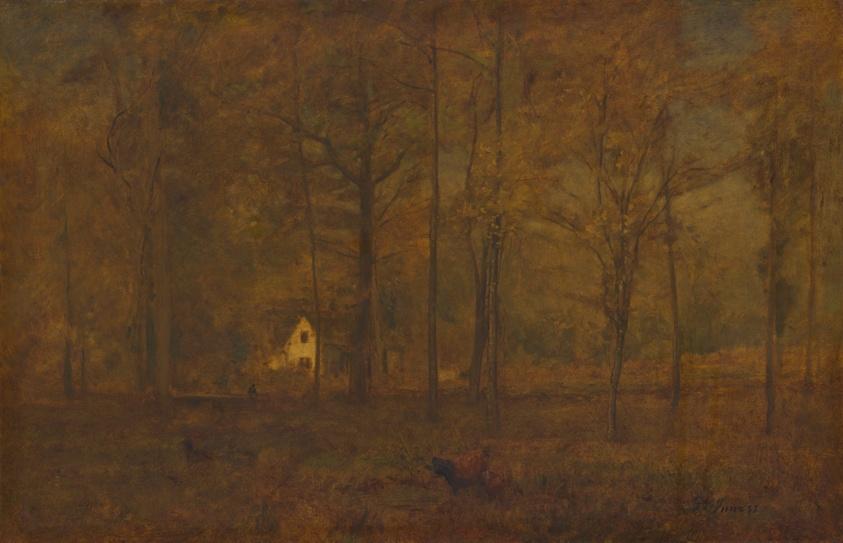
Autumn Woods
George Inness
824 likes94 comments
Paintale uses cookies for essential site functionality and, where enabled, to serve relevant advertising via Google AdSense. You can accept all cookies or reject non-essential ones. See our Privacy Policy for details.
Now viewing
A Marine
George Inness
Period
1871-1900
Theme
Landscape
Medium
Oil on canvas
Current Location
Art Institute of Chicago, Chicago
The Story
George Inness’s rough, energetic brushstrokes evoke the raw beauty and potentially destructive power of the ocean in this dramatic seascape. He created it during a trip to Europe in the early 1870s. It was previously thought to depict Étretat, in Normandy, France, but scholars now believe that the image is of Porto d’Anzio, Italy. The sky is illuminated by patches of orange and white light, outlining the ships and distant town on the horizon.
Careful study of the surface of the central rock in the foreground illustrates the artist’s impressive manipulation of paint: by employing shifts in texture and shading, he was able to emphasize distinctions between sun and shadow, wet and dry, and clean and algae-covered. Inness traveled to Europe to study landscape painting with the masters of the Barbizon School, who were known for a personal style that contrasted with the grandiose Hudson River School in America.
The physical object — Oil on canvas, 76.8 × 114.9 cm (30 1/4 × 45 1/4 in.) — carries its own history of handling and restoration. George Inness's brushwork here moves between exacting description and looser, more suggestive passages, a balance typical of 19th-century American studio practice.
Look closely and the painting opens up. Objects you might pass over — a folded letter, a half-drawn curtain, the angle of a glance — were placed to be read. The scale is the argument: a single, tiny figure against sky and rock does the work of describing nature as something larger than any human claim on it.
Today the painting is held by Art Institute of Chicago in Chicago, where it remains a touchstone for understanding George Inness's contribution to Western art. It has been studied, copied, restored, and argued over for centuries — proof that great paintings keep generating new readings long after their creators have gone.
“A silence so complete it becomes its own witness.”
George Inness’s rough, energetic brushstrokes evoke the raw beauty and potentially destructive power of the ocean in this dramatic seascape. He created it during a trip to Europe in the early 1870s. It was previously thought to depict Étretat, in Normandy, France, but scholars now believe that the image is of Porto d’Anzio, Italy. The sky is illuminated by patches of orange and white light, outlining the ships and distant town on the horizon. Careful study of the surface of the central rock in the foreground illustrates the artist’s impressive manipulation of paint: by employing shifts in texture and shading, he was able to emphasize distinctions between sun and shadow, wet and dry, and clean and algae-covered. Inness traveled to Europe to study landscape painting with the masters of the Barbizon School, who were known for a personal style that contrasted with the grandiose Hudson River School in America. The influence of this intimate approach is apparent in the painting of the rocks and spraying seawater.
Edward B. Butler Collection
Inscriptions: Signed, lower left: "G. Inness".
Harry Reinhardt, New York, by 1913; Edward B. Butler, Chicago, 1913; given to the Art Institute of Chicago, 1913.
Art Institute of Chicago, Chicago. View on the museum’s official page.
See more works at Art Institute of Chicago or browse the full George Inness collection.
A restrained palette and sculptural lighting create a solemn geometry. The wooden crate and letter anchor the narrative with journalistic precision.
Sources
Keep Exploring
More paintings like this
George Inness
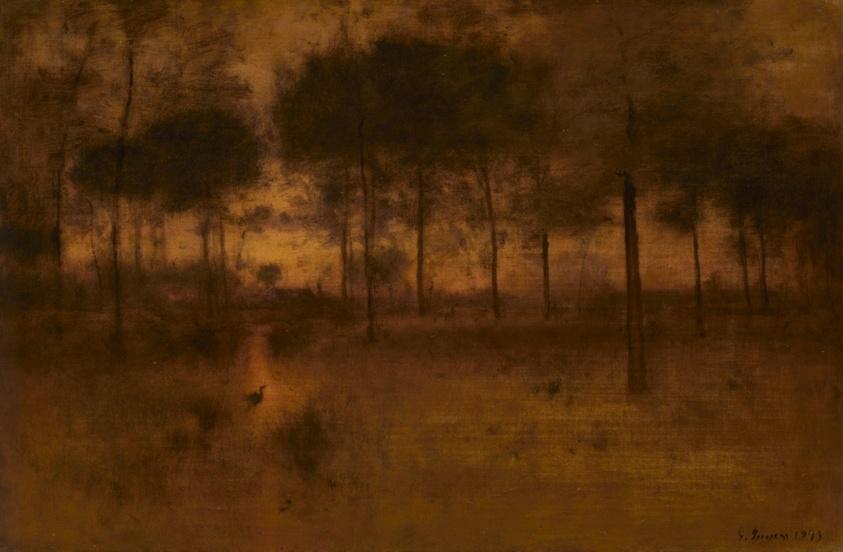
George Inness

George Inness
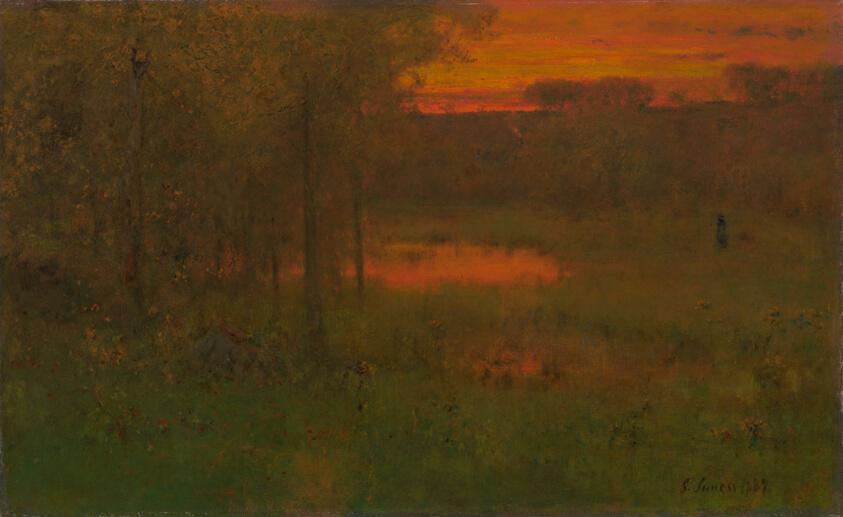
George Inness
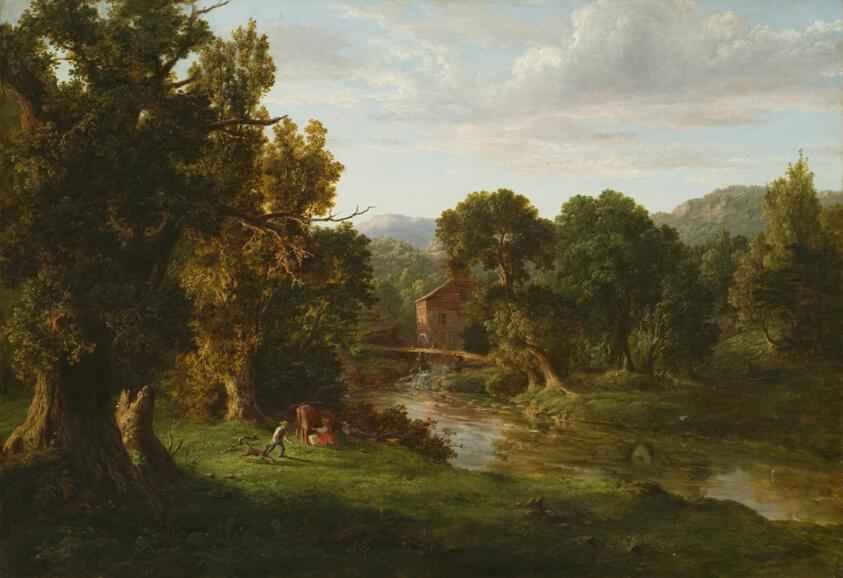
George Inness
George Inness
George Inness

George Inness