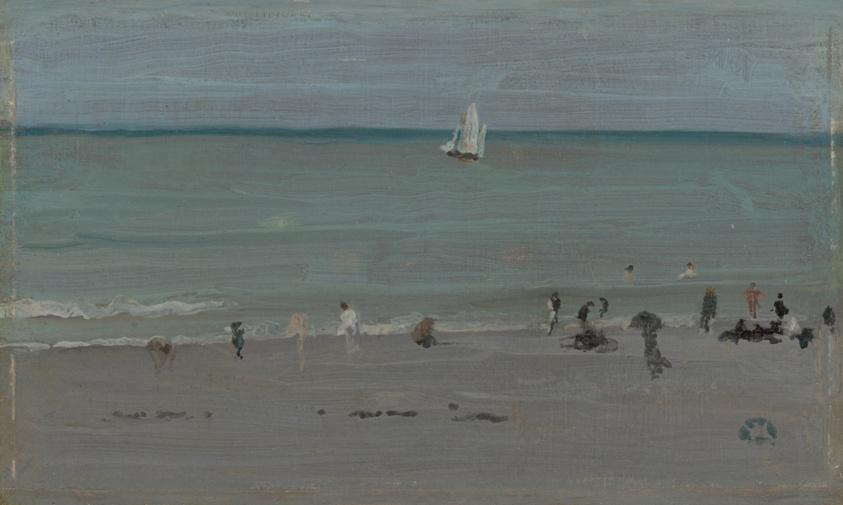
Coast Scene, Bathers
James McNeill Whistler
1163 likes93 comments
Paintale uses cookies for essential site functionality and, where enabled, to serve relevant advertising via Google AdSense. You can accept all cookies or reject non-essential ones. See our Privacy Policy for details.
Now viewing
Nocturne: Blue and Gold—Southampton Water
James McNeill Whistler
Period
1871-1900
Theme
Tragedy & Death
Medium
Oil on canvas
Current Location
Art Institute of Chicago, Chicago
The Story
In the early 1870s James McNeill Whistler took a radical step toward abstraction with his Nocturnes series. In keeping with his art-for-art’s-sake creed, these works capture the stillness of evening while evoking a connection to music. Unlike his earlier marine paintings, the subject of this work—an inlet along the English Channel near Southampton—is obscured by the approaching night.
Large shipping vessels appear as ghostly shapes, reduced to shadowy forms by the deepening twilight, while the only points of brightness come from the subtle reflections of lights and the fragmented orb of the moon. The setting thus serves primarily as a vehicle for Whistler’s interest in the harmonies of muted color amid darkness.
Executed in Oil on canvas, measuring 51 × 76.7 cm (20 1/16 × 30 3/16 in.), the surface rewards close looking. James McNeill Whistler builds the composition through layered glazes and a tightly controlled palette, letting cool shadows recede so that the warm, lit passages step forward.
Look closely and the painting opens up. Objects you might pass over — a folded letter, a half-drawn curtain, the angle of a glance — were placed to be read. The composition slows the eye down at exactly the moment it would rather look away, which is the point.
Housed at Art Institute of Chicago in Chicago, the painting has passed through the hands of collectors, dealers, and institutions before reaching public view — a provenance that is itself part of the object's story.
“A silence so complete it becomes its own witness.”
In the early 1870s James McNeill Whistler took a radical step toward abstraction with his Nocturnes series. In keeping with his art-for-art’s-sake creed, these works capture the stillness of evening while evoking a connection to music. Unlike his earlier marine paintings, the subject of this work—an inlet along the English Channel near Southampton—is obscured by the approaching night. Large shipping vessels appear as ghostly shapes, reduced to shadowy forms by the deepening twilight, while the only points of brightness come from the subtle reflections of lights and the fragmented orb of the moon. The setting thus serves primarily as a vehicle for Whistler’s interest in the harmonies of muted color amid darkness.
Stickney Fund
Technique: oil painting, painting (image making).
Inscriptions: Artist insignia recto, right-bottom, on water, in yellow paint: [butterfly]..
The artist, 1872; Alfred Chapman (1839–1917), London, June 1874 [<a href="https://www.whistler.arts.gla.ac.uk/correspondence/recno/display/?cid=11251">letter from James McNeill Whistler to James Alfred Chapman, June 22, 1874, GUW 11251</a>]. H. Wunderlich and Co., New York, by January 1900 [<a href="https://www.whistler.arts.gla.ac.uk/correspondence/recno/display/?cid=00739">letter from James McNeill Whistler to John James Cowan, January 6, 1900, GUW 00739</a>]; sold to the Art Institute of Chicago, 1900.
Art Institute of Chicago, Chicago. View on the museum’s official page.
See more works at Art Institute of Chicago or browse the full James McNeill Whistler collection.
A restrained palette and sculptural lighting create a solemn geometry. The wooden crate and letter anchor the narrative with journalistic precision.
Sources
Keep Exploring
More paintings like this
James McNeill Whistler
James McNeill Whistler
James McNeill Whistler
James McNeill Whistler
James McNeill Whistler
Frederic Remington
Thomas Hicks American
Eastman Johnson