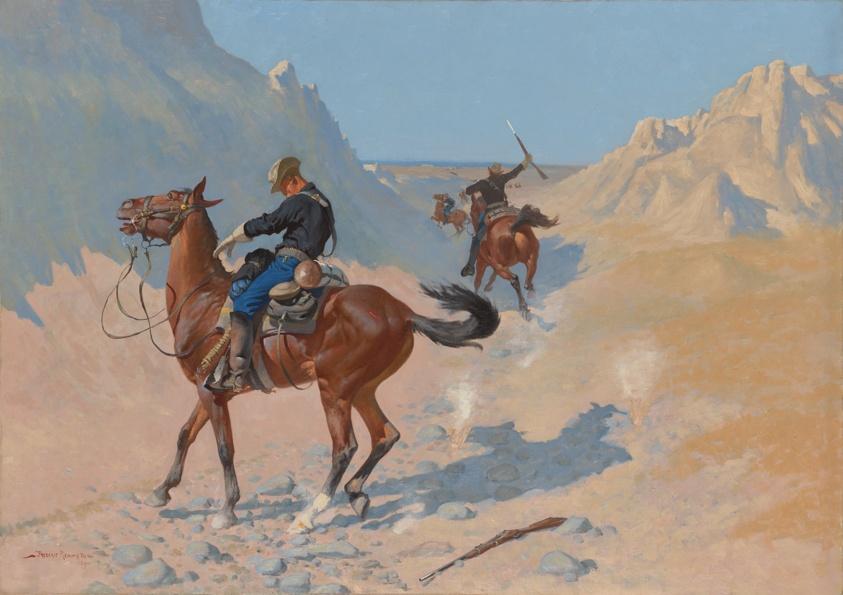
The Advance-Guard, or The Military Sacrifice (The Ambush)
Frederic Remington
1034 likes44 comments
Paintale uses cookies for essential site functionality and, where enabled, to serve relevant advertising via Google AdSense. You can accept all cookies or reject non-essential ones. See our Privacy Policy for details.
Now viewing
Husking Bee, Island of Nantucket
Eastman Johnson
Period
1871-1900
Theme
Tragedy & Death
Medium
Oil on canvas
Current Location
Art Institute of Chicago, Chicago
The Story
Eastman Johnson painted this composition in 1876, 100 years after the founding of the United States. The centennial fostered a sense of nostalgia among some residents as industrialization and urban growth rapidly transformed the nation. Husking Bee, Island of Nantucket depicts a seasonal gathering on the rural Massachusetts island. Community members work together to shuck corn and ready the harvest, a traditional activity that was far removed from daily life for many in the late 19th century.
Johnson employed a warm palette and loose brushwork to describe this agrarian subject, presenting an uncomplicated vision of cooperation and closeness to the land.
As Oil on canvas (69.6 × 138.2 cm (27 3/8 × 54 3/8 in.)), the work shows the tool marks and layering choices typical of Eastman Johnson's output in this period — decisions about ground, underpainting, and glaze that a photograph can only partly convey.
Look closely and the painting opens up. Objects you might pass over — a folded letter, a half-drawn curtain, the angle of a glance — were placed to be read. Light hardens into edge, drapery becomes shroud, and the body is staged like an argument about mortality.
Housed at Art Institute of Chicago in Chicago, the painting has passed through the hands of collectors, dealers, and institutions before reaching public view — a provenance that is itself part of the object's story.
“A silence so complete it becomes its own witness.”
Eastman Johnson painted this composition in 1876, 100 years after the founding of the United States. The centennial fostered a sense of nostalgia among some residents as industrialization and urban growth rapidly transformed the nation. Husking Bee, Island of Nantucket depicts a seasonal gathering on the rural Massachusetts island. Community members work together to shuck corn and ready the harvest, a traditional activity that was far removed from daily life for many in the late 19th century. Johnson employed a warm palette and loose brushwork to describe this agrarian subject, presenting an uncomplicated vision of cooperation and closeness to the land.
Gift of Honoré and Potter Palmer
Inscriptions: Signed recto, bottom-left, in brown paint: "E. Johnson / 1876"..
Eastman Johnson, New York, Jan-Feb. 1876 [lent to National Academy of Design 1876]. Napoleon Sarony (1821–1896), New York, by May 1878 [lent to Paris Exposition Universelle International 1878 and Chicago Inter–State Industrial Exposition 1882]. Potter (1826–1902) and Bertha Palmer (1849–1918; born Bertha Honoré, also Mrs. Potter Palmer), Chicago, 1889; by descent to his wife, Bertha Palmer, 1902 [lent to Art Institute of Chicago 1910]; by descent to her sons, Honoré Palmer (1874–1964) and Potter Palmer II (1875–1943), 1918; given to the Art Institute of Chicago, 1922.
Art Institute of Chicago, Chicago. View on the museum’s official page.
See more works at Art Institute of Chicago or browse the full Eastman Johnson collection.
A restrained palette and sculptural lighting create a solemn geometry. The wooden crate and letter anchor the narrative with journalistic precision.
Sources
Keep Exploring
More paintings like this
Frederic Remington
Thomas Hicks American
James McNeill Whistler

Eastman Johnson
Jacques Louis David
Caravaggio
Guido Cagnacci

Sandro Botticelli