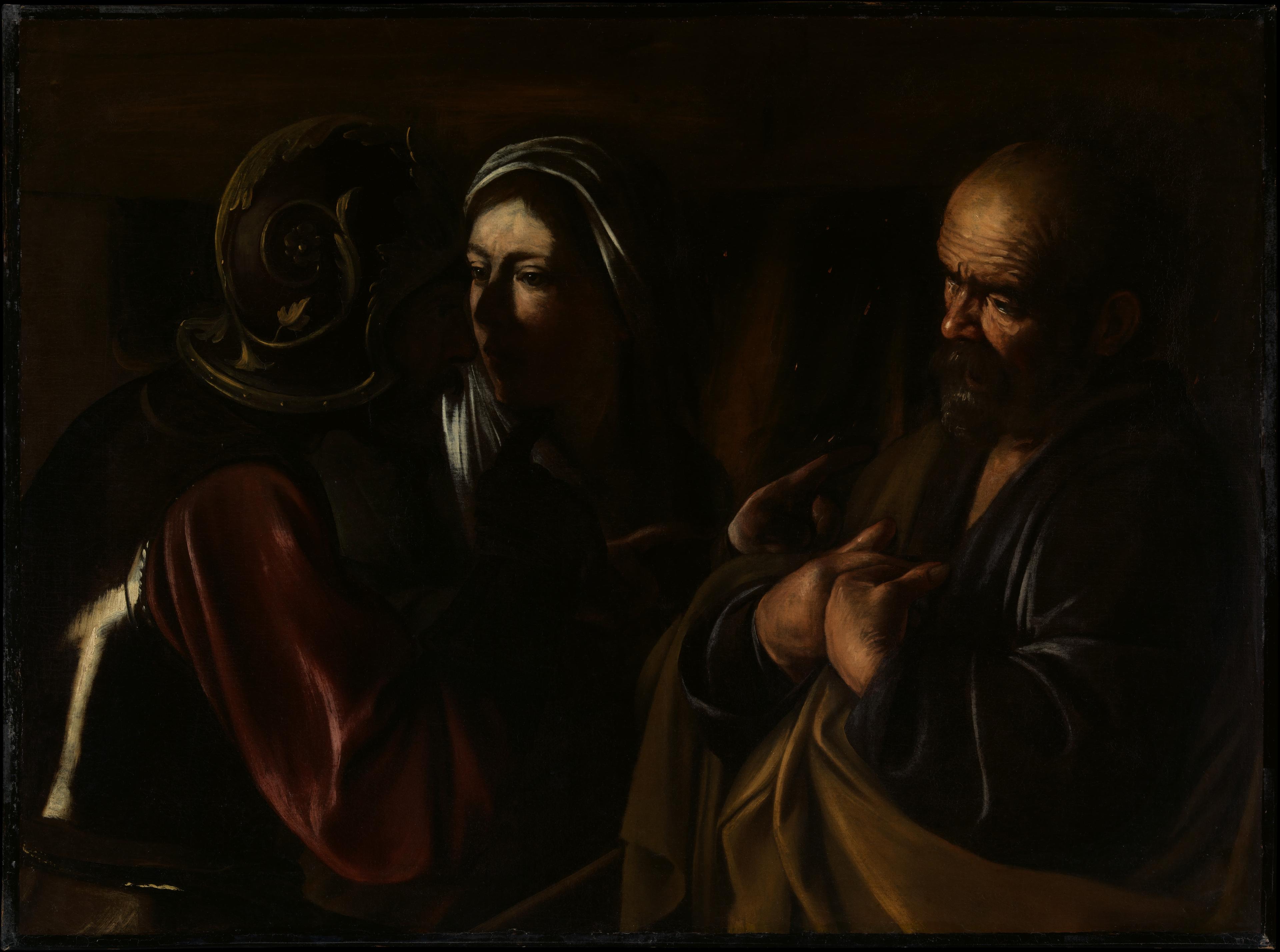
The Denial of Saint Peter
Caravaggio
1278 likes88 comments
Paintale uses cookies for essential site functionality and, where enabled, to serve relevant advertising via Google AdSense. You can accept all cookies or reject non-essential ones. See our Privacy Policy for details.
Now viewing
The Crucifixion of Saint Andrew
Caravaggio
Period
Baroque
Theme
Tragedy & Death
Medium
oil on canvas
Current Location
Cleveland Museum of Art, Cleveland
The Story
The Crucifixion of Saint Andrew (1607) is a painting by the Italian Baroque master Caravaggio. It is in the collection of the Cleveland Museum of Art, which acquired it from the Arnaiz collection in Madrid in 1976, having been taken to Spain by the Spanish Viceroy of Naples in 1610. The incident depicted, the martyrdom of Saint Andrew, was supposed to have taken place in Patras, Greece.
The saint, bound to the cross with ropes, was said to have survived two days, preaching to the crowd and eventually converting them so that they demanded his release. When the Roman Proconsul Aegeas—depicted lower right—ordered him taken down, his men were struck by a miraculous paralysis, in answer to the saint's prayer that he be allowed to undergo martyrdom. From the 17th century Saint Andrew was shown on a diagonal cross, but Caravaggio would have been influenced by the 16th century belief that he was crucified on a normal Latin cross.
Executed in oil on canvas, measuring Framed: 233.5 x 184 x 12 cm (91 15/16 x 72 7/16 x 4 3/4 in.); Unframed: 202.5 x 152.7 cm (79 3/4 x 60 1/8 in.), the surface rewards close looking. Caravaggio builds the composition through layered glazes and a tightly controlled palette, letting cool shadows recede so that the warm, lit passages step forward.
Look closely and the painting opens up. Objects you might pass over — a folded letter, a half-drawn curtain, the angle of a glance — were placed to be read. Grief here is choreographed: hands, drapery, and gaze are arranged to guide sympathy rather than simply record a scene.
Today the painting is held by Cleveland Museum of Art in Cleveland, where it remains a touchstone for understanding Caravaggio's contribution to Western art. It has been studied, copied, restored, and argued over for centuries — proof that great paintings keep generating new readings long after their creators have gone.
“A silence so complete it becomes its own witness.”
Andrew the Apostle, Latin cross, crucifixion, crucifixion of Andrew, bystander.
The Crucifixion of Saint Andrew, 1606–7. Caravaggio (Italian, 1571–1610). Oil on canvas; framed: 233.5 x 184 x 12 cm (91 15/16 x 72 7/16 x 4 3/4 in.); unframed: 202.5 x 152.7 cm (79 3/4 x 60 1/8 in.). The Cleveland Museum of Art, Leonard C. Hanna Jr. Fund, 1976.2
Accession: 1976.2. Leonard C. Hanna Jr. Fund
Materials: oil paint, canvas.
Technique: oil on canvas.
Don Juan Alonso Pimentel y Herrera, Eighth Conde de Benavente, Spanish viceroy in Naples. Don Juan Francisco Alonso Pimentel y Ponce de Léon (grandson of above, inherited and lived 1584–1652) Tenth Conde de Benavente, Valladolid. An unidentified convent in Castilla, Spain. A. Tors, Madrid. José Manuel Arnaiz, Madrid. Legatt Brothers (London) sold by Arnaiz to the Cleveland Museum of Art.
Cleveland Museum of Art, Cleveland. View on the museum’s official page.
See more works at Cleveland Museum of Art or browse the full Caravaggio collection.
A restrained palette and sculptural lighting create a solemn geometry. The wooden crate and letter anchor the narrative with journalistic precision.
Sources
Keep Exploring
More paintings like this
Caravaggio
Caravaggio
Caravaggio
Caravaggio
Guido Cagnacci
Caravaggio
Pedro Orrente
Hendrick ter Brugghen