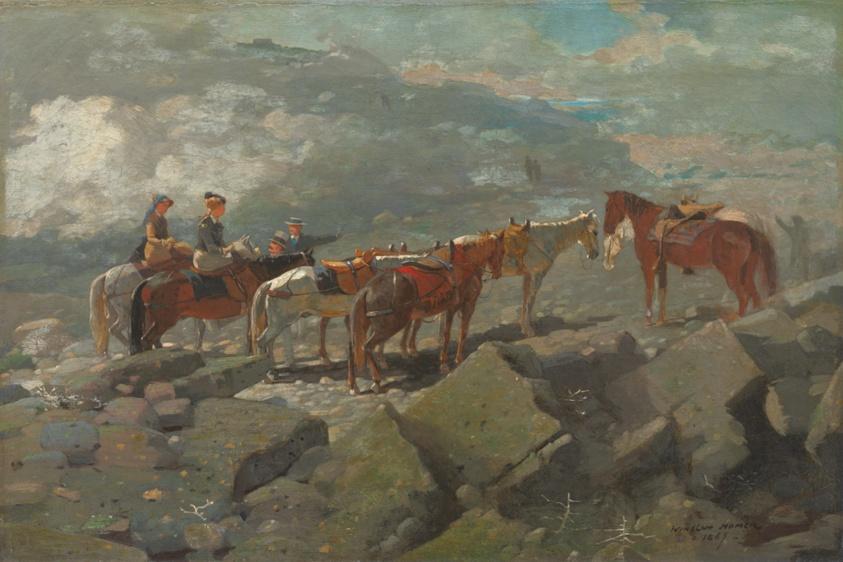
Mount Washington
Winslow Homer
727 likes17 comments
Paintale uses cookies for essential site functionality and, where enabled, to serve relevant advertising via Google AdSense. You can accept all cookies or reject non-essential ones. See our Privacy Policy for details.
Now viewing
Peach Blossoms
Winslow Homer
Period
1871-1900
Theme
Power & Politics
Medium
Oil on canvas
Current Location
Art Institute of Chicago, Chicago
The Story
Winslow Homer often depicted scenes of leisure in his early career. This painting features a young woman looking at burgeoning peach blossoms, indicating both early spring and perhaps her youth. The setting, which often recurs in Homer's oeuvre, reflects nostalgia for a fading rural past. Contemporary critics referred to the artist's style at this time as independent of foreign influences, suggesting an inherently American quality. However, his stylistic decisions link this work to both French and Japanese art.
Impressionism inspired Homer's use of a lighter palette, and the attention to linearity in the tree is reminiscent of Japanese calligraphy. The painting thus serves as visual evidence of the global artistic exchange of the late 19th century.
Working in Oil on canvas at 33.7 × 49 cm (13 1/4 × 19 5/8 in.), Winslow Homer constructs depth through value contrast rather than outline, letting figures emerge from darkness the way they would under candlelight or through a shuttered window.
Look closely and the painting opens up. Objects you might pass over — a folded letter, a half-drawn curtain, the angle of a glance — were placed to be read. Crowns, columns, and heraldry quietly insist on legitimacy — this is a painting working hard on behalf of a patron.
Today the painting is held by Art Institute of Chicago in Chicago, where it remains a touchstone for understanding Winslow Homer's contribution to Western art. It has been studied, copied, restored, and argued over for centuries — proof that great paintings keep generating new readings long after their creators have gone.
“A silence so complete it becomes its own witness.”
Winslow Homer often depicted scenes of leisure in his early career. This painting features a young woman looking at burgeoning peach blossoms, indicating both early spring and perhaps her youth. The setting, which often recurs in Homer's oeuvre, reflects nostalgia for a fading rural past. Contemporary critics referred to the artist's style at this time as independent of foreign influences, suggesting an inherently American quality. However, his stylistic decisions link this work to both French and Japanese art. Impressionism inspired Homer's use of a lighter palette, and the attention to linearity in the tree is reminiscent of Japanese calligraphy. The painting thus serves as visual evidence of the global artistic exchange of the late 19th century.
Gift of George B. Harrington
Inscriptions: signed, lower right, with monogram: "W H / 1878".
Art Institute of Chicago, Chicago. View on the museum’s official page.
See more works at Art Institute of Chicago or browse the full Winslow Homer collection.
A restrained palette and sculptural lighting create a solemn geometry. The wooden crate and letter anchor the narrative with journalistic precision.
Sources
Keep Exploring
More paintings like this
Winslow Homer
Winslow Homer

Winslow Homer

Georges Seurat
Winslow Homer

Julie Hart Beers

George Hitchcock American

Paul Cezanne