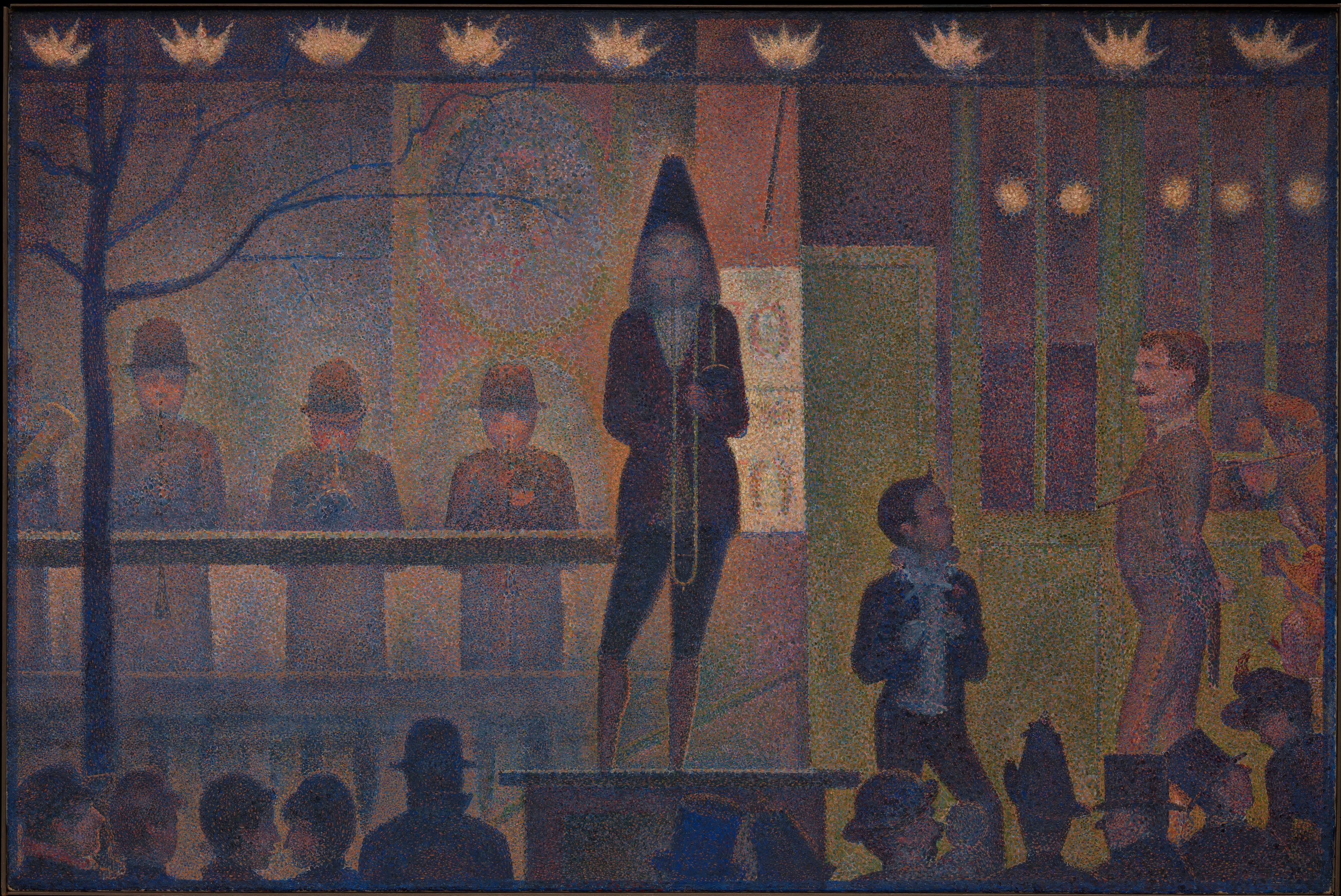
Circus Sideshow (Parade de cirque)
Georges Seurat
656 likes126 comments
Paintale uses cookies for essential site functionality and, where enabled, to serve relevant advertising via Google AdSense. You can accept all cookies or reject non-essential ones. See our Privacy Policy for details.
Now viewing
A Sunday on La Grande Jatte — 1884
Georges Seurat
Period
1871-1900
Theme
Power & Politics
Medium
Oil on canvas
Current Location
Art Institute of Chicago, Chicago
The Story
A Sunday Afternoon on the Island of La Grande Jatte (French: Un dimanche après-midi à l'Île de la Grande Jatte) was painted from 1884 to 1886 and is Georges Seurat's most famous work. It is recognised as a leading example of pointillist technique and as a founding work of the neo-impressionist movement. Seurat's composition, painted on a large canvas, includes a number of Parisians at a park on the banks of the River Seine. It is held in the collection of the Art Institute of Chicago.
Created in 1884, this work belongs firmly within the power & politics tradition of American painting. Georges Seurat worked at a moment when the young republic was still deciding what its own art should look like — how much to borrow from Europe, how much to invent from its own landscape and daily life. Every gesture, fabric, and gleam of light was pitched at an audience learning to take American subjects seriously.
Executed in Oil on canvas, measuring 207.5 × 308.1 cm (81 3/4 × 121 1/4 in.), the surface rewards close looking. Georges Seurat builds the composition through layered glazes and a tightly controlled palette, letting cool shadows recede so that the warm, lit passages step forward.
Look closely and the painting opens up. Objects you might pass over — a folded letter, a half-drawn curtain, the angle of a glance — were placed to be read. Crowns, columns, and heraldry quietly insist on legitimacy — this is a painting working hard on behalf of a patron.
Today the painting is held by Art Institute of Chicago in Chicago, where it remains a touchstone for understanding Georges Seurat's contribution to Western art. It has been studied, copied, restored, and argued over for centuries — proof that great paintings keep generating new readings long after their creators have gone.
“A silence so complete it becomes its own witness.”
bathing, île de la Jatte, woman, man, umbrella, tree, dog, boat.
In Ferris Bueller’s Day Off, Ferris’s best friend Cameron Frye intensely studies this nearly ten-foot-wide painting during a scene set at the Art Institute. Featuring people of every age and social class on the banks of the River Seine, A Sunday on La Grande Jatte—1884 has captivated visitors ever since its arrival at the museum in 1924. If we, like Cameron, come closer to the painting, figures and forms dissolve into dots and dashes of complementary colors laid side by side, characteristic of Seurat’s pointillist technique. Many smaller painted and drawn sketches and several larger canvases, in which Seurat laid out the parameters for the landscape and figures, led up to this majestically composed scene. Seurat returned to the work two years after its start date, amplifying the silhouettes of some figures and adding others. Some of these, like the monkey on the leash, seem so integral to the final composition that it is hard to imagine them as add-ons, but others, like the man carrying a rolled newspaper in the furthest distance, are barely noticeable. To the artist, however, every decision was essential to his aim of making a painting of modern life equivalent to a classical Greek frieze.
Helen Birch Bartlett Memorial Collection
Materials: oil paint, canvas.
Technique: oil painting, painting techniques, painting, painting (image making).
Inscriptions: Inscribed lower right: Seurat.
By descent to Mme. Seurat, the artist’s mother (died 1899), Paris, 1891; by descent to Emile Seurat, the artist’s brother; sold for 800 francs to Casimir Brû, Paris, 1900; given by him to his daughter, Lucie, Paris, 1900; Lucie Brû Cousturier and Edmond Cousturier, Paris; sold for $20,000 possibly through Charles Vildrac, Paris to Frederic Clay and Helen Birch Bartlett, Chicago, 1924; given to the Art Institute, 1926.
Art Institute of Chicago, Chicago. View on the museum’s official page.
See more works at Art Institute of Chicago or browse the full Georges Seurat collection.
A restrained palette and sculptural lighting create a solemn geometry. The wooden crate and letter anchor the narrative with journalistic precision.
Sources
Keep Exploring
More paintings like this
Georges Seurat

Winslow Homer

Julie Hart Beers

George Hitchcock American

Paul Cezanne
Anthony van Dyck

Leonardo da Vinci

Leonardo da Vinci