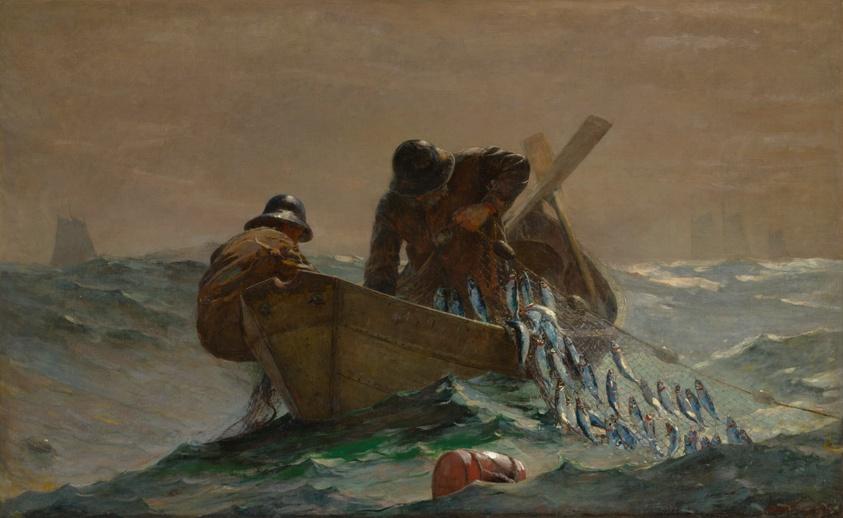
The Herring Net
Winslow Homer
464 likes94 comments
Paintale uses cookies for essential site functionality and, where enabled, to serve relevant advertising via Google AdSense. You can accept all cookies or reject non-essential ones. See our Privacy Policy for details.
Now viewing
Coast of Maine
Winslow Homer
Period
1871-1900
Theme
Landscape
Medium
Oil on canvas
Current Location
Art Institute of Chicago, Chicago
The Story
Maine Coast is an 1896 oil painting on canvas by American artist Winslow Homer. It is part of the collection of the Metropolitan Museum of Art in New York. The painting is a seaward view from the cliffs at Prouts Neck, Scarborough, Maine on a stormy day. A powerful wave is about to crash onto the black rocks below in a mass of white foam.
Created in 1893, this work belongs firmly within the landscape tradition of American painting. Winslow Homer worked at a moment when the young republic was still deciding what its own art should look like — how much to borrow from Europe, how much to invent from its own landscape and daily life. Every gesture, fabric, and gleam of light was pitched at an audience learning to take American subjects seriously.
Working in Oil on canvas at 61 × 76.2 cm (24 × 30 in.), Winslow Homer constructs depth through value contrast rather than outline, letting figures emerge from darkness the way they would under candlelight or through a shuttered window.
Look closely and the painting opens up. Objects you might pass over — a folded letter, a half-drawn curtain, the angle of a glance — were placed to be read. What reads as a faithful record of a place is also a composition: foreground, middle distance, and horizon are arranged to pull the eye on a deliberate path through the scene.
Housed at Art Institute of Chicago in Chicago, the painting has passed through the hands of collectors, dealers, and institutions before reaching public view — a provenance that is itself part of the object's story.
“A silence so complete it becomes its own witness.”
marine art, wind wave.
Winslow Homer observed the shoreline in various weather conditions and seasons after moving to live in near isolation in Prouts Neck, Maine, in 1883. Amid the remote and dramatic landscape, he depicted seascapes void of human life, focusing instead on an emotional response to nature. His marine scenes are larger than his earlier works, the size of the canvases emphasize the vastness and power of the sea. Homer alluded to the violence of water through the sharply diagonal shoreline and vigorous brushwork. The flat areas of color that he employed to represent the rugged rocks simultaneously hint at abstraction.
Arthur Jerome Eddy Memorial Collection
Materials: oil paint, canvas.
Inscriptions: Signed, lower left: "Homer 93".
Arthur Jerome Eddy, Chicago, from c. 1893 to 1931; given to the Art Institute of Chicago, 1931.
Art Institute of Chicago, Chicago. View on the museum’s official page.
See more works at Art Institute of Chicago or browse the full Winslow Homer collection.
A restrained palette and sculptural lighting create a solemn geometry. The wooden crate and letter anchor the narrative with journalistic precision.
Sources
Keep Exploring
More paintings like this
Winslow Homer

Winslow Homer
James McNeill Whistler
James McNeill Whistler
George Inness
George Inness
George Inness
Theodore Robinson