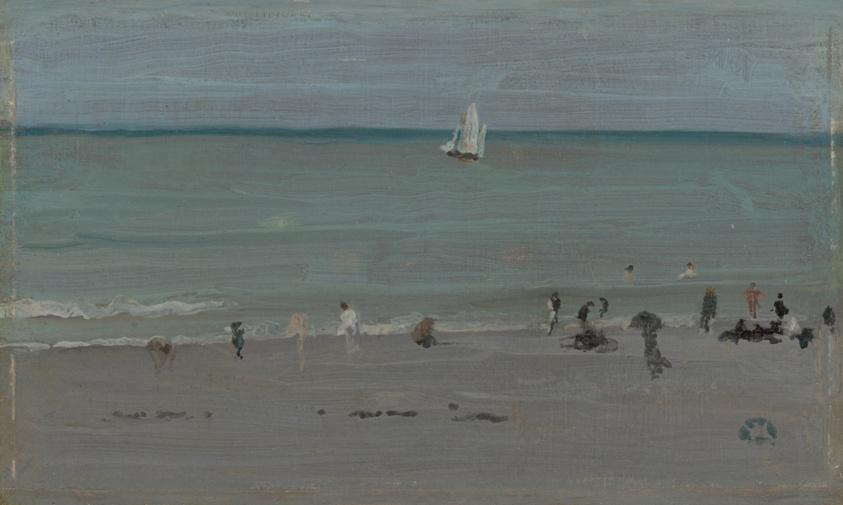
Coast Scene, Bathers
James McNeill Whistler
1163 likes93 comments
Paintale uses cookies for essential site functionality and, where enabled, to serve relevant advertising via Google AdSense. You can accept all cookies or reject non-essential ones. See our Privacy Policy for details.
Now viewing
The Valley of Arconville
Theodore Robinson
Period
1871-1900
Theme
Landscape
Medium
Oil on canvas
Current Location
Art Institute of Chicago, Chicago
The Story
One of the first American artists to paint in Giverny, France (northwest of Paris), Theodore Robinson drew upon the teachings of the region’s most famous resident, Claude Monet, in his vibrant compositions. Using layered, broken brushwork, Robinson foregrounded the slope of the hill, leading the eye from the figure at right across the Valley of Arconville (southeast of Paris).
Capturing the effects of light on the landscape like Monet and other progressive French painters, Robinson nonetheless rendered his forms with a measure of solidity that was more typical of American artists who worked in an Impressionist style.
The physical object — Oil on canvas, 45.8 × 55.7 cm (18 × 21 7/8 in.) — carries its own history of handling and restoration. Theodore Robinson's brushwork here moves between exacting description and looser, more suggestive passages, a balance typical of 19th-century American studio practice.
Look closely and the painting opens up. Objects you might pass over — a folded letter, a half-drawn curtain, the angle of a glance — were placed to be read. What reads as a faithful record of a place is also a composition: foreground, middle distance, and horizon are arranged to pull the eye on a deliberate path through the scene.
Housed at Art Institute of Chicago in Chicago, the painting has passed through the hands of collectors, dealers, and institutions before reaching public view — a provenance that is itself part of the object's story.
“A silence so complete it becomes its own witness.”
One of the first American artists to paint in Giverny, France (northwest of Paris), Theodore Robinson drew upon the teachings of the region’s most famous resident, Claude Monet, in his vibrant compositions. Using layered, broken brushwork, Robinson foregrounded the slope of the hill, leading the eye from the figure at right across the Valley of Arconville (southeast of Paris). Capturing the effects of light on the landscape like Monet and other progressive French painters, Robinson nonetheless rendered his forms with a measure of solidity that was more typical of American artists who worked in an Impressionist style.
Friends of American Art Collection
Inscriptions: Signed recto, bottom-right, on grass, in brown paint: "TH. ROBINSON"..
Arthur A. Carey, Waltham, MA, by 1889. M. Knoedler & Co., New York, by 1908; sold to Hillyer Art Gallery, Smith College, Northampton, MA, 1908; sold to M. Knoedler and Company, New York, 1931; sold to the Art Institute of Chicago, 1941.
Art Institute of Chicago, Chicago. View on the museum’s official page.
See more works at Art Institute of Chicago or browse the full Theodore Robinson collection.
A restrained palette and sculptural lighting create a solemn geometry. The wooden crate and letter anchor the narrative with journalistic precision.
Sources
Keep Exploring
More paintings like this
James McNeill Whistler
James McNeill Whistler
George Inness
George Inness
George Inness

George Inness
George Inness

Childe Hassam