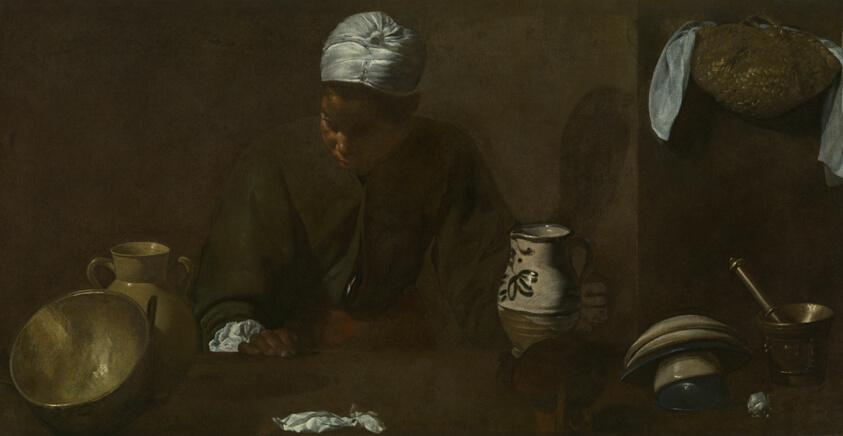
Kitchen Scene
Diego Velázquez
1161 likes91 comments
Paintale uses cookies for essential site functionality and, where enabled, to serve relevant advertising via Google AdSense. You can accept all cookies or reject non-essential ones. See our Privacy Policy for details.
Now viewing
Saint John the Baptist in the Wilderness
Diego Velázquez
Period
1600-1650
Theme
Power & Politics
Medium
Oil on canvas
Current Location
Art Institute of Chicago, Chicago
The Story
This painting depicts a young Saint John the Baptist living as a hermit in the wilderness. His cross of reeds, pointing gesture, and the nearby lamb refer to his role as a prophet foretelling the coming of Christ, the so-called “lamb of God,” in the New Testament. Previously attributed to an unknown Sevillian artist, this painting has recently been recognized as the work of a young Diego Velázquez.
The treatment of the saint is more idealized than figures in Velázquez’s earliest work, suggesting that it may have been made after his brief visit in 1622 to Madrid, where Italian paintings in the royal collection exposed him to new ways of portraying the human figure.
As Oil on canvas (175.3 × 152.5 cm (69 × 60 in.); Framed: 202.3 × 184.2 × 9.2 cm (79 5/8 × 72 1/2 × 3 5/8 in.)), the work shows the tool marks and layering choices typical of Diego Velázquez's output in this period — decisions about ground, underpainting, and glaze that a photograph can only partly convey.
Look closely and the painting opens up. Objects you might pass over — a folded letter, a half-drawn curtain, the angle of a glance — were placed to be read. Crowns, columns, and heraldry quietly insist on legitimacy — this is a painting working hard on behalf of a patron.
Today the painting is held by Art Institute of Chicago in Chicago, where it remains a touchstone for understanding Diego Velázquez's contribution to Western art. It has been studied, copied, restored, and argued over for centuries — proof that great paintings keep generating new readings long after their creators have gone.
“A silence so complete it becomes its own witness.”
This painting features documented symbols with their own dedicated meaning in art history:
This painting depicts a young Saint John the Baptist living as a hermit in the wilderness. His cross of reeds, pointing gesture, and the nearby lamb refer to his role as a prophet foretelling the coming of Christ, the so-called “lamb of God,” in the New Testament. Previously attributed to an unknown Sevillian artist, this painting has recently been recognized as the work of a young Diego Velázquez. The treatment of the saint is more idealized than figures in Velázquez’s earliest work, suggesting that it may have been made after his brief visit in 1622 to Madrid, where Italian paintings in the royal collection exposed him to new ways of portraying the human figure.
Gift of Barbara Deering Danielson
Technique: oil painting, painting techniques, painting (image making), painting.
Art Institute of Chicago, Chicago. View on the museum’s official page.
See more works at Art Institute of Chicago or browse the full Diego Velázquez collection.
A restrained palette and sculptural lighting create a solemn geometry. The wooden crate and letter anchor the narrative with journalistic precision.
Sources
Keep Exploring
More paintings like this
Diego Velázquez
Diego Velázquez
Cecco del Caravaggio
Jacob van Ruisdael
Anthony van Dyck

Leonardo da Vinci

Leonardo da Vinci
James McNeill Whistler