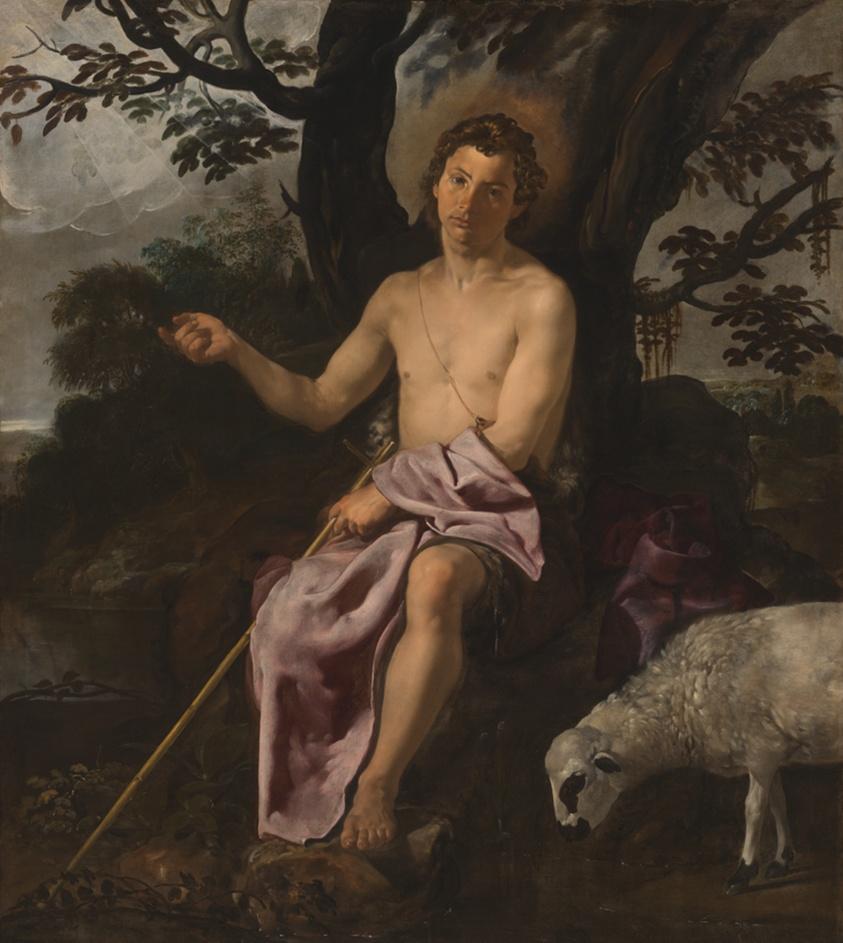
Saint John the Baptist in the Wilderness
Diego Velázquez
1548 likes138 comments
Paintale uses cookies for essential site functionality and, where enabled, to serve relevant advertising via Google AdSense. You can accept all cookies or reject non-essential ones. See our Privacy Policy for details.
Now viewing
Kitchen Scene
Diego Velázquez
Period
1600-1650
Theme
Daily Life
Medium
Oil on canvas
Current Location
Art Institute of Chicago, Chicago
The Story
In this modest kitchen scene, a type known as a bodegón (from the Spanish word for pantry), Diego Velázquez depicted a young African woman at work, surrounded by exquisitely rendered pots, jugs, a mortar and pestle, and a crumpled paper wrapper for spices. In creating this painting, Velázquez may have used an enslaved woman from his or an associate’s household as a model. Slavery was widespread in the young artist’s hometown of Seville, Spain, and Velázquez, his father, and his teacher, Francisco Pacheco, were all enslavers.
Created in 1618 during the 1600-1650 period, this work belongs firmly within the daily life tradition. Diego Velázquez worked at a moment when the rivalry between Catholic Baroque drama and Protestant restraint reshaped what a painting could mean. Every gesture, fabric, and gleam of light was decoded by contemporary viewers like a private language.
Working in Oil on canvas at 55.9 × 104.2 cm (21 7/8 × 41 1/8 in.); Framed: 74.9 × 125.1 × 7.3 cm (29 1/2 × 49 1/4 × 2 7/8 in.), Diego Velázquez constructs depth through value contrast rather than outline, letting figures emerge from darkness the way they would under candlelight or through a shuttered window.
Look closely and the painting opens up. Objects you might pass over — a folded letter, a half-drawn curtain, the angle of a glance — were placed to be read. The apparent casualness is staged — objects and gestures are arranged to read as a moment caught rather than composed.
Housed at Art Institute of Chicago in Chicago, the painting has passed through the hands of collectors, dealers, and institutions before reaching public view — a provenance that is itself part of the object's story.
“A silence so complete it becomes its own witness.”
In this modest kitchen scene, a type known as a bodegón (from the Spanish word for pantry), Diego Velázquez depicted a young African woman at work, surrounded by exquisitely rendered pots, jugs, a mortar and pestle, and a crumpled paper wrapper for spices. In creating this painting, Velázquez may have used an enslaved woman from his or an associate’s household as a model. Slavery was widespread in the young artist’s hometown of Seville, Spain, and Velázquez, his father, and his teacher, Francisco Pacheco, were all enslavers.
Robert A. Waller Memorial Fund
Technique: painting, oil painting, painting (image making), painting techniques.
Private collection, Zurich [according to Mayer 1936]. Dr. L. von Buerkel, Munich [according to Mayer 1936]. Bottenwieser, Berlin [according to Mayer 1936]. J. Goudstikker, Amsterdam, by 1927, until 1935 [see Mayer 1927; Mayer 1936 mentions Mrs. Sterner, New York as owner between Goudstikker and the Art Institute, however, the painting was shipped directly from Goudstikker in Amsterdam to Chicago in November, 1935]; sold by Goudstikker to The Art Institute, 1935.
Art Institute of Chicago, Chicago. View on the museum’s official page.
See more works at Art Institute of Chicago or browse the full Diego Velázquez collection.
A restrained palette and sculptural lighting create a solemn geometry. The wooden crate and letter anchor the narrative with journalistic precision.
Sources
Keep Exploring
More paintings like this
Diego Velázquez
Attributed to Peter Paul Rubens
Pieter Claesz
Frans Snyders
Pietro della Vecchia
Pieter de Neyn
Attributed to Anthony van Dyck
Workshop of Diego Velázquez