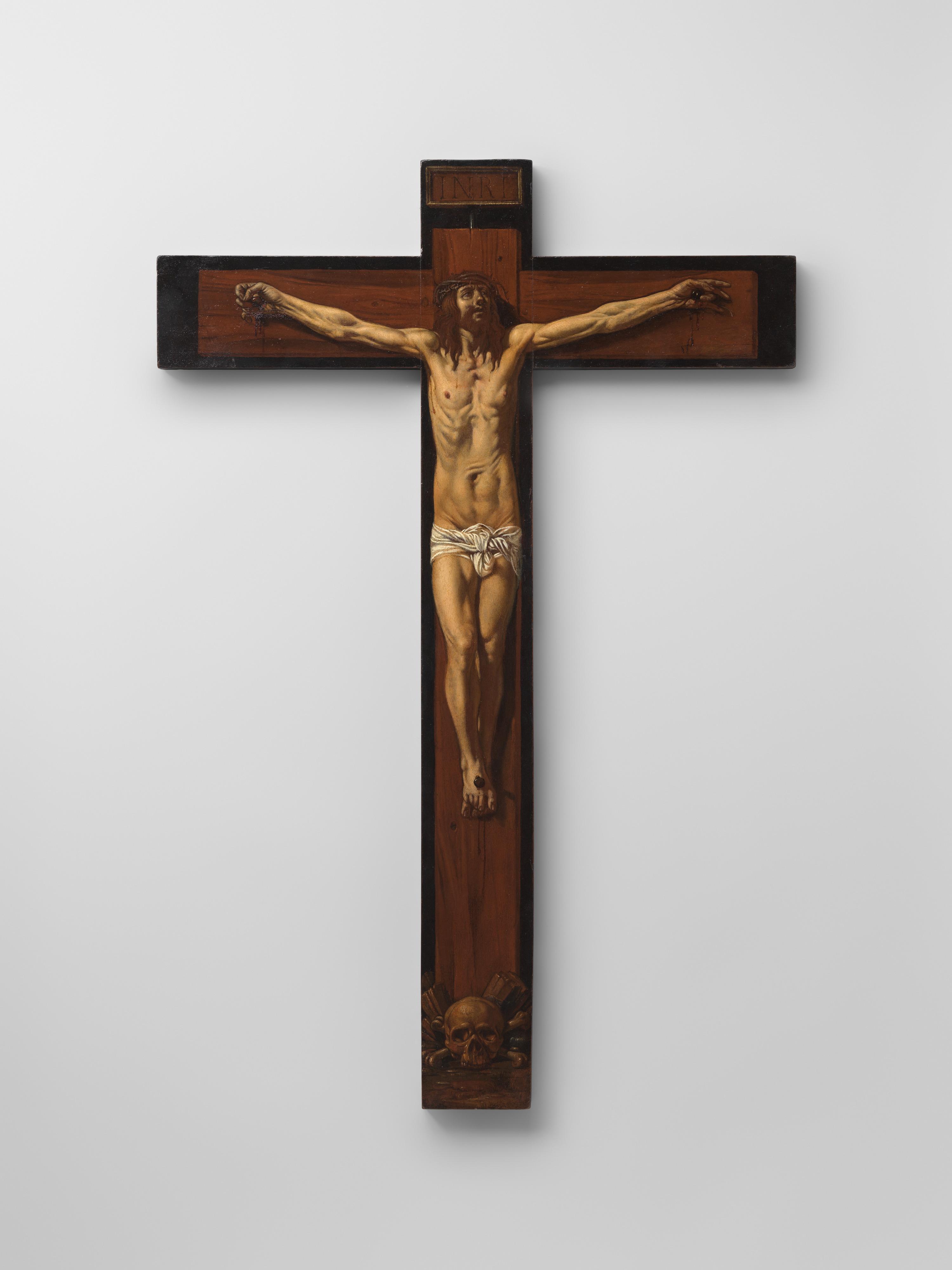
Christ on the Cross
Cecco del Caravaggio
842 likes92 comments
Paintale uses cookies for essential site functionality and, where enabled, to serve relevant advertising via Google AdSense. You can accept all cookies or reject non-essential ones. See our Privacy Policy for details.
Now viewing
The Resurrection
Cecco del Caravaggio
Period
1600-1650
Theme
Power & Politics
Medium
Oil on canvas
Current Location
Art Institute of Chicago, Chicago
The Story
Francesco Boneri was one of the closest followers of Caravaggio, the groundbreaking and influential painter of the Italian Baroque period. Boneri may have assisted and modeled for Caravaggio during the elder painter’s last years in Rome, a personal connection suggested by his contemporary nickname, Cecco (a diminutive of Francesco) del Carravaggio. The Resurrection exaggerates the bold contrast of light and dark and the realistic treatment of sacred figures that were hallmarks of Caravaggio’s revolutionary style.
The only documented painting by Boneri, this work was commissioned in 1619 by the Tuscan ambassador to Rome, Piero Guicciardini, for his family’s chapel in Florence. For reasons lost to history, the painting was rejected, a not uncommon event in Rome’s rapidly evolving art scene. It was eventually sold to another important collector, Cardinal Scipione Borghese.
As Oil on canvas (339.1 × 199.5 cm (133 1/2 × 78 1/2 in.); Framed: 389.9 × 246.4 × 10.2 cm (153 1/2 × 97 × 4 in.)), the work shows the tool marks and layering choices typical of Cecco del Caravaggio's output in this period — decisions about ground, underpainting, and glaze that a photograph can only partly convey.
Look closely and the painting opens up. Objects you might pass over — a folded letter, a half-drawn curtain, the angle of a glance — were placed to be read. Scale and setting do political work here, elevating the subject above the room it would have hung in.
Housed at Art Institute of Chicago in Chicago, the painting has passed through the hands of collectors, dealers, and institutions before reaching public view — a provenance that is itself part of the object's story.
“A silence so complete it becomes its own witness.”
Francesco Boneri was one of the closest followers of Caravaggio, the groundbreaking and influential painter of the Italian Baroque period. Boneri may have assisted and modeled for Caravaggio during the elder painter’s last years in Rome, a personal connection suggested by his contemporary nickname, Cecco (a diminutive of Francesco) del Carravaggio. The Resurrection exaggerates the bold contrast of light and dark and the realistic treatment of sacred figures that were hallmarks of Caravaggio’s revolutionary style. The only documented painting by Boneri, this work was commissioned in 1619 by the Tuscan ambassador to Rome, Piero Guicciardini, for his family’s chapel in Florence. For reasons lost to history, the painting was rejected, a not uncommon event in Rome’s rapidly evolving art scene. It was eventually sold to another important collector, Cardinal Scipione Borghese.
Charles H. and Mary F. S. Worcester Collection
Technique: oil painting, painting, painting (image making), painting techniques.
Commissioned by Piero Guicciardini, Rome, 1619 [according to mandates relating to payments for the decoration of the family chapel in Santa Felicita in Florence, published in Corti 1989 p. 130]; rejected upon completion and sold in Rome [this and the following according to the Oct. 18, 1620 entry of chapel expense account, cited in published in Corti 1989 p. 137, “…et sono per essermi accollato la terza tavola già fatta per mano di Francesco del Caravaggio et dàtola via, non havendo hauto sodisfatione d’essa.” See also Papi 2001.]. Cardinal Scipione Borghese, Rome, about 1620 [Borghese inventory, published in Corradini 1998]. Giorgio Sangiorgi (1886-1965), Rome [this and the following according to the Brummer Gallery inventory cards, Metropolitan Museum of Art, New York]; sold to the Brummer Gallery, New York, Aug. 19, 1931 as by Horatio Gentileschi for $2,400; sold to the Art Institute of Chicago, Oct. 29, 1934 as by Horatio Gentileschi.
Art Institute of Chicago, Chicago. View on the museum’s official page.
See more works at Art Institute of Chicago or browse the full Cecco del Caravaggio collection.
A restrained palette and sculptural lighting create a solemn geometry. The wooden crate and letter anchor the narrative with journalistic precision.
Sources
Keep Exploring
More paintings like this
Cecco del Caravaggio
Jacob van Ruisdael
Diego Velázquez
Anthony van Dyck

Leonardo da Vinci

Leonardo da Vinci
James McNeill Whistler
Moretto da Brescia