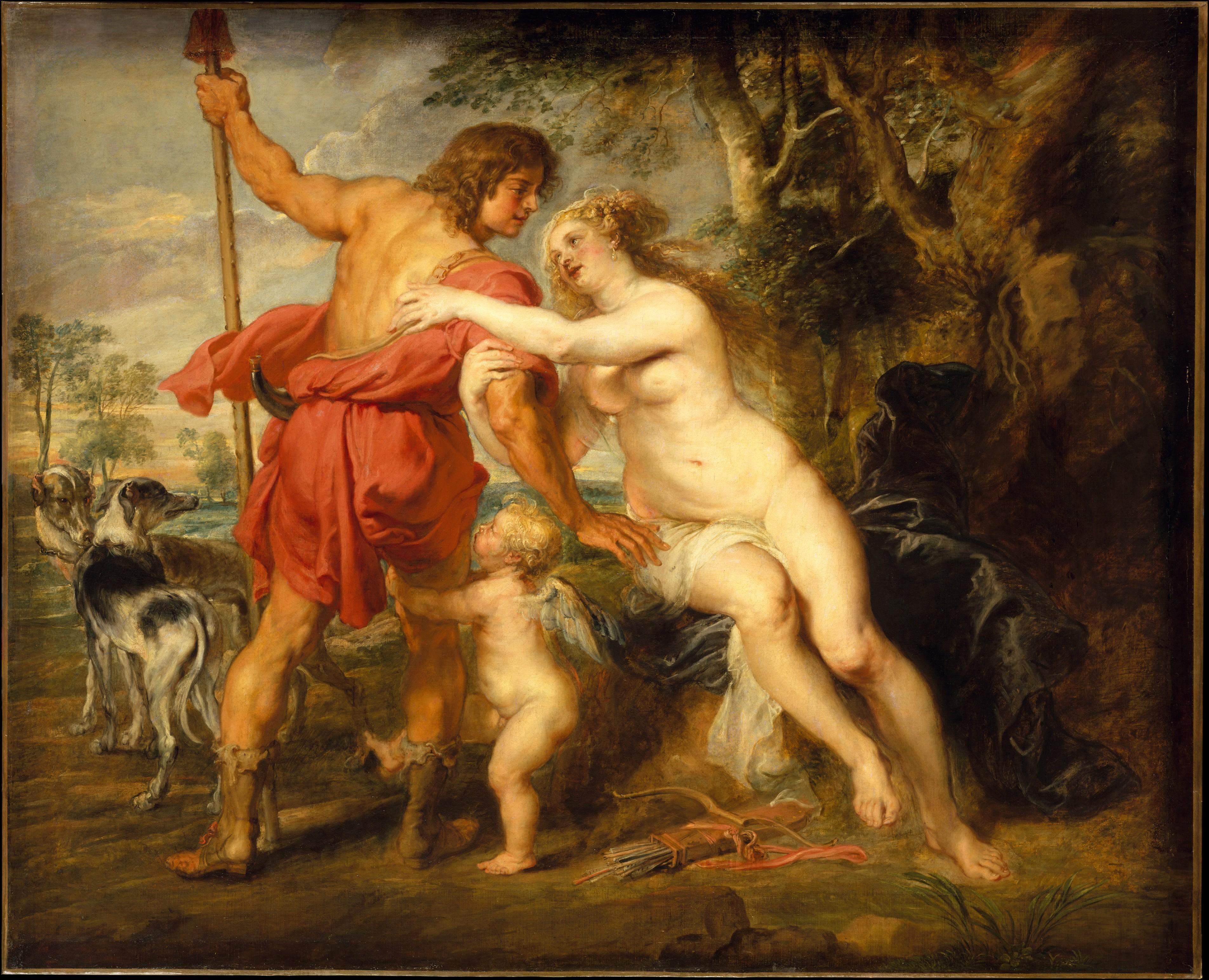
Venus and Adonis
Peter Paul Rubens
478 likes28 comments
Paintale uses cookies for essential site functionality and, where enabled, to serve relevant advertising via Google AdSense. You can accept all cookies or reject non-essential ones. See our Privacy Policy for details.
Now viewing
The Capture of Samson
Peter Paul Rubens
Period
1600-1650
Theme
Love & Romance
Medium
Oil on panel
Current Location
Art Institute of Chicago, Chicago
The Story
This panel, made as a sketch for a larger painting commissioned by the mayor of Antwerp, Nicolas Rockox, demonstrates the influence of the ancient and modern art Peter Paul Rubens studied in Italy. The subject comes from a story in the Hebrew Bible in which the mighty Samson awakes to find that his lover, Delilah, has cut off his hair, the source of his strength.
Rubens drew from ancient Roman sculpture for Samson’s contorted pose as he is captured by soldiers, while the strong contrast of light and dark recalls the work of 16th-century Italian painter Tintoretto—for example, Tarquin and Lucretia.
Working in Oil on panel at 50.4 × 66.4 cm (19 3/4 × 26 1/8 in.); Framed: 73.3 × 89.5 × 12.1 cm (28 7/8 × 35 1/4 × 4 3/4 in.), Peter Paul Rubens constructs depth through value contrast rather than outline, letting figures emerge from darkness the way they would under candlelight or through a shuttered window.
Look closely and the painting opens up. Objects you might pass over — a folded letter, a half-drawn curtain, the angle of a glance — were placed to be read. Cupids, mirrors, and flowers are not decoration; they signal desire, vanity, and the swift passage of beauty.
Housed at Art Institute of Chicago in Chicago, the painting has passed through the hands of collectors, dealers, and institutions before reaching public view — a provenance that is itself part of the object's story.
“A silence so complete it becomes its own witness.”
This panel, made as a sketch for a larger painting commissioned by the mayor of Antwerp, Nicolas Rockox, demonstrates the influence of the ancient and modern art Peter Paul Rubens studied in Italy. The subject comes from a story in the Hebrew Bible in which the mighty Samson awakes to find that his lover, Delilah, has cut off his hair, the source of his strength. Rubens drew from ancient Roman sculpture for Samson’s contorted pose as he is captured by soldiers, while the strong contrast of light and dark recalls the work of 16th-century Italian painter Tintoretto—for example, Tarquin and Lucretia.
Robert A. Waller Memorial Fund
Technique: painting, oil painting, painting (image making), painting techniques, panel painting.
Probably in the collection of the artist, Antwerp, until his death in 1640 and then included in a large lot of oil sketches in his estate sale, 1642 [Jeffrey M. Muller, “Oil-Sketches in Rubens’s Collection,” Burlington Magazine 117 (1975), pp. 374-75, and Held 1980, p. 11, argue that the oil sketches were disposed of in this way]. Frank T. Sabin Gallery, London, by 1914 [Arundel Club 1914, no. 14]; sold through W.R. Valentiner to the Art Institute, November 1923 [as by Van Dyck, according to a letter of August 1, 1923 from Valentiner to Robert Harshe in Art Institute archives and receipt from Sabin dated November 5, 1923, copies in curatorial file].
Art Institute of Chicago, Chicago. View on the museum’s official page.
See more works at Art Institute of Chicago or browse the full Peter Paul Rubens collection.
A restrained palette and sculptural lighting create a solemn geometry. The wooden crate and letter anchor the narrative with journalistic precision.
Sources
Keep Exploring
More paintings like this
Peter Paul Rubens
Peter Paul Rubens
Peter Paul Rubens
Peter Paul Rubens
Peter Paul Rubens
Peter Paul Rubens
Peter Paul Rubens
Peter Paul Rubens