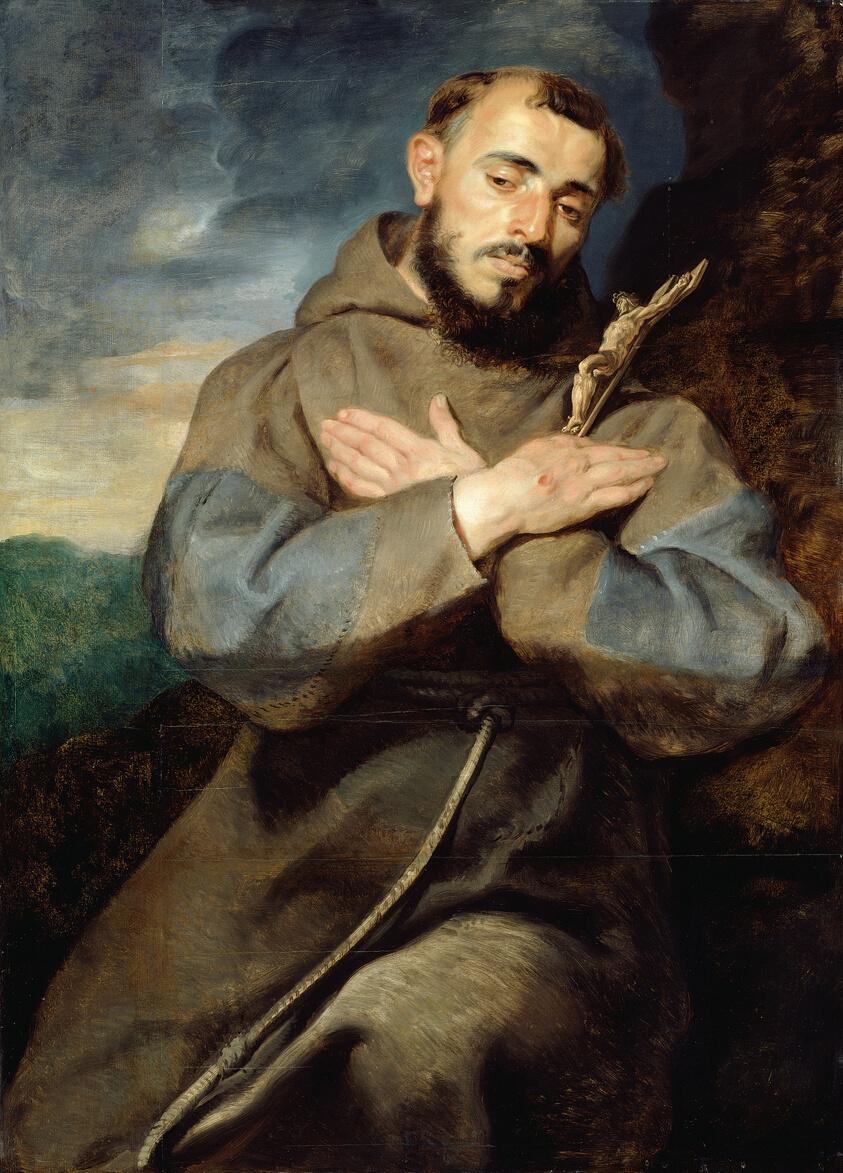
Saint Francis
Peter Paul Rubens
444 likes114 comments
Paintale uses cookies for essential site functionality and, where enabled, to serve relevant advertising via Google AdSense. You can accept all cookies or reject non-essential ones. See our Privacy Policy for details.
Now viewing
The Holy Family with Saints Elizabeth and John the Baptist
Peter Paul Rubens
Period
1600-1650
Theme
Portrait
Medium
Oil on panel
Current Location
Art Institute of Chicago, Chicago
The Story
Peter Paul Rubens’s distinctive blend of fleshy figures and heroic actions dominated the artistic ethos of Antwerp (in present-day Belgium) for much of the 1600s. Here, he translated a sacred subject into vernacular language. The infant Jesus cuddles on the lap of his mother, Mary, whose exposed breast serves as a visual reminder of the human needs of Jesus, also the child of God.
Her elderly cousin Elizabeth and Elizabeth’s son, John the Baptist, look on in wonder and awe, and Joseph, Mary’s husband, tends to a lamb, a symbol of Jesus’s eventual self-sacrifice. Notably, not one of these figures bears a halo, and they are all wearing contemporary dress. Furthermore, not one engages with the viewer; rather, they participate in a series of interlocked gazes that ultimately lead back to Mary.
Executed in Oil on panel, measuring 114.5 × 91.5 cm (45 1/8 × 36 in.); Framed: 137.8 × 115.6 × 12.7 cm (54 1/4 × 45 1/2 × 5 in.), the surface rewards close looking. Peter Paul Rubens builds the composition through layered glazes and a tightly controlled palette, letting cool shadows recede so that the warm, lit passages step forward.
Look closely and the painting opens up. Objects you might pass over — a folded letter, a half-drawn curtain, the angle of a glance — were placed to be read. Every prop in a portrait like this is a decision — jewelry, fabric, and hand position were negotiated between painter and patron to shape how the sitter would be remembered.
Art Institute of Chicago in Chicago now holds the work, where conservators and historians continue to revisit its condition and attribution. Each generation of scholarship adds a layer to how Peter Paul Rubens's output from this period is understood.
“A silence so complete it becomes its own witness.”
This painting features documented symbols with their own dedicated meaning in art history:
Peter Paul Rubens’s distinctive blend of fleshy figures and heroic actions dominated the artistic ethos of Antwerp (in present-day Belgium) for much of the 1600s. Here, he translated a sacred subject into vernacular language. The infant Jesus cuddles on the lap of his mother, Mary, whose exposed breast serves as a visual reminder of the human needs of Jesus, also the child of God. Her elderly cousin Elizabeth and Elizabeth’s son, John the Baptist, look on in wonder and awe, and Joseph, Mary’s husband, tends to a lamb, a symbol of Jesus’s eventual self-sacrifice. Notably, not one of these figures bears a halo, and they are all wearing contemporary dress. Furthermore, not one engages with the viewer; rather, they participate in a series of interlocked gazes that ultimately lead back to Mary. Rubens energized the European art market with his robust and monumental forms, inspired by those of Michelangelo and Raphael that he had seen in Italy. A consummate businessman, Rubens not only directed assistants to paint multiple variants of this composition, but he also commissioned engravings after it. It was an early success for the young, ambitious painter, who achieved a harmonious blend of emotional tenderness and moral strength within each figure.
Major Acquisitions Fund
Technique: oil painting, painting, painting techniques, panel painting, painting (image making).
Jacques Langlier, Paris, who acquired it in three pieces and had it conserved by the successors to Godefroid before selling it to Antoine Poullain for 24,000 fr [annotation in the copy of the Poullain sale in the Philadelphia Museum of Art; information on this and related annotations in other copies of this sale catalogue were kindly supplied by Burton Fredericksen, email of December 13, 2013 in curatorial file; it was presumably when the three vertical boards were reassembled that a narrow horizontal board was added across the top of the panel]; Antoine Poullain, Paris; sold J. B. P. Lebrun, Paris, March 15, 1780, lot 22 for 11,000 fr. to Orsay [according to annotated catalogue cited above and catalogue of the Orsay sale]; Comte d’Orsay, Paris, sold Basan, Paris, 14 April 1790, lot 65 [see also Rooses, 1886, p. 301]. The painting was taken to England but remained unsold and was returned to Paris [according to Smith 1830, p. 246, under no. 837]. Nicolas Lerouge; Paris, offered for sale January 16, 1816, lot 19, but bought in [according to annotated sale cat. at the Johnson Collection, Philadelphia Museum of Art (the name Castalan or Catalan is also mentioned as the consigner, see Rooses 1886, p. 301)]; Chevalier Sebastian Erard; his estate sale, Château de la Muette, August 7, 1832, lot no. 126, for 6,020 fr. to Hope [according to catalogue of Hope sale]; William Williams Hope, Rushton Hall, Northamptonshire; sold, Hôtel des Commissaries-Priseurs, Paris, May 11, 1858, lot no. 7 for 4200 fr. [annotated catalogue at the Frick Art Reference Library]. M. Thirion, Paris; sold Galerie Georges Petit, Paris, June 10, 1907, lot 17 for 59,000 fr. to de Jonghe [according to letter of May 2, 1967 from Julius Weitzner to Charles Cunningham in curatorial file, Paris; the painting has frequently been confused with the larger version on canvas formerly in the Marlborough and Butler collections, Rooses no. 227)]; S. de Jonghe, Paris (died c. 1943), who sent it to George Blumenthal in New York in 1938 [according to Weitzner letter cited above, noting that Blumenthal was de Jonghe’s partner at Lazard Frères]; transferred on de Jonghe’s death to Alavoine and Company for sale [letter of Julius Weitzner cited above]; sold to Julius H. Weitzner, London and New York by 1946 [he lent it to Los Angeles 1946]; given to his daughter Marjorie Weitzner Gambino, Rome, and sold on her behalf to the Art Institute, 1967.
Art Institute of Chicago, Chicago. View on the museum’s official page.
See more works at Art Institute of Chicago or browse the full Peter Paul Rubens collection.
A restrained palette and sculptural lighting create a solemn geometry. The wooden crate and letter anchor the narrative with journalistic precision.
Sources
Keep Exploring
More paintings like this
Peter Paul Rubens
Peter Paul Rubens
Peter Paul Rubens
Peter Paul Rubens
Peter Paul Rubens
Peter Paul Rubens
Peter Paul Rubens
Peter Paul Rubens