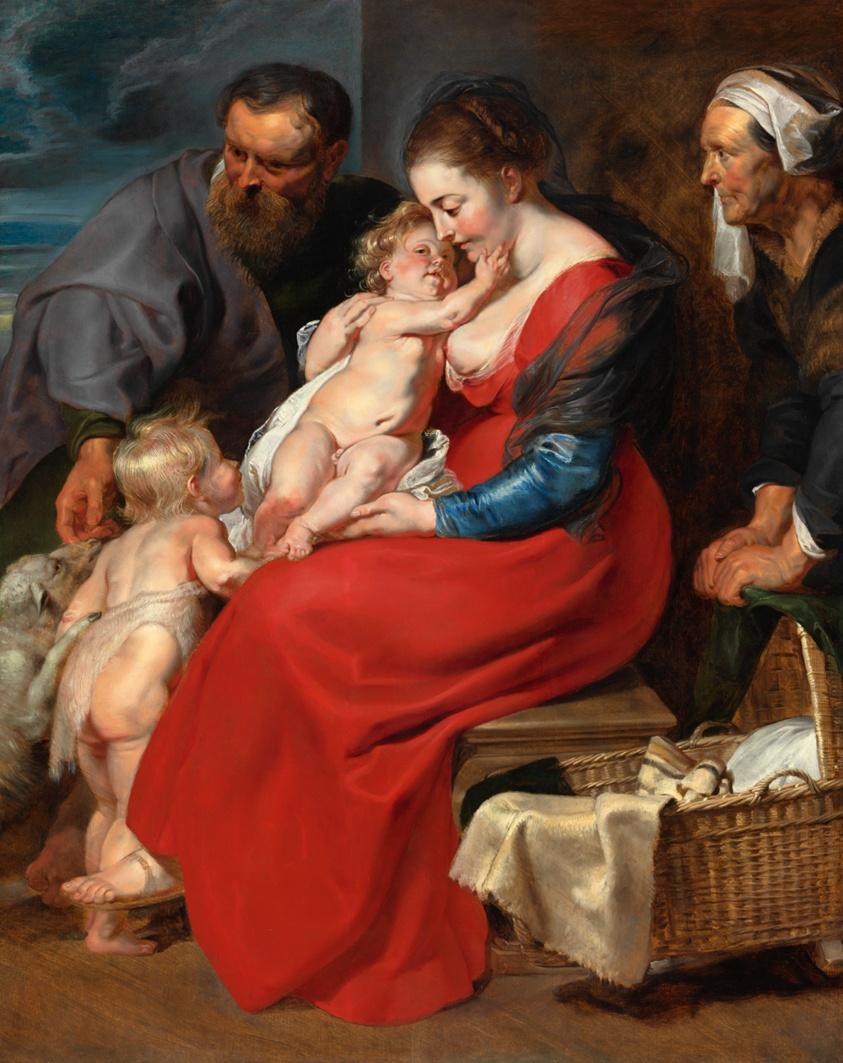
The Holy Family with Saints Elizabeth and John the Baptist
Peter Paul Rubens
1047 likes77 comments
Paintale uses cookies for essential site functionality and, where enabled, to serve relevant advertising via Google AdSense. You can accept all cookies or reject non-essential ones. See our Privacy Policy for details.
Now viewing
Saint Francis
Peter Paul Rubens
Period
1600-1650
Theme
Portrait
Medium
Oil on panel
Current Location
Art Institute of Chicago, Chicago
The Story
Saint Francis Receiving the Stigmata is an oil painting on canvas by Peter Paul Rubens. It was originally produced as an altarpiece for the Franciscan Recollects Church in Ghent. The church also housed other works by Rubens, including St Mary Magdalene in Ecstasy and The Virgin Mary and Saint Francis Saving the World from Christ's Anger. In 1797 the painting was seized from Saint Peter's Abbey, Ghent to form part of a new 'Nationaal Museum', which opened to the public in 1802. It now hangs in the Museum of Fine Arts, Ghent.
Created in 1610 during the 1600-1650 period, this work belongs firmly within the portrait tradition. Peter Paul Rubens worked at a moment when the rivalry between Catholic Baroque drama and Protestant restraint reshaped what a painting could mean. Every gesture, fabric, and gleam of light was decoded by contemporary viewers like a private language.
The physical object — Oil on panel, 99 × 78.8 cm (43 1/4 × 31 in.); Framed: 148 × 118.8 × 7.6 cm (58 1/4 × 46 3/4 × 3 in.) — carries its own history of handling and restoration. Peter Paul Rubens's brushwork here moves between exacting description and looser, more suggestive passages, a balance typical of Baroque studio practice.
Look closely and the painting opens up. Objects you might pass over — a folded letter, a half-drawn curtain, the angle of a glance — were placed to be read. Likeness was only part of the job; the painting also had to argue for the sitter's place in the world.
Housed at Art Institute of Chicago in Chicago, the painting has passed through the hands of collectors, dealers, and institutions before reaching public view — a provenance that is itself part of the object's story.
“A silence so complete it becomes its own witness.”
Francis of Assisi, stigmata.
The Franciscans were among the reformed religious orders whose preaching and teaching activities helped revive the Roman Catholic Church in the Southern Netherlands following years of religious and political turmoil in the 1500s. Peter Paul Rubens here depicted the order’s founder, Saint Francis of Assisi, recognizable by the wound that imitates the pierced hands of the crucified Jesus. In this portrait-like image, which was likely made on commission, Rubens conveyed the saint’s spirituality through his meditative gaze and posture.
George F. Harding Collection
Materials: oil paint, canvas.
Technique: painting, oil painting, painting (image making), painting techniques, panel painting.
Art Institute of Chicago, Chicago. View on the museum’s official page.
See more works at Art Institute of Chicago or browse the full Peter Paul Rubens collection.
A restrained palette and sculptural lighting create a solemn geometry. The wooden crate and letter anchor the narrative with journalistic precision.
Sources
Keep Exploring
More paintings like this
Peter Paul Rubens
Peter Paul Rubens
Peter Paul Rubens
Peter Paul Rubens
Peter Paul Rubens
Peter Paul Rubens
Peter Paul Rubens
Peter Paul Rubens