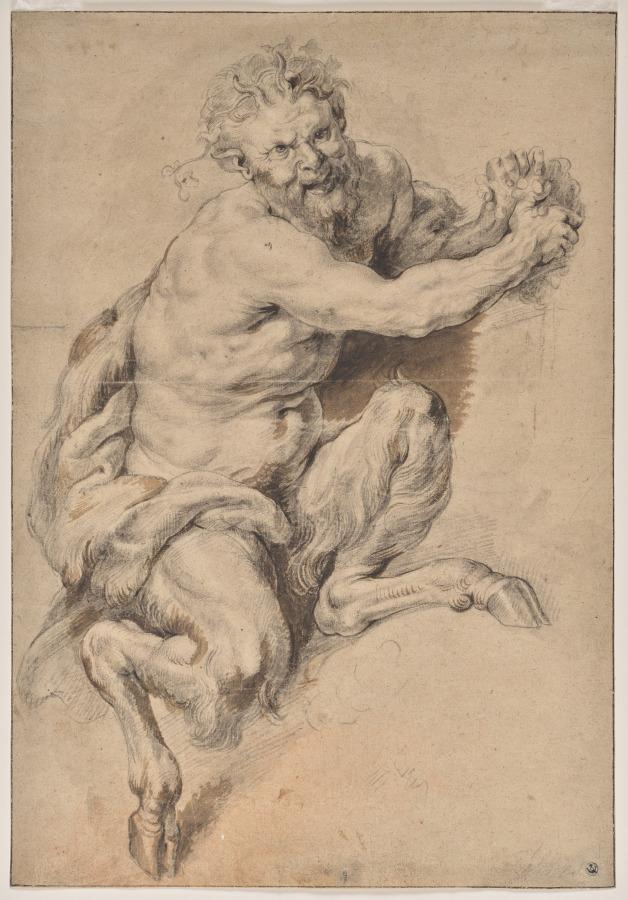
A Faun Grasping a Bunch of Grapes
Peter Paul Rubens
1598 likes88 comments
Paintale uses cookies for essential site functionality and, where enabled, to serve relevant advertising via Google AdSense. You can accept all cookies or reject non-essential ones. See our Privacy Policy for details.
Now viewing
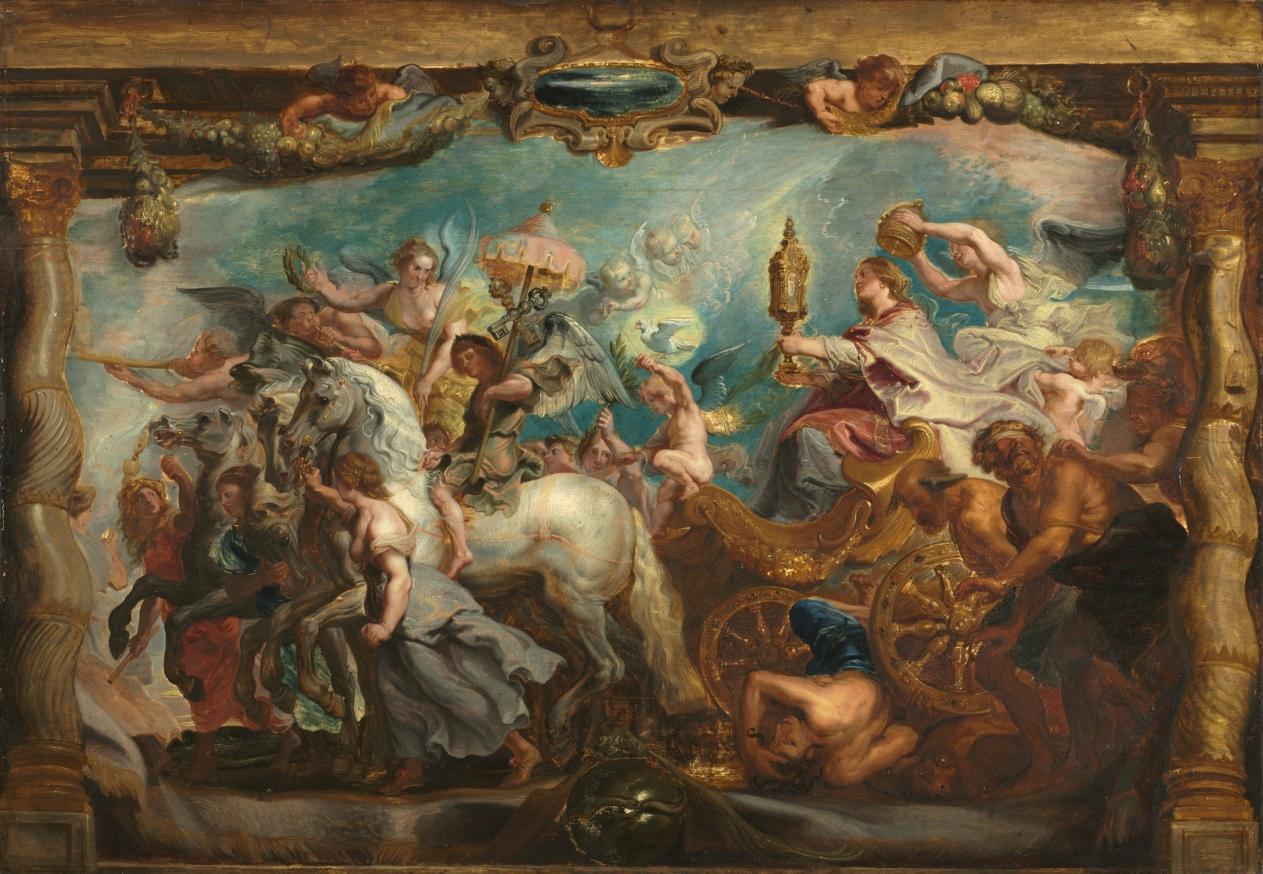
The Adoration of the Eucharist
Peter Paul Rubens
Period
1600-1650
Theme
Daily Life
Medium
Oil on panel
Current Location
Art Institute of Chicago, Chicago
The Story
Peter Paul Rubens designed this elaborate oil sketch as part of a tapestry series intended for the Convent of Las Descalzas Reales in Madrid. Rubens created two tiers of celebrants—the heavenly on the upper level and the earthly on the lower level—adoring the Eucharist, an important sacrament in the Roman Catholic Church, which is lifted by two angels beneath a central arch.
The series’ patron, Spanish archduchess Isabella Clara Eugenia, is represented in a nun’s habit at the lower left to signify her piety and reinforce her status as an important patron of the arts in the ruling Habsburg family.
Working in Oil on panel at 31.5 × 32 cm (12 1/2 × 12 1/2 in.); Framed: 47.6 × 47.6 × 7 cm (18 3/4 × 18 3/4 × 2 3/4 in.), Peter Paul Rubens constructs depth through value contrast rather than outline, letting figures emerge from darkness the way they would under candlelight or through a shuttered window.
Look closely and the painting opens up. Objects you might pass over — a folded letter, a half-drawn curtain, the angle of a glance — were placed to be read. Scenes like this were prized precisely because they made ordinary labor and leisure worth painting at all.
Today the painting is held by Art Institute of Chicago in Chicago, where it remains a touchstone for understanding Peter Paul Rubens's contribution to Western art. It has been studied, copied, restored, and argued over for centuries — proof that great paintings keep generating new readings long after their creators have gone.
“A silence so complete it becomes its own witness.”
Peter Paul Rubens designed this elaborate oil sketch as part of a tapestry series intended for the Convent of Las Descalzas Reales in Madrid. Rubens created two tiers of celebrants—the heavenly on the upper level and the earthly on the lower level—adoring the Eucharist, an important sacrament in the Roman Catholic Church, which is lifted by two angels beneath a central arch. The series’ patron, Spanish archduchess Isabella Clara Eugenia, is represented in a nun’s habit at the lower left to signify her piety and reinforce her status as an important patron of the arts in the ruling Habsburg family.
Mr. and Mrs. Martin A. Ryerson Collection
Technique: painting, painting (image making), painting techniques, panel painting.
Probably in the collection of the artist, Antwerp, until his death in 1640 and then included in a large lot of oil sketches in his estate sale, 1642 [Jeffrey M. Muller, “Oil-Sketches in Rubens’s Collection,” Burlington Magazine 117 (1975), pp. 374-75, and Held 1980, p. 11, argue that the oil sketches were disposed of in this way]. Probably Jean van Lancker, Antwerp; his estate sale, Antwerp, 23 May, 1769 and following days, lot 72, “Une belle Esquisse, un Sanctuaire au milieu de 4 petites pieces jointes ensemble, Rubens, B[ois], 13 x 12. Canon Pierre André Joseph Knyff, Antwerp (died 1784), his estate sale, Antwerp, J. Grange, 18 July 1785 and following days, lot 74, “Un Autel enrichi d’ornemens & de colonnes, sur lequel est, représentée l’Adoration de l’Eucharistie: à droite, on voit le Pape à genoux, qui offre de l’encens; il est accompagné de Diàcres, de Prêtres & de beaucoup d’autres figures; à gauches sont l’Empereur, un Roi, des Princes, & plusieurs autres personnes, qui adorent le Saint Sacrement, au-dessus duquel on apperçoit un grand nombre d’Anges qui jouent des instrumens. Dans cette belle esquisse bien terminée et bien coloriée, l’on remarque beaucoup de finesse & de vérité. 11 ½ x 11 3/4 . B[ois]”, to Giraud, according to annotated catalogue in the RKD, The Hague]. Dowdeswell Galleries, London, by 1914, when sold to Martin A. Ryerson [an invoice from Dowdeswell to Ryerson is dated June 23, 1914]; Martin A. Ryerson, Chicago (1856–1932), from 1914; by descent to his wife Carrie Hutchinson Ryerson (1859–1937), Chicago, 1932 [Last Will and Testament of Martin A. Ryerson, Died August 11, 1932, copy in Institutional Archives, Art Institute of Chicago]; bequeathed to the Art Institute of Chicago, 1937.
Art Institute of Chicago, Chicago. View on the museum’s official page.
See more works at Art Institute of Chicago or browse the full Peter Paul Rubens collection.
A restrained palette and sculptural lighting create a solemn geometry. The wooden crate and letter anchor the narrative with journalistic precision.
Sources
Keep Exploring
More paintings like this
Peter Paul Rubens
Peter Paul Rubens
Peter Paul Rubens
Peter Paul Rubens
Peter Paul Rubens
Peter Paul Rubens
Peter Paul Rubens
Peter Paul Rubens