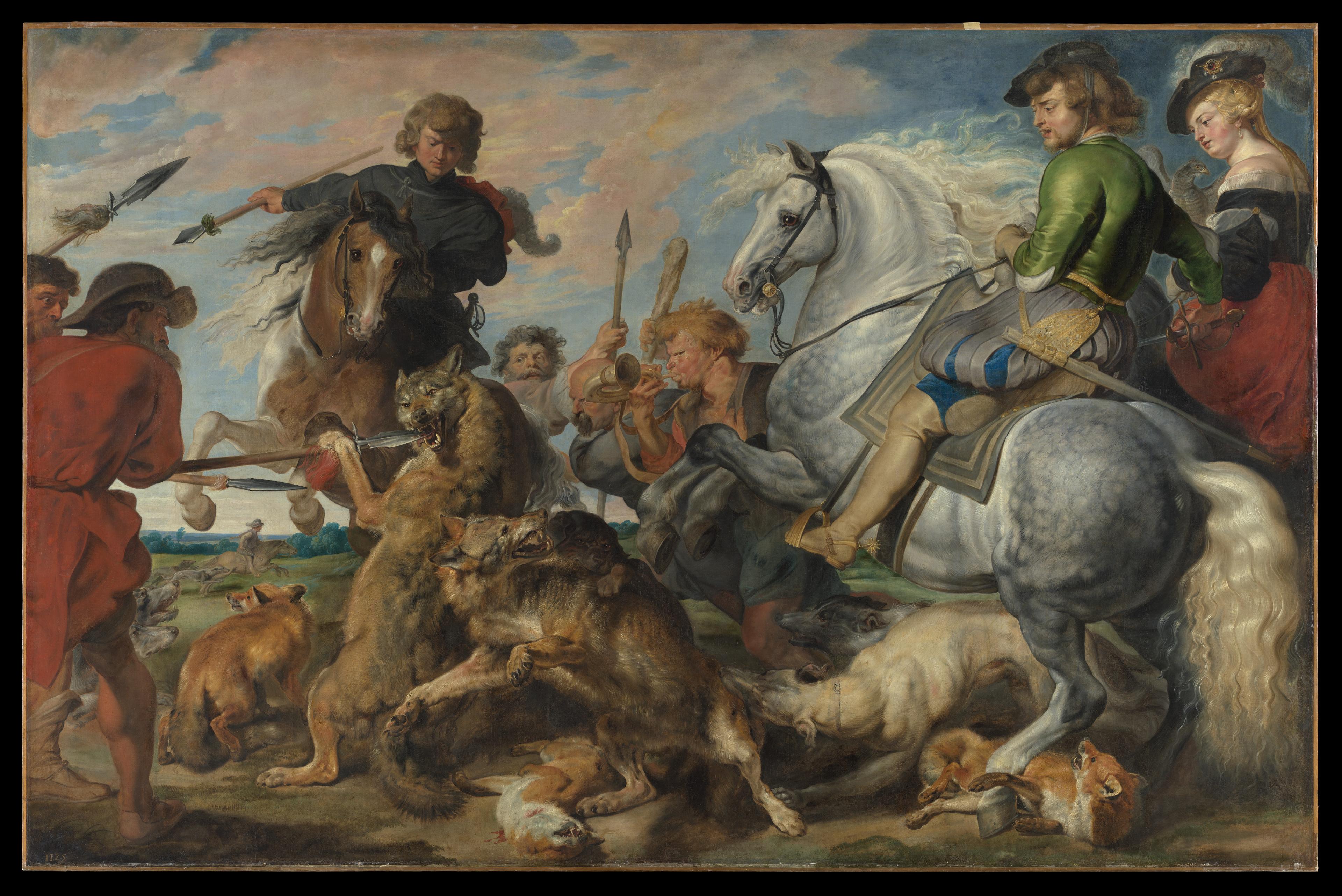
Wolf and Fox Hunt
Peter Paul Rubens
477 likes27 comments
Paintale uses cookies for essential site functionality and, where enabled, to serve relevant advertising via Google AdSense. You can accept all cookies or reject non-essential ones. See our Privacy Policy for details.
Now viewing
A Faun Grasping a Bunch of Grapes
Peter Paul Rubens
Period
Baroque
Theme
Daily Life
Medium
black chalk and brush and brown wash; framing lines in pen and black ink
Current Location
Cleveland Museum of Art, Cleveland
The Story
A Faun Grasping a Bunch of Grapes, after 1616–18. Studio of Peter Paul Rubens (Flemish, 1577–1640). Black chalk and brush and brown wash; framing lines in pen and black ink; sheet: 37.8 x 26.2 cm (14 7/8 x 10 5/16 in.). The Cleveland Museum of Art, Purchase from the J. H. Wade Fund, 1943.341
Created in 1616 during the Baroque period, this work belongs firmly within the daily life tradition. Peter Paul Rubens worked at a moment when the rivalry between Catholic Baroque drama and Protestant restraint reshaped what a painting could mean. Every gesture, fabric, and gleam of light was decoded by contemporary viewers like a private language.
As black chalk and brush and brown wash; framing lines in pen and black ink (Sheet: 37.8 x 26.2 cm (14 7/8 x 10 5/16 in.)), the work shows the tool marks and layering choices typical of Peter Paul Rubens's output in this period — decisions about ground, underpainting, and glaze that a photograph can only partly convey.
Look closely and the painting opens up. Objects you might pass over — a folded letter, a half-drawn curtain, the angle of a glance — were placed to be read. Scenes like this were prized precisely because they made ordinary labor and leisure worth painting at all.
Housed at Cleveland Museum of Art in Cleveland, the painting has passed through the hands of collectors, dealers, and institutions before reaching public view — a provenance that is itself part of the object's story.
“A silence so complete it becomes its own witness.”
This painting features documented symbols with their own dedicated meaning in art history:
A Faun Grasping a Bunch of Grapes, after 1616–18. Studio of Peter Paul Rubens (Flemish, 1577–1640). Black chalk and brush and brown wash; framing lines in pen and black ink; sheet: 37.8 x 26.2 cm (14 7/8 x 10 5/16 in.). The Cleveland Museum of Art, Purchase from the J. H. Wade Fund, 1943.341
Accession: 1943.341. Purchase from the J. H. Wade Fund
Technique: black chalk and brush and brown wash; framing lines in pen and black ink.
Inscriptions: VERSO, upper right, in brown ink: no 40 ; lower left, in brown ink: 6/14.
Unidentified collector's mark, grey stamp "C", verso (not in Lugt) Valerius Röver (1686-1739), Delft (Lugt 2984a-c), album 6, no. 14 his widow, Delft with Hendrik de Leth Johann Goll van Franckenstein (1722-1785) and his son (1750-1821), Amsterdam Emile Wauters, Brussels (Lugt 911, lower right, in black ink) [his sale Frederick Muller & Co., Amsterdam, 15-16 June 1926, lot 172] Henry Oppenheimer, London (Lugt 1351, not stamped); [his sale, Christie's, London, 10, 13-14 July 1936, lot 305, cat. by K.T. Parker] Mr. and Mrs. David Birnbaum, New York with Mortimer Brandt Gallery, New York Cleveland Museum of Art, Cleveland OH, USA
Cleveland Museum of Art, Cleveland. View on the museum’s official page.
See more works at Cleveland Museum of Art or browse the full Peter Paul Rubens collection.
A restrained palette and sculptural lighting create a solemn geometry. The wooden crate and letter anchor the narrative with journalistic precision.
Sources
Keep Exploring
More paintings like this
Peter Paul Rubens
Peter Paul Rubens
Peter Paul Rubens
Peter Paul Rubens
Peter Paul Rubens
Peter Paul Rubens
Peter Paul Rubens
Peter Paul Rubens