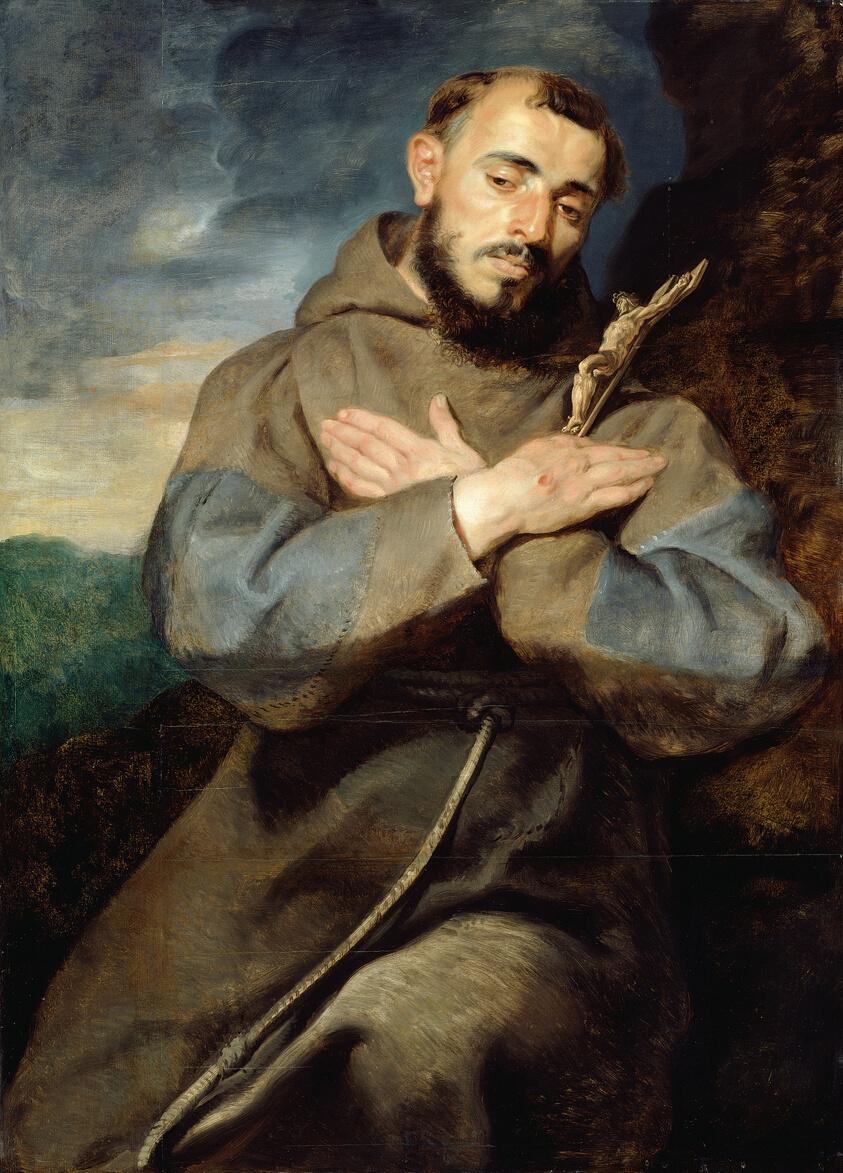
Saint Francis
Peter Paul Rubens
444 likes114 comments
Paintale uses cookies for essential site functionality and, where enabled, to serve relevant advertising via Google AdSense. You can accept all cookies or reject non-essential ones. See our Privacy Policy for details.
Now viewing
The Wedding of Peleus and Thetis
Peter Paul Rubens
Period
1600-1650
Theme
Portrait
Medium
Oil on panel
Current Location
Art Institute of Chicago, Chicago
The Story
In this oil sketch, the Flemish artist Peter Paul Rubens illustrated a moment from the ancient Roman poem Metamorphoses for the hunting lodge of King Philip IV of Spain. In the middle of a wedding celebration, the goddess of discord, Eris, has thrown a golden apple into the feast to provoke jealousy.
She succeeds in igniting a competition for the extraordinary fruit between Venus, goddess of beauty, who sits nude in the foreground; Juno, goddess of marriage, who wears a flowing veil at the center; and Minerva, goddess of war, who stands at the left in a helmet. Rubens humanized the gods through robust modeling of their bodies and facial expressions, a choice appropriate to the subject matter, a story of their pride and vanity.
As Oil on panel (27 × 42.6 cm (10 5/8 × 16 3/4 in.); Framed: 42.2 × 57.8 × 6.4 cm (16 5/8 × 22 3/4 × 2 1/2 in.)), the work shows the tool marks and layering choices typical of Peter Paul Rubens's output in this period — decisions about ground, underpainting, and glaze that a photograph can only partly convey.
Look closely and the painting opens up. Objects you might pass over — a folded letter, a half-drawn curtain, the angle of a glance — were placed to be read. Likeness was only part of the job; the painting also had to argue for the sitter's place in the world.
Art Institute of Chicago in Chicago now holds the work, where conservators and historians continue to revisit its condition and attribution. Each generation of scholarship adds a layer to how Peter Paul Rubens's output from this period is understood.
“A silence so complete it becomes its own witness.”
This painting features documented symbols with their own dedicated meaning in art history:
In this oil sketch, the Flemish artist Peter Paul Rubens illustrated a moment from the ancient Roman poem Metamorphoses for the hunting lodge of King Philip IV of Spain. In the middle of a wedding celebration, the goddess of discord, Eris, has thrown a golden apple into the feast to provoke jealousy. She succeeds in igniting a competition for the extraordinary fruit between Venus, goddess of beauty, who sits nude in the foreground; Juno, goddess of marriage, who wears a flowing veil at the center; and Minerva, goddess of war, who stands at the left in a helmet. Rubens humanized the gods through robust modeling of their bodies and facial expressions, a choice appropriate to the subject matter, a story of their pride and vanity.
Charles H. and Mary F. S. Worcester Collection
Technique: oil painting, panel painting, painting techniques, painting (image making), painting.
Art Institute of Chicago, Chicago. View on the museum’s official page.
See more works at Art Institute of Chicago or browse the full Peter Paul Rubens collection.
A restrained palette and sculptural lighting create a solemn geometry. The wooden crate and letter anchor the narrative with journalistic precision.
Sources
Keep Exploring
More paintings like this
Peter Paul Rubens
Peter Paul Rubens
Peter Paul Rubens
Peter Paul Rubens
Peter Paul Rubens
Peter Paul Rubens
Peter Paul Rubens
Peter Paul Rubens