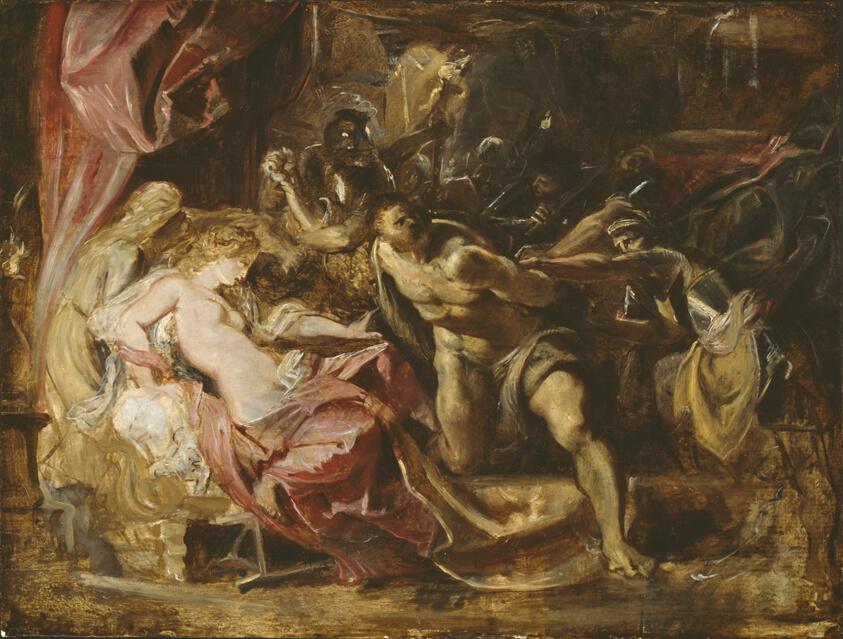
The Capture of Samson
Peter Paul Rubens
941 likes11 comments
Paintale uses cookies for essential site functionality and, where enabled, to serve relevant advertising via Google AdSense. You can accept all cookies or reject non-essential ones. See our Privacy Policy for details.
Now viewing
St. Albert of Louvain
Peter Paul Rubens
Period
1600-1650
Theme
Tragedy & Death
Medium
Oil on panel
Current Location
Art Institute of Chicago, Chicago
The Story
Peter Paul Rubens executed this study and 38 more as he prepared to decorate the ceiling of the Jesuit church in Antwerp. He presented such highly finished sketches to his patrons as proposals for major projects. This work shows a dramatically foreshortened saint gliding majestically on a cloud. The bold perspective would have furthered the illusion that the painting was a window in the ceiling of the church, offering a view to the open sky above. The man depicted here is the 12th-century martyr Albert of Louvain, patron saint of Archduke Albert, governor of the Spanish Netherlands.
Created in 1620 during the 1600-1650 period, this work belongs firmly within the tragedy & death tradition. Peter Paul Rubens worked at a moment when the rivalry between Catholic Baroque drama and Protestant restraint reshaped what a painting could mean. Every gesture, fabric, and gleam of light was decoded by contemporary viewers like a private language.
Working in Oil on panel at 34.7 × 45.8 cm (13 5/8 × 18 in.); Framed: 58.5 × 69.3 × 6.4 cm (23 × 27 1/4 × 2 1/2 in.), Peter Paul Rubens constructs depth through value contrast rather than outline, letting figures emerge from darkness the way they would under candlelight or through a shuttered window.
Look closely and the painting opens up. Objects you might pass over — a folded letter, a half-drawn curtain, the angle of a glance — were placed to be read. The composition slows the eye down at exactly the moment it would rather look away, which is the point.
Housed at Art Institute of Chicago in Chicago, the painting has passed through the hands of collectors, dealers, and institutions before reaching public view — a provenance that is itself part of the object's story.
“A silence so complete it becomes its own witness.”
Peter Paul Rubens executed this study and 38 more as he prepared to decorate the ceiling of the Jesuit church in Antwerp. He presented such highly finished sketches to his patrons as proposals for major projects. This work shows a dramatically foreshortened saint gliding majestically on a cloud. The bold perspective would have furthered the illusion that the painting was a window in the ceiling of the church, offering a view to the open sky above. The man depicted here is the 12th-century martyr Albert of Louvain, patron saint of Archduke Albert, governor of the Spanish Netherlands.
Bequest of Dr. John J. Ireland
Technique: painting, oil painting, painting (image making), painting techniques, panel painting.
Matthäus Merian d. Ä., Basel, to 1650; by descent in Merian family to 1796; sold Basel, 1796, no. 27, for F10. Grazio Enea Lanfranconi, Bratislava, by 1895; sold Lempertz, Cologne, 21–23 October 1895, no. 174 as St. Jerome. Dr. Leo Cohn, Paris [according to Puyvelde 1940, no. 38]. Dr. Leo Charles Collins, New York [he lent the picture to Schaeffer and Brandt 1942; a Collins, an émigré, who was active both as a lawyer and art historian, was probably identical with Dr. Leo Cohn, originally of Vienna; see the introduction to Leo C. Collins, Hercules Seghers, Chicago, 1953]. E. and A. Silberman Galleries, New York. John J. Ireland (died 1968), Chicago, by 1955 [lent to New York 1955]; bequeathed to the Art Institute, 1968.
Art Institute of Chicago, Chicago. View on the museum’s official page.
See more works at Art Institute of Chicago or browse the full Peter Paul Rubens collection.
A restrained palette and sculptural lighting create a solemn geometry. The wooden crate and letter anchor the narrative with journalistic precision.
Sources
Keep Exploring
More paintings like this
Peter Paul Rubens
Peter Paul Rubens
Peter Paul Rubens
Peter Paul Rubens
Peter Paul Rubens
Peter Paul Rubens
Peter Paul Rubens
Peter Paul Rubens