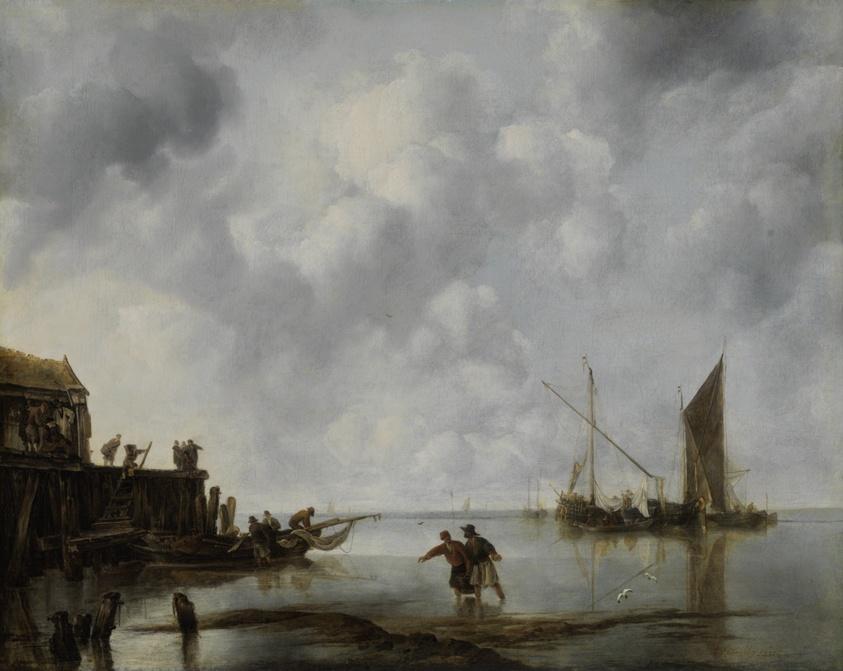
Fishing Boats in a Calm
Jan van de Cappelle
1463 likes33 comments
Paintale uses cookies for essential site functionality and, where enabled, to serve relevant advertising via Google AdSense. You can accept all cookies or reject non-essential ones. See our Privacy Policy for details.
Now viewing
Dead Birds and Shot Bags
Attributed to Pieter Boel
Period
1650-1700
Theme
Daily Life
Medium
Oil on canvas
Current Location
Art Institute of Chicago, Chicago
The Story
Arranged in sinuous poses to emphasize individual feathers and decorative patterns in the plumage, the lifeless birds in this painting demonstrate the artist’s careful attention to reproducing the natural world. Pieter Boel, who specialized in the game still lifes popularized in the Southern Netherlands by Frans Snyders, executed highly naturalistic representations of fowl and canines during his years in Antwerp. The heightened shadows in this work reflect Boel’s study of Italian painting during a stay there in the 1640s.
Created in 1655 during the 1650-1700 period, this work belongs firmly within the daily life tradition. Attributed to Pieter Boel worked at a moment when the rivalry between Catholic Baroque drama and Protestant restraint reshaped what a painting could mean. Every gesture, fabric, and gleam of light was decoded by contemporary viewers like a private language.
Executed in Oil on canvas, measuring 32.6 × 43.3 cm (12 3/4 × 17 in.); Framed: 49.5 × 59.7 × 6.4 cm (19 1/2 × 23 1/2 × 2 1/2 in.), the surface rewards close looking. Attributed to Pieter Boel builds the composition through layered glazes and a tightly controlled palette, letting cool shadows recede so that the warm, lit passages step forward.
Look closely and the painting opens up. Objects you might pass over — a folded letter, a half-drawn curtain, the angle of a glance — were placed to be read. Even the everyday is loaded: a basin, a candle, a worn shoe become small monuments to a vanished daily world.
Today the painting is held by Art Institute of Chicago in Chicago, where it remains a touchstone for understanding Attributed to Pieter Boel's contribution to Western art. It has been studied, copied, restored, and argued over for centuries — proof that great paintings keep generating new readings long after their creators have gone.
“A silence so complete it becomes its own witness.”
This painting features documented symbols with their own dedicated meaning in art history:
Arranged in sinuous poses to emphasize individual feathers and decorative patterns in the plumage, the lifeless birds in this painting demonstrate the artist’s careful attention to reproducing the natural world. Pieter Boel, who specialized in the game still lifes popularized in the Southern Netherlands by Frans Snyders, executed highly naturalistic representations of fowl and canines during his years in Antwerp. The heightened shadows in this work reflect Boel’s study of Italian painting during a stay there in the 1640s.
A. A. Munger Collection
Technique: painting, oil painting, painting (image making), painting techniques.
Adolf Mayer, Mannheim and The Hague, by December 1936 [see The Hague 1936 exh. cat., no. 77, and label on reverse of stretcher]; by descent to his sons, Adolf I. Mayer Jr., New York, and H. Herbert Mayer, The Hague [see forward of 1948 Oberlin exh. cat.]; probably offered for sale by Adolf I. Mayer Jr. and H. Herbert Mayer through Van Diemen-Lilienfeld Gallery, New York [see forward of Oberlin 1948 exh. cat. and Van Diemen and Lilienfeld label on reverse of stretcher]; sold by Van Diemen-Lilienfeld Gallery, New York, to the Art Institute, 1955.
Art Institute of Chicago, Chicago. View on the museum’s official page.
See more works at Art Institute of Chicago or browse the full Attributed to Pieter Boel collection.
A restrained palette and sculptural lighting create a solemn geometry. The wooden crate and letter anchor the narrative with journalistic precision.
Sources
Keep Exploring
More paintings like this
Jan van de Cappelle
Jacob Ochtervelt
Claude Lorrain
Pieter Mulier, II
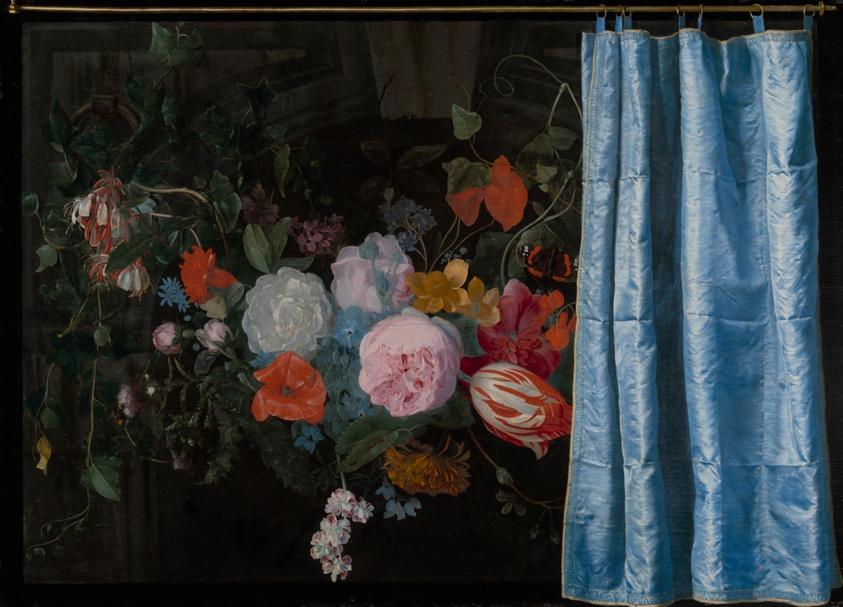
Adriaen van der SpeltFrans van Mieris

Leonardo da Vinci

Leonardo da Vinci

Leonardo da Vinci