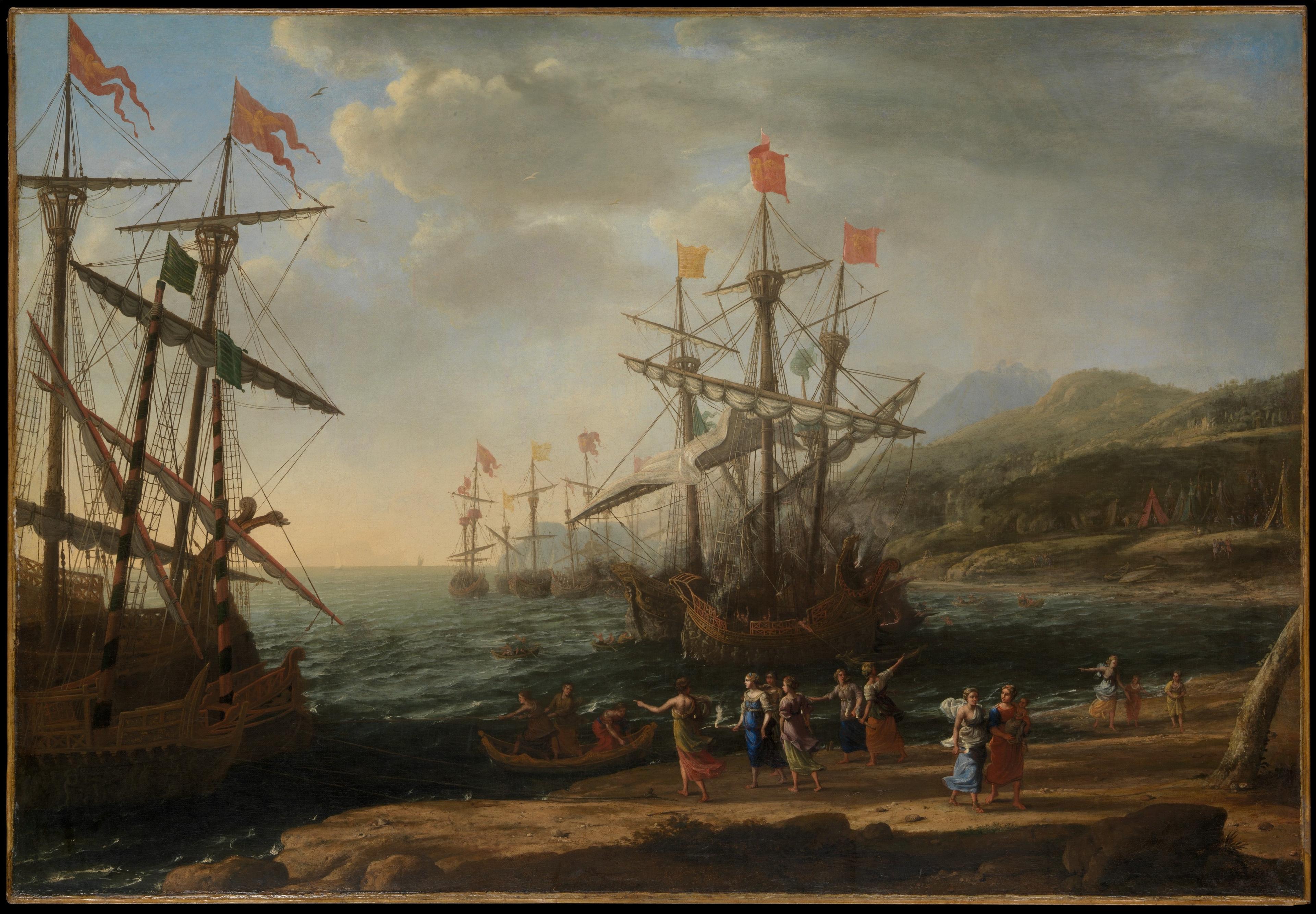
The Trojan Women Setting Fire to Their Fleet
Claude Lorrain
1106 likes136 comments
Paintale uses cookies for essential site functionality and, where enabled, to serve relevant advertising via Google AdSense. You can accept all cookies or reject non-essential ones. See our Privacy Policy for details.
Now viewing
View of Delphi with a Procession
Claude Lorrain
Period
1650-1700
Theme
Daily Life
Medium
Oil on canvas
Current Location
Art Institute of Chicago, Chicago
The Story
This painting of the ancient city of Delphi (in what is now Greece) presents a delicate rendering of the glowing Mediterranean atmosphere. Like many other foreign artists drawn to the ruins of antiquity, French painter Claude Lorrain was fascinated with the ancient Roman Empire. Here, he evoked a serene, bucolic world akin to the poetic vision of the ancient Roman writer Virgil, depicting the ruins restored to their original glory as Claude imagined. This painting was commissioned by Cardinal Carlo Camillo Massimi, an important and erudite collector in Rome.
Created in 1673 during the 1650-1700 period, this work belongs firmly within the daily life tradition. Claude Lorrain worked at a moment when the rivalry between Catholic Baroque drama and Protestant restraint reshaped what a painting could mean. Every gesture, fabric, and gleam of light was decoded by contemporary viewers like a private language.
Working in Oil on canvas at 101.6 × 127 cm (40 × 50 in.); Framed: 130.2 × 156.6 cm (51 1/4 × 61 5/8 in.), Claude Lorrain constructs depth through value contrast rather than outline, letting figures emerge from darkness the way they would under candlelight or through a shuttered window.
Look closely and the painting opens up. Objects you might pass over — a folded letter, a half-drawn curtain, the angle of a glance — were placed to be read. The apparent casualness is staged — objects and gestures are arranged to read as a moment caught rather than composed.
Art Institute of Chicago in Chicago now holds the work, where conservators and historians continue to revisit its condition and attribution. Each generation of scholarship adds a layer to how Claude Lorrain's output from this period is understood.
“A silence so complete it becomes its own witness.”
This painting of the ancient city of Delphi (in what is now Greece) presents a delicate rendering of the glowing Mediterranean atmosphere. Like many other foreign artists drawn to the ruins of antiquity, French painter Claude Lorrain was fascinated with the ancient Roman Empire. Here, he evoked a serene, bucolic world akin to the poetic vision of the ancient Roman writer Virgil, depicting the ruins restored to their original glory as Claude imagined. This painting was commissioned by Cardinal Carlo Camillo Massimi, an important and erudite collector in Rome.
Robert A. Waller Memorial Fund
Technique: painting, painting (image making), painting techniques.
Inscriptions: Signed lower right: CLAUDIO [...] (barely legible).
Commissioned along with Coast View with Perseus and the Origin of Coral (LV 184) by Cardinal Carlo Camillo Massimi (died 1676), Rome, 1673, presumably to accompany two other paired paintings by Claude, identified as Landscape with Argus Gaurding Io (LV 86) and Coast View with Apollo and the Cumaean Sibyl (LV 99) [according to inscriptions that accompany the drawing after the painting in Claude’s “Liber Veritatis” (LV 182) that read “CLAVDIO fecit IV / Roma 1673” and “quadro facto per leminmo e Reve.ro / sigre Cardinale Massimo / A Roma 1673”]; at his death to his younger brother, Fabio Camillo Massimi [according to Röthlisberger 1979, vol. 1, p. 240, under LV 86]. Possibly John Drummond, first earl of Melfort, London, by 1690; possibly sold Whitehall, London, June 21, 1693 [suggested by Röthlisberger 1979, vol. 1, pp. 239–41, under LV 86, pp. 428–31, LV 182 on the basis that one of the pendants of the painting, Landscape with Argus Guarding Io, Holkham Hall, Norfolk, may be listed in an 1693 supplement to an 1692 inventory of the Melfort collection]. Humphrey Edwin, by 1746; probably sold by his widow, c. 1750 [according to Röthlisberger 1979, vol. 1, p. 430, under LV 182]. In the possession of the Earls of Derby, certainly by 1854 when it was lent to London 1854; by descent to Edward George Villiers, seventeenth earl of Derby; sold Christie’s London, July 26, 1940, no. 9, to Rothschild for £126, as Priests Proceeding with a Sacrificial Bull towards a Fortified City [price and buyer according to an annotated copy of the sale catalogue, Christie’s, London]. Arnold Seligmann, Rey, and Co., New York, by 1941; purchased by the Art Institute, 1941.
Art Institute of Chicago, Chicago. View on the museum’s official page.
See more works at Art Institute of Chicago or browse the full Claude Lorrain collection.
A restrained palette and sculptural lighting create a solemn geometry. The wooden crate and letter anchor the narrative with journalistic precision.
Sources
Keep Exploring
More paintings like this
Claude Lorrain
Jan van de Cappelle
Jacob Ochtervelt
Attributed to Pieter Boel
Pieter Mulier, II
Adriaen van der SpeltFrans van Mieris

Leonardo da Vinci

Leonardo da Vinci