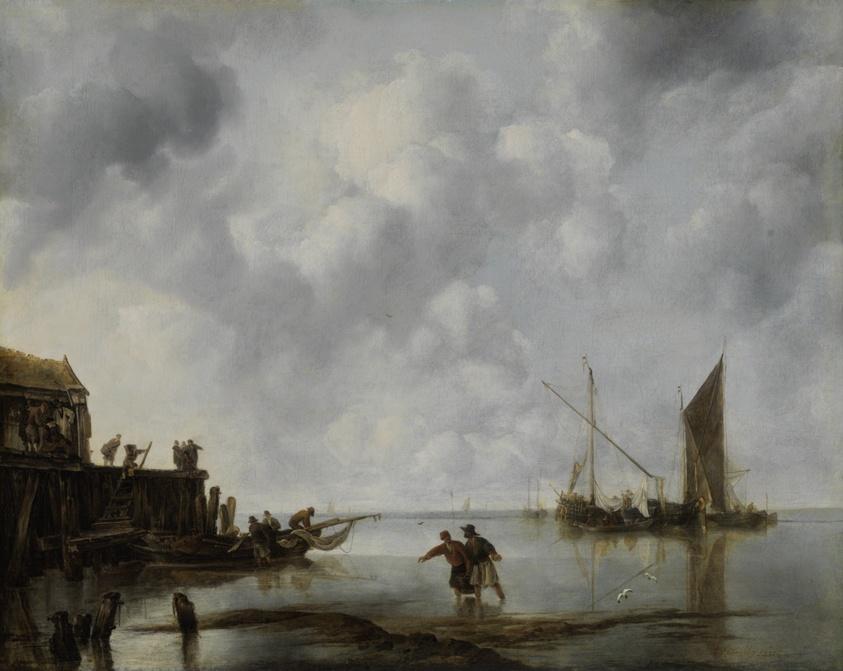
Fishing Boats in a Calm
Jan van de Cappelle
1463 likes33 comments
Paintale uses cookies for essential site functionality and, where enabled, to serve relevant advertising via Google AdSense. You can accept all cookies or reject non-essential ones. See our Privacy Policy for details.
Now viewing
Trompe-l'Oeil Still Life with a Flower Garland and a Curtain
Adriaen van der SpeltFrans van Mieris
Period
1650-1700
Theme
Daily Life
Medium
Oil on panel
Current Location
Art Institute of Chicago, Chicago
The Story
Adrien van der Spelt’s splendid garland displays about 20 floral varieties—including a tulip, a 16th-century import from Persia that would eventually become an icon of Dutch culture. The deceptively realistic blue curtain, painted by Frans van Mieris, refers to the historical strategy for protecting paintings but also to the tale of Parhassius, a skilled Greek artist who fooled his rival into attempting to pull back a curtain painted onto one of his pictures.
Examples of collaborative works by Dutch artists from this period are rare, perhaps due to the intense competition created by the region’s thriving art market.
As Oil on panel (46.5 × 63.9 cm (18 1/4 × 25 1/8 in.); Framed: 69.2 × 86.7 × 8.3 cm (27 1/4 × 34 1/8 × 3 1/4 in.)), the work shows the tool marks and layering choices typical of Adriaen van der SpeltFrans van Mieris's output in this period — decisions about ground, underpainting, and glaze that a photograph can only partly convey.
Look closely and the painting opens up. Objects you might pass over — a folded letter, a half-drawn curtain, the angle of a glance — were placed to be read. The apparent casualness is staged — objects and gestures are arranged to read as a moment caught rather than composed.
Art Institute of Chicago in Chicago now holds the work, where conservators and historians continue to revisit its condition and attribution. Each generation of scholarship adds a layer to how Adriaen van der SpeltFrans van Mieris's output from this period is understood.
“A silence so complete it becomes its own witness.”
Adrien van der Spelt’s splendid garland displays about 20 floral varieties—including a tulip, a 16th-century import from Persia that would eventually become an icon of Dutch culture. The deceptively realistic blue curtain, painted by Frans van Mieris, refers to the historical strategy for protecting paintings but also to the tale of Parhassius, a skilled Greek artist who fooled his rival into attempting to pull back a curtain painted onto one of his pictures. Examples of collaborative works by Dutch artists from this period are rare, perhaps due to the intense competition created by the region’s thriving art market.
Wirt D. Walker Fund
Technique: panel painting, oil painting, painting, painting (image making), painting techniques.
Inscriptions: Inscribed lower left: van der Spelt.1658.
Henric Bugge van Ring (died 1669), Leyden, by 1667 [his inventory of that year, “een stuk met bloemen van der Spelt en een gordijntgen daer bij staende van Mieris” (A piece with flowers by van der Spelt and a little curtain with it by Mieris)]. John Webb, London; sold, Phillips, London, July 8–9, 1828, lot 70 as van der Spelt. George Granville Leveson-Gower, 1st Duke of Sutherland (d. 1833), Stafford House, London [described by Passavant 1833]; by descent to George Granville Leveson-Gower, 2nd Duke of Sutherland, Stafford House, London (d. 1861) to at least 1854 [described by Waagen 1837 and 1854]. Vitale Bloch, Paris, by 1949; sold to Art Institute of Chicago, 1949.
Art Institute of Chicago, Chicago. View on the museum’s official page.
See more works at Art Institute of Chicago or browse the full Adriaen van der SpeltFrans van Mieris collection.
A restrained palette and sculptural lighting create a solemn geometry. The wooden crate and letter anchor the narrative with journalistic precision.
Sources
Keep Exploring
More paintings like this
Jan van de Cappelle
Jacob Ochtervelt
Claude Lorrain
Attributed to Pieter Boel
Pieter Mulier, II

Leonardo da Vinci

Leonardo da Vinci

Leonardo da Vinci