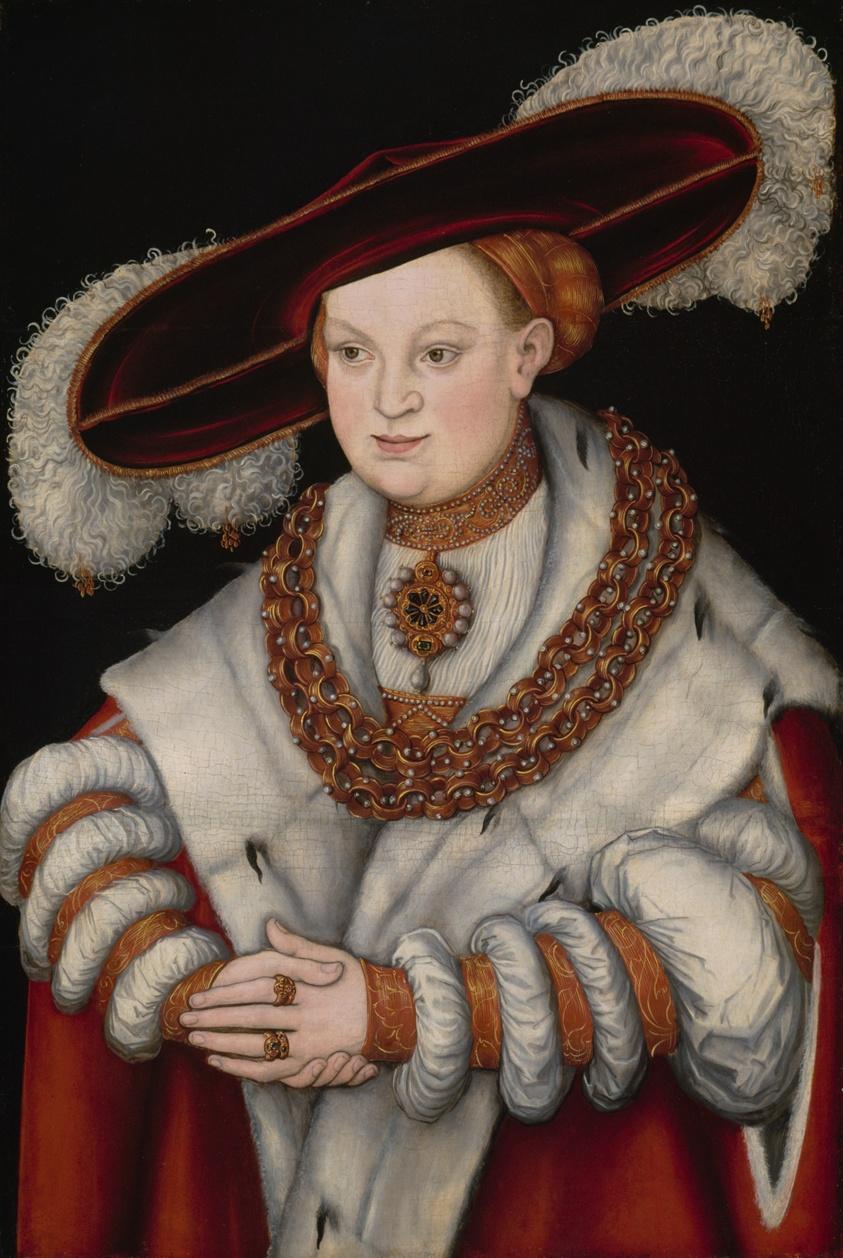
Portrait of Magdalena of Saxony, Wife of Elector Joachim II of Brandenburg
Lucas Cranach the Elder
1122 likes72 comments
Paintale uses cookies for essential site functionality and, where enabled, to serve relevant advertising via Google AdSense. You can accept all cookies or reject non-essential ones. See our Privacy Policy for details.
Now viewing
Judith
Jan Sanders van Hemessen
Period
1500-1550
Theme
Portrait
Medium
Oil on panel
Current Location
Art Institute of Chicago, Chicago
The Story
Jan Sanders van Hemessen portrayed the Jewish heroine Judith as a muscular nude to be both admired and feared. When the Assyrian army threatened Judith’s people, the handsome widow saved them from slaughter by infiltrating the tent of the enemy general, Holofernes, to win his confidence and then behead him. Van Hemessen’s life-size interpretation reflects contemporary male ambivalence toward female agency.
It celebrates Judith’s physical and moral strength but also foregrounds the sexuality that enabled her triumph, reproducing for viewers the aggressive beauty that caused her adversary’s demise. Judith was one of several religious and mythological figures featured in works hailing the power of women, a recurrent theme in northern Europe during the late Middle Ages and Renaissance.
Working in Oil on panel at 99.1 × 77.2 cm (39 × 30 3/8 in.); Framed: 119.7 × 97.8 × 6.4 cm (47 1/8 × 38 1/2 × 2 1/2 in.), Jan Sanders van Hemessen constructs depth through value contrast rather than outline, letting figures emerge from darkness the way they would under candlelight or through a shuttered window.
Look closely and the painting opens up. Objects you might pass over — a folded letter, a half-drawn curtain, the angle of a glance — were placed to be read. Likeness was only part of the job; the painting also had to argue for the sitter's place in the world.
Housed at Art Institute of Chicago in Chicago, the painting has passed through the hands of collectors, dealers, and institutions before reaching public view — a provenance that is itself part of the object's story.
“A silence so complete it becomes its own witness.”
Jan Sanders van Hemessen portrayed the Jewish heroine Judith as a muscular nude to be both admired and feared. When the Assyrian army threatened Judith’s people, the handsome widow saved them from slaughter by infiltrating the tent of the enemy general, Holofernes, to win his confidence and then behead him. Van Hemessen’s life-size interpretation reflects contemporary male ambivalence toward female agency. It celebrates Judith’s physical and moral strength but also foregrounds the sexuality that enabled her triumph, reproducing for viewers the aggressive beauty that caused her adversary’s demise. Judith was one of several religious and mythological figures featured in works hailing the power of women, a recurrent theme in northern Europe during the late Middle Ages and Renaissance. Van Hemessen was one of the chief proponents of a style, popular in the Netherlands in the first half of the sixteenth century, that was deeply indebted to the monumental character of classical sculpture, as well as to the art of Michelangelo and Raphael. Judith’s muscular body and her elaborate, twisting pose reflect these influences. Van Hemessen combined an idealized form with precisely rendered textures, as in Holofernes’s hair and beard and Judith’s gauzy headdress and brocaded bag. The figure’s straining pose, the dramatic lighting, and the highly detailed surfaces all serve to heighten the tension of this composition.
Wirt D. Walker Fund
Technique: oil painting, painting, painting techniques, panel painting, painting (image making).
Marie Catherine d’Onyn de Chastre (née Baronne de Herckenrode) (1731–1824); sold, Douarière d’Onyn de Chastre (née Baronne de Herckenrode), Leuven, Belgium, June 10, 1825, lot 129, to Désiré van den Schrieck (1785–1857), Leuven, Belgium. With Robert Lebel, Paris, by 1956; sold to the Art Institute of Chicago, 1956.
Art Institute of Chicago, Chicago. View on the museum’s official page.
See more works at Art Institute of Chicago or browse the full Jan Sanders van Hemessen collection.
A restrained palette and sculptural lighting create a solemn geometry. The wooden crate and letter anchor the narrative with journalistic precision.
Sources
Keep Exploring
More paintings like this
Lucas Cranach the Elder
Follower of Titian
Ridolfo Ghirlandaio
Attributed to Hans Holbein the Younger
Attributed to Hans Maler

Master of the Lille Adoration
Anonymous
Albrecht Dürer