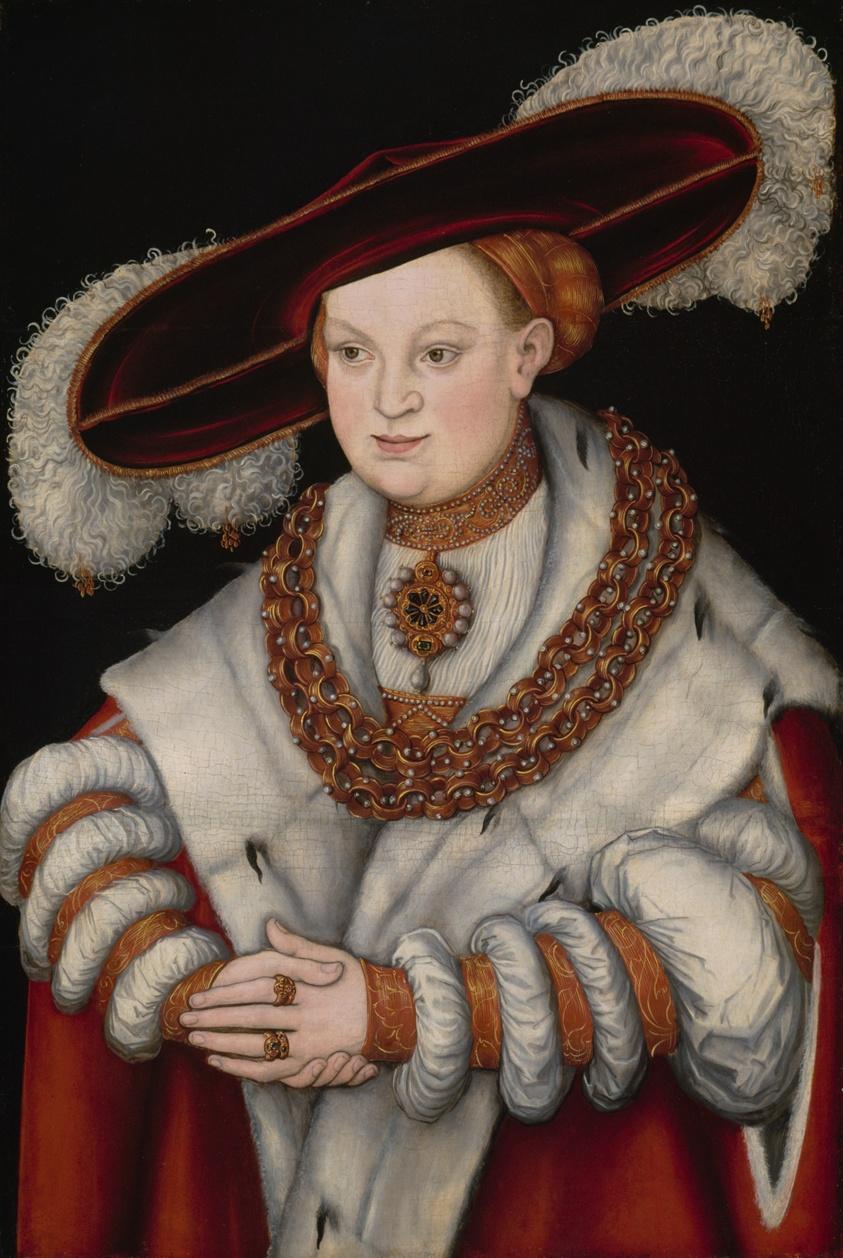
Portrait of Magdalena of Saxony, Wife of Elector Joachim II of Brandenburg
Lucas Cranach the Elder
1122 likes72 comments
Paintale uses cookies for essential site functionality and, where enabled, to serve relevant advertising via Google AdSense. You can accept all cookies or reject non-essential ones. See our Privacy Policy for details.
Now viewing
Portrait of a Gentleman
Ridolfo Ghirlandaio
Period
1500-1550
Theme
Portrait
Medium
Oil, with tempera (?), on panel, transferred to canvas
Current Location
Art Institute of Chicago, Chicago
The Story
The unknown sitter in this arresting portrait wears a furlined robe and capuccio, a hood rolled up and worn as a hat—both conventional apparel for well-to-do Florentine merchants. Ridolfo Ghirlandaio’s pyramidal presentation of the sitter and use of active, searching light reveal his study of portraits by Leonardo da Vinci and Raphael. The son of renowned Florentine painter Domenico Ghirlandaio, Ridolfo successfully continued the family workshop well into the 16th century.
Created in 1500 during the 1500-1550 period, this work belongs firmly within the portrait tradition. Ridolfo Ghirlandaio worked at a moment when the rediscovery of classical antiquity reshaped what a painting could mean. Every gesture, fabric, and gleam of light was decoded by contemporary viewers like a private language.
As Oil, with tempera (?), on panel, transferred to canvas (68.2 × 49.2 cm (26 11/16 × 19 3/8 in.); Framed: 94.7 × 77.5 × 8.3 cm (37 1/4 × 30 1/2 × 3 1/4 in.)), the work shows the tool marks and layering choices typical of Ridolfo Ghirlandaio's output in this period — decisions about ground, underpainting, and glaze that a photograph can only partly convey.
Look closely and the painting opens up. Objects you might pass over — a folded letter, a half-drawn curtain, the angle of a glance — were placed to be read. Every prop in a portrait like this is a decision — jewelry, fabric, and hand position were negotiated between painter and patron to shape how the sitter would be remembered.
Housed at Art Institute of Chicago in Chicago, the painting has passed through the hands of collectors, dealers, and institutions before reaching public view — a provenance that is itself part of the object's story.
“A silence so complete it becomes its own witness.”
The unknown sitter in this arresting portrait wears a furlined robe and capuccio, a hood rolled up and worn as a hat—both conventional apparel for well-to-do Florentine merchants. Ridolfo Ghirlandaio’s pyramidal presentation of the sitter and use of active, searching light reveal his study of portraits by Leonardo da Vinci and Raphael. The son of renowned Florentine painter Domenico Ghirlandaio, Ridolfo successfully continued the family workshop well into the 16th century.
Mr. and Mrs. Martin A. Ryerson Collection
Technique: oil painting, painting, painting (image making), painting techniques, panel painting.
Possibly Prince Brancaccio, Rome [according to a letter from Wilhelm von Bode to Scott and Fowles dated January 2, 1912; however the bill of sale from Scott and Fowles to Martin A. Ryerson dated April 13, 1912 states that the picture was “bought from the collection of Prince Piombino, Rome, about twenty years since,” copies in curatorial file]. William Beattie, Glasgow, by 1901 [see Armstrong 1901, p. 46]. Arthur T. Sulley, London, by 1910 [see letter from Bernard Berenson to Arthur T. Sulley dated October 23, 1910, in the Archives, The Art Institute of Chicago]. Scott and Fowles, New York, by 1912; sold by Scott and Fowles to Martin A. Ryerson (died 1932), Chicago, 1912; on loan to the Art Institute from 1912; bequeathed to the Art Institute, 1933.
Art Institute of Chicago, Chicago. View on the museum’s official page.
See more works at Art Institute of Chicago or browse the full Ridolfo Ghirlandaio collection.
A restrained palette and sculptural lighting create a solemn geometry. The wooden crate and letter anchor the narrative with journalistic precision.
Sources
Keep Exploring
More paintings like this
Lucas Cranach the Elder
Follower of Titian
Attributed to Hans Holbein the Younger
Jan Sanders van Hemessen
Attributed to Hans Maler

Master of the Lille Adoration
Anonymous
Albrecht Dürer