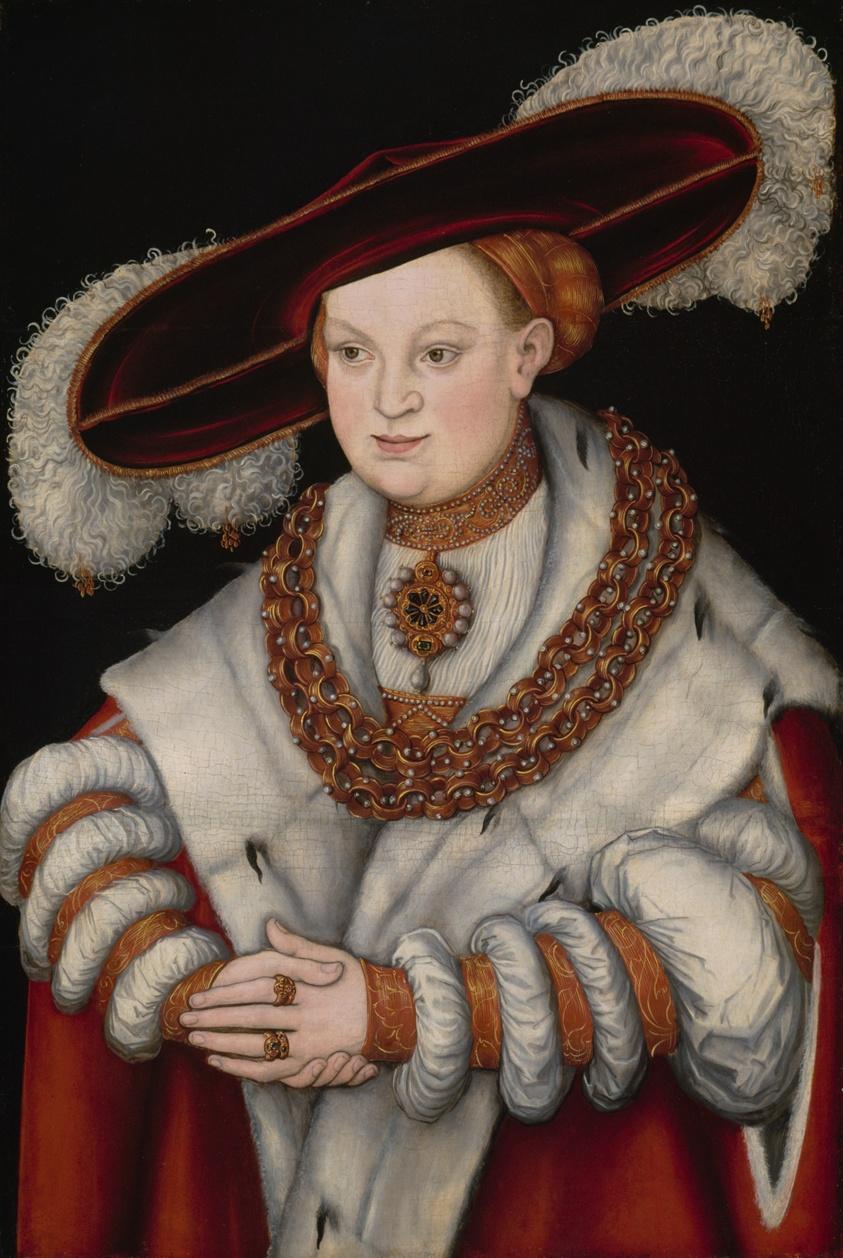
Portrait of Magdalena of Saxony, Wife of Elector Joachim II of Brandenburg
Lucas Cranach the Elder
1122 likes72 comments
Paintale uses cookies for essential site functionality and, where enabled, to serve relevant advertising via Google AdSense. You can accept all cookies or reject non-essential ones. See our Privacy Policy for details.
Now viewing
Portrait of a Lady
Follower of Titian
Period
1500-1550
Theme
Portrait
Medium
Oil on canvas
Current Location
Art Institute of Chicago, Chicago
The Story
Portrait of a Lady, formerly known as Portrait of Giulia Gonzaga, is an oil painting by, or possibly after Titian. It is dated, broadly, to the period 1525–1565. The painting is in the collection of the Art Institute of Chicago.
Created in 1540 during the 1500-1550 period, this work belongs firmly within the portrait tradition. Follower of Titian worked at a moment when the rediscovery of classical antiquity reshaped what a painting could mean. Every gesture, fabric, and gleam of light was decoded by contemporary viewers like a private language.
Working in Oil on canvas at 63.5 × 51.8 cm (25 × 20 5/16 in.); Framed: 85.1 × 76.2 × 6.4 cm (33 1/2 × 30 × 2 1/2 in.), Follower of Titian constructs depth through value contrast rather than outline, letting figures emerge from darkness the way they would under candlelight or through a shuttered window.
Look closely and the painting opens up. Objects you might pass over — a folded letter, a half-drawn curtain, the angle of a glance — were placed to be read. Likeness was only part of the job; the painting also had to argue for the sitter's place in the world.
Housed at Art Institute of Chicago in Chicago, the painting has passed through the hands of collectors, dealers, and institutions before reaching public view — a provenance that is itself part of the object's story.
“A silence so complete it becomes its own witness.”
woman.
Max and Leola Epstein Collection
Materials: oil paint, canvas.
Technique: oil painting, painting techniques, painting (image making), painting.
Private Collection, Italy [based on customs stamps from Florence on the reverse of the painting]. Sold by Böhler and Steinmeyer, New York, to Max Epstein (d. 1954), Chicago, between 1928 and 1930 [see Art News 1930; the painting is not included in the 1929 catalogue of the Epstein collection]; bequeathed to the Art Institute, 1954.
Art Institute of Chicago, Chicago. View on the museum’s official page.
See more works at Art Institute of Chicago or browse the full Follower of Titian collection.
A restrained palette and sculptural lighting create a solemn geometry. The wooden crate and letter anchor the narrative with journalistic precision.
Sources
Keep Exploring
More paintings like this
Lucas Cranach the Elder
Ridolfo Ghirlandaio
Attributed to Hans Holbein the Younger
Jan Sanders van Hemessen
Attributed to Hans Maler

Master of the Lille Adoration
Anonymous
Albrecht Dürer