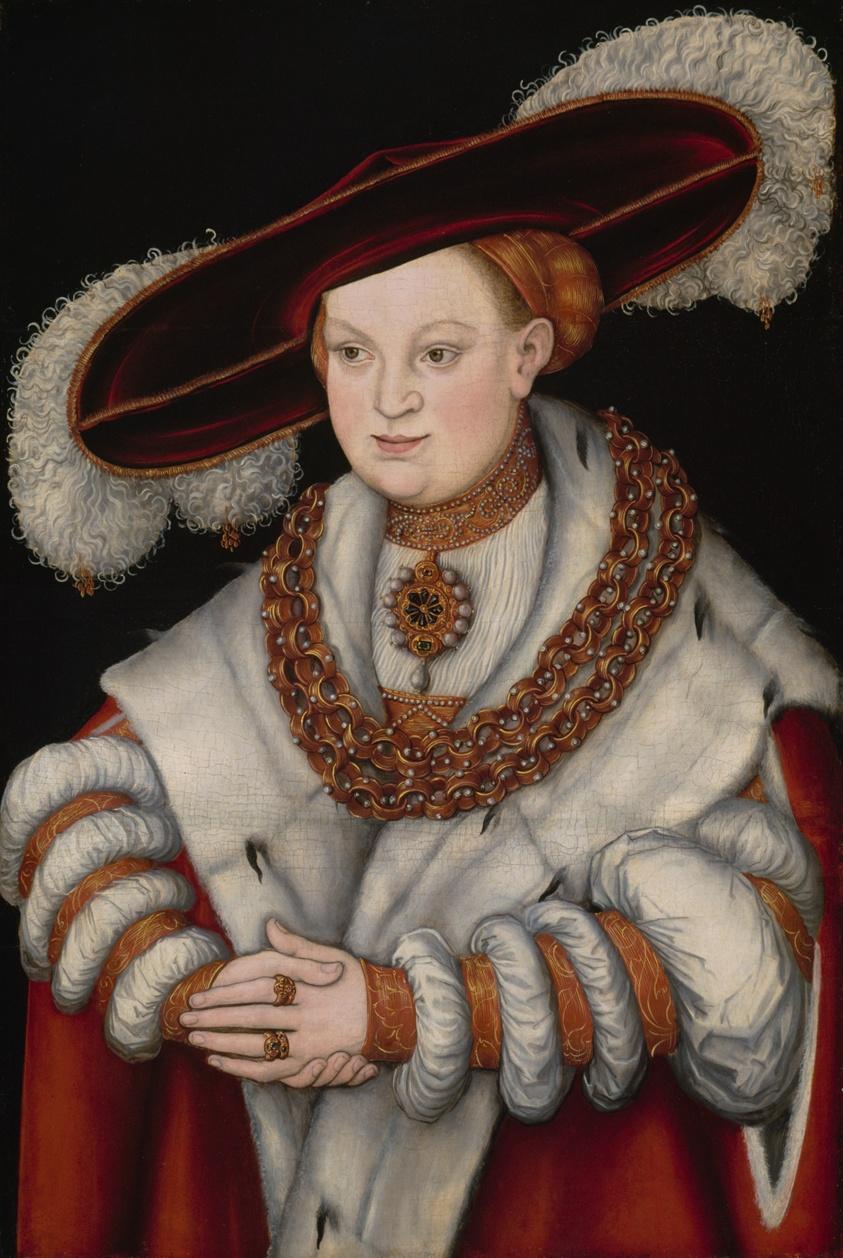
Portrait of Magdalena of Saxony, Wife of Elector Joachim II of Brandenburg
Lucas Cranach the Elder
1122 likes72 comments
Paintale uses cookies for essential site functionality and, where enabled, to serve relevant advertising via Google AdSense. You can accept all cookies or reject non-essential ones. See our Privacy Policy for details.
Now viewing
Christ Carrying the Cross
Attributed to Hans Maler
Period
1500-1550
Theme
Portrait
Medium
Oil on panel
Current Location
Art Institute of Chicago, Chicago
The Story
This narrow panel was probably part of a predella, the supporting lower portion of an altarpiece, which no doubt featured other scenes from the Passion of Christ. It is most likely an early work by Hans Maler, who worked in Ulm in southwestern Germany before settling in the Tyrol. He is now known chiefly for portraits painted in the later part of his career for members of the imperial family and other prominent sitters.
His earlier religious paintings are a variant on the expressive, patterned style and vivid characterization of an accomplished group of painters working in Ulm and nearby Memmingen, notably Bartholomäus Zeitblom and Bernhard Strigel.
The physical object — Oil on panel, 33.8 × 57.5 cm (13 5/16 × 22 5/8 in.); Framed: 44.5 × 66.4 × 6.4 cm (17 1/2 × 26 1/8 × 2 1/2 in.) — carries its own history of handling and restoration. Attributed to Hans Maler's brushwork here moves between exacting description and looser, more suggestive passages, a balance typical of Renaissance studio practice.
Look closely and the painting opens up. Objects you might pass over — a folded letter, a half-drawn curtain, the angle of a glance — were placed to be read. Likeness was only part of the job; the painting also had to argue for the sitter's place in the world.
Art Institute of Chicago in Chicago now holds the work, where conservators and historians continue to revisit its condition and attribution. Each generation of scholarship adds a layer to how Attributed to Hans Maler's output from this period is understood.
“A silence so complete it becomes its own witness.”
This narrow panel was probably part of a predella, the supporting lower portion of an altarpiece, which no doubt featured other scenes from the Passion of Christ. It is most likely an early work by Hans Maler, who worked in Ulm in southwestern Germany before settling in the Tyrol. He is now known chiefly for portraits painted in the later part of his career for members of the imperial family and other prominent sitters. His earlier religious paintings are a variant on the expressive, patterned style and vivid characterization of an accomplished group of painters working in Ulm and nearby Memmingen, notably Bartholomäus Zeitblom and Bernhard Strigel.
Charles H. and Mary F. S. Worcester Collection
Technique: oil painting, painting, painting (image making), painting techniques, panel painting.
Private collection, France [according to Baldass 1926/27]; Galerie St. Lucas, Vienna, 1926 [Baldass 1926/27]. A. S. Drey, Munich, by 1928; sold to Charles Worcester, Chicago, 1928 [letter from Drey to Worcester, Nov. 26, 1928, Art Institute Archives]; on loan to the Art Institute from 1930; given to the Art Institute, 1947.
Art Institute of Chicago, Chicago. View on the museum’s official page.
See more works at Art Institute of Chicago or browse the full Attributed to Hans Maler collection.
A restrained palette and sculptural lighting create a solemn geometry. The wooden crate and letter anchor the narrative with journalistic precision.
Sources
Keep Exploring
More paintings like this
Lucas Cranach the Elder
Follower of Titian
Ridolfo Ghirlandaio
Attributed to Hans Holbein the Younger
Jan Sanders van Hemessen

Master of the Lille Adoration
Anonymous
Albrecht Dürer