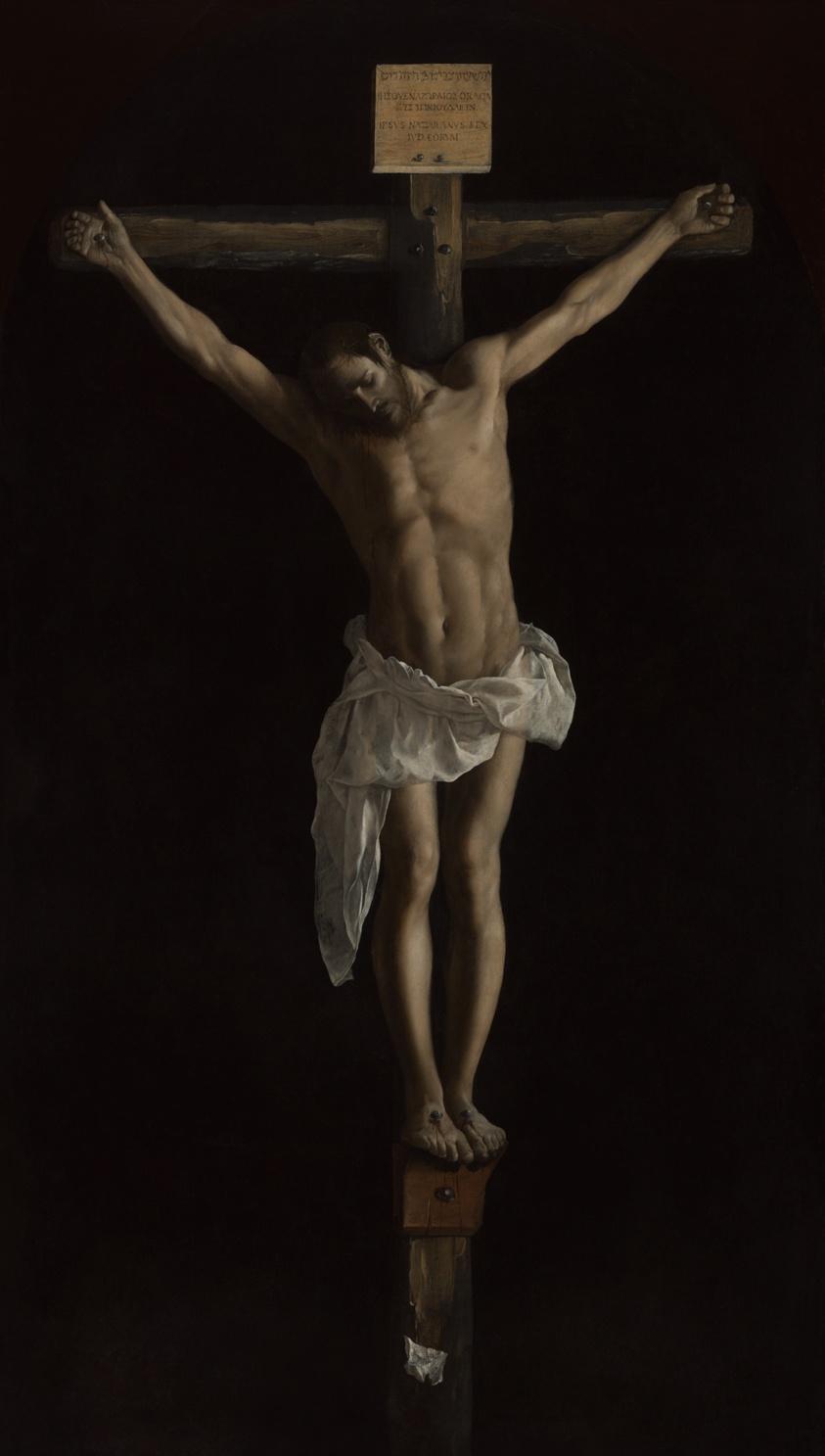
The Crucifixion
Francisco de Zurbarán
1520 likes90 comments
Paintale uses cookies for essential site functionality and, where enabled, to serve relevant advertising via Google AdSense. You can accept all cookies or reject non-essential ones. See our Privacy Policy for details.
Now viewing
Saint Romanus of Antioch and Saint Barulas
Francisco de Zurbarán
Period
1600-1650
Theme
Tragedy & Death
Medium
Oil on canvas
Current Location
Art Institute of Chicago, Chicago
The Story
Francisco de Zurbarán excelled at painting altarpieces that presented saints in an accessible manner. Catholic reformers, who aimed to revitalize Catholicism in the face of the Protestant Reformation, emphasized that religious painting should feature easily recognizable figures and narratives in order to reach contemporary audiences. This canvas, made for the high altar of the church of San Román in Seville, Spain, aligns with the church’s dedication to Saint Romanus of Antioch.
Romanus towers over Saint Barulas, a seven-year-old child who was inspired to martyrdom by the elder saint’s words. Romanus holds up his own tongue, torn out by his tormentors, and grasps a massive book inscribed with a prayer invoking his intercession on behalf of the faithful.
As Oil on canvas (246.5 × 185.4 cm (97 1/16 × 73 in.)), the work shows the tool marks and layering choices typical of Francisco de Zurbarán's output in this period — decisions about ground, underpainting, and glaze that a photograph can only partly convey.
Look closely and the painting opens up. Objects you might pass over — a folded letter, a half-drawn curtain, the angle of a glance — were placed to be read. The composition slows the eye down at exactly the moment it would rather look away, which is the point.
Today the painting is held by Art Institute of Chicago in Chicago, where it remains a touchstone for understanding Francisco de Zurbarán's contribution to Western art. It has been studied, copied, restored, and argued over for centuries — proof that great paintings keep generating new readings long after their creators have gone.
“A silence so complete it becomes its own witness.”
Francisco de Zurbarán excelled at painting altarpieces that presented saints in an accessible manner. Catholic reformers, who aimed to revitalize Catholicism in the face of the Protestant Reformation, emphasized that religious painting should feature easily recognizable figures and narratives in order to reach contemporary audiences. This canvas, made for the high altar of the church of San Román in Seville, Spain, aligns with the church’s dedication to Saint Romanus of Antioch. Romanus towers over Saint Barulas, a seven-year-old child who was inspired to martyrdom by the elder saint’s words. Romanus holds up his own tongue, torn out by his tormentors, and grasps a massive book inscribed with a prayer invoking his intercession on behalf of the faithful.
Gift of Mrs. Chauncey McCormick and Mrs. Richard E. Danielson
Technique: painting, oil painting, painting (image making), painting techniques.
Inscriptions: Inscribed lower right: 1638.
Church of San Roman, Seville, until at least 1800 [Cean Bermudez 1800]; removed by government decree and deposited in the Alcazar, Seville, 1810 [lmaz 1896, no. 11]; taken by Marshal Jean-de-Dieu Soult (1769-1851), 1st Duke of Dalmatia, Paris, by 1812 [see the Getty Provenance Index database, F-23, which lists the painting in Sault's estate inventory of February 5, 1852, as no. 150; date of acquisition according to Delenda 2009]; sale of his estate, Galerie Lebrun, Paris, May 19-22, 1852, lot no. 28, presumably bought in [according to an annotated copy of the sale catalogue, Rijksbureau voor Kunsthistorische Documentatie, The Hague; copies in curatorial file, and Baticle 1999]; by descent to his son, Napoleon-Hector Soult (1802-1857), 2nd Duke of Dalmatia, Paris [according to a postmortem inventory of his collection, dated January 18, 1858; Getty Provenance Index database, F-197, no. 9]; by descent; sold, collection of Marshal Soult, Hotel Drouot, Paris, April 17, 1867, lot no. 6, for 5,330 francs [according to an annotated copy of the sale catalogue, Rijksbureau voor Kunsthistorische Documentatie, The Hague; copy in curatorial file]. Sergei Ivanovich Stchoukine, Paris and Moscow, until 1910 [this and the following according to London 1913; date according to Delenda 2009]. Joachim Caravallo, Château de Villandry, France, from 1910 to 1914. Grafton Galleries, London, from 1914 to 1918 [Kehrer 1918; date according to Delenda 2009]. Charles Deering (1852-1927), Chicago and Miami, by 1918 [Arroyo 1918]; by descent to his daughters, Mrs. Chauncey McCormick (née Marion Deering) and Mrs. Richard Ely Danielson (née Barbara Deering); given to the Art Institute of Chicago, 1947.
Art Institute of Chicago, Chicago. View on the museum’s official page.
See more works at Art Institute of Chicago or browse the full Francisco de Zurbarán collection.
A restrained palette and sculptural lighting create a solemn geometry. The wooden crate and letter anchor the narrative with journalistic precision.
Sources
Keep Exploring
More paintings like this
Francisco de Zurbarán
María Josefa Sánchez
Peter Paul Rubens
Jacques Louis David
Caravaggio
Guido Cagnacci

Sandro Botticelli

Sandro Botticelli