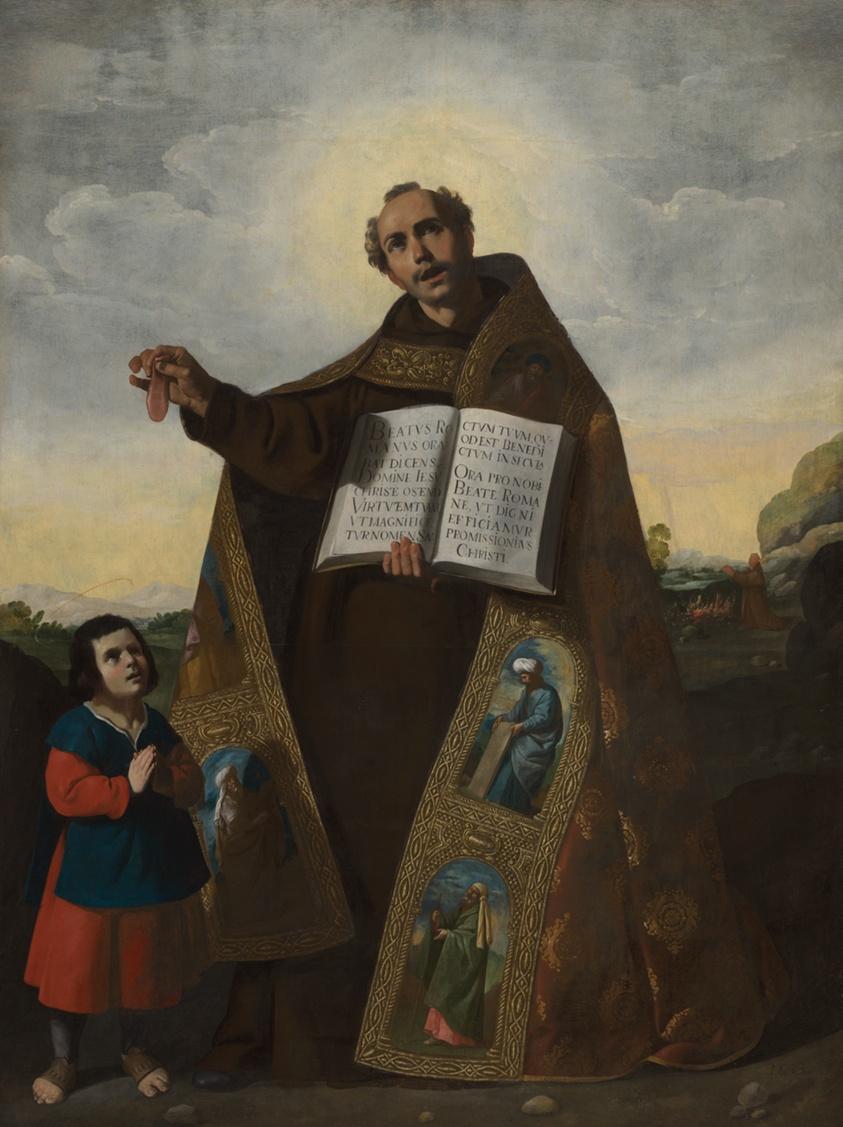
Saint Romanus of Antioch and Saint Barulas
Francisco de Zurbarán
1066 likes36 comments
Paintale uses cookies for essential site functionality and, where enabled, to serve relevant advertising via Google AdSense. You can accept all cookies or reject non-essential ones. See our Privacy Policy for details.
Now viewing
The Crucifixion
Francisco de Zurbarán
Period
1600-1650
Theme
Tragedy & Death
Medium
Oil on canvas
Current Location
Art Institute of Chicago, Chicago
The Story
In 1626 the Dominican monastery of San Pablo el Real in Seville, Spain, commissioned the young Francisco de Zurbarán to execute a cycle of paintings including The Crucifixion. This work was installed in a dimly lit space in the monastery and was visible to visitors through a grill. Early commentators remarked on its powerful illusion of three-dimensionality, as though it was a sculpture rather than a painting.
The dramatically illuminated figure of Christ, set against a dark, empty background, appears outside of time and place, both idealized in its quiet beauty and humanized by the individualized face and insistent realism.
As Oil on canvas (290.3 × 165.5 cm (114 5/16 × 65 3/16 in.); Framed: 339.1 × 212.1 × 14 cm (133 3/8 × 83 1/2 × 5 1/2 in.)), the work shows the tool marks and layering choices typical of Francisco de Zurbarán's output in this period — decisions about ground, underpainting, and glaze that a photograph can only partly convey.
Look closely and the painting opens up. Objects you might pass over — a folded letter, a half-drawn curtain, the angle of a glance — were placed to be read. Light hardens into edge, drapery becomes shroud, and the body is staged like an argument about mortality.
Art Institute of Chicago in Chicago now holds the work, where conservators and historians continue to revisit its condition and attribution. Each generation of scholarship adds a layer to how Francisco de Zurbarán's output from this period is understood.
“A silence so complete it becomes its own witness.”
In 1626 the Dominican monastery of San Pablo el Real in Seville, Spain, commissioned the young Francisco de Zurbarán to execute a cycle of paintings including The Crucifixion. This work was installed in a dimly lit space in the monastery and was visible to visitors through a grill. Early commentators remarked on its powerful illusion of three-dimensionality, as though it was a sculpture rather than a painting. The dramatically illuminated figure of Christ, set against a dark, empty background, appears outside of time and place, both idealized in its quiet beauty and humanized by the individualized face and insistent realism.
Robert A. Waller Memorial Fund
Technique: oil painting, painting, painting techniques, painting (image making).
Inscriptions: Signed and dated bottom center: Franco Dezur / Fa 1627 (on a scrap of paper at the foot of the cross).
Painted for the sacristy of the Dominican monastery San Pablo el Real, Seville; placed on deposit at Palacio Real, Seville, on the order of Joseph Bonaparte, King of Spain, 1810 [see M. Gómez Imaz, 1917, p. 141, no. 224]; acquired by General Jean Toussaint Arrighi de Casanova, Duc de Padoue (died 1853) shortly thereafter [as recounted by his son to Father Stanislas Du Lac, S.J.; see letter from Father Du Lac to Father Paul Troussard dated 16 February 1901 and preserved at the Bibliothèque Sèvres, Paris, copy in file]; by descent to his son, Ernest Louis Hyacinthe Arrighi de Casanova, 2nd Duc de Padoue, given by him to Father Stanislas Du Lac S.J. (died 1909), rector of the Collège Saint Geneviève, Paris, 1876 [see letter cited above; Father Du Lac explained that he received the painting in thanks for his spiritual assistance to the duke's wife]; probably taken by Father Du Lac to St. Mary's College, Canterbury for the period between 1880 and 1890 and likely remained at Canterbury when St. Mary's College was replaced by a Jesuit school for novitiates; it was apparently moved from Canterbury to Laval along with the Jesuit novices' school in 1897 and was in Laval in 1901 [see letters from Jacqueline Diot and Father Du Lac in curatorial file]; transferred from Laval to the Jesuit seminary of Saint Louis at Jersey [see note with Du Lac letter]; transferred with the seminary to Chantilly in 1951 [see undated typewritten notes in curatorial file]. Dr. H. F. Fankhauser, Basel, 1952 [See Baticle in New York, 1988]; sold to the Art Institute, 1954.
Art Institute of Chicago, Chicago. View on the museum’s official page.
See more works at Art Institute of Chicago or browse the full Francisco de Zurbarán collection.
A restrained palette and sculptural lighting create a solemn geometry. The wooden crate and letter anchor the narrative with journalistic precision.
Sources
Keep Exploring
More paintings like this
Francisco de Zurbarán
María Josefa Sánchez
Peter Paul Rubens
Jacques Louis David
Caravaggio
Guido Cagnacci

Sandro Botticelli

Sandro Botticelli