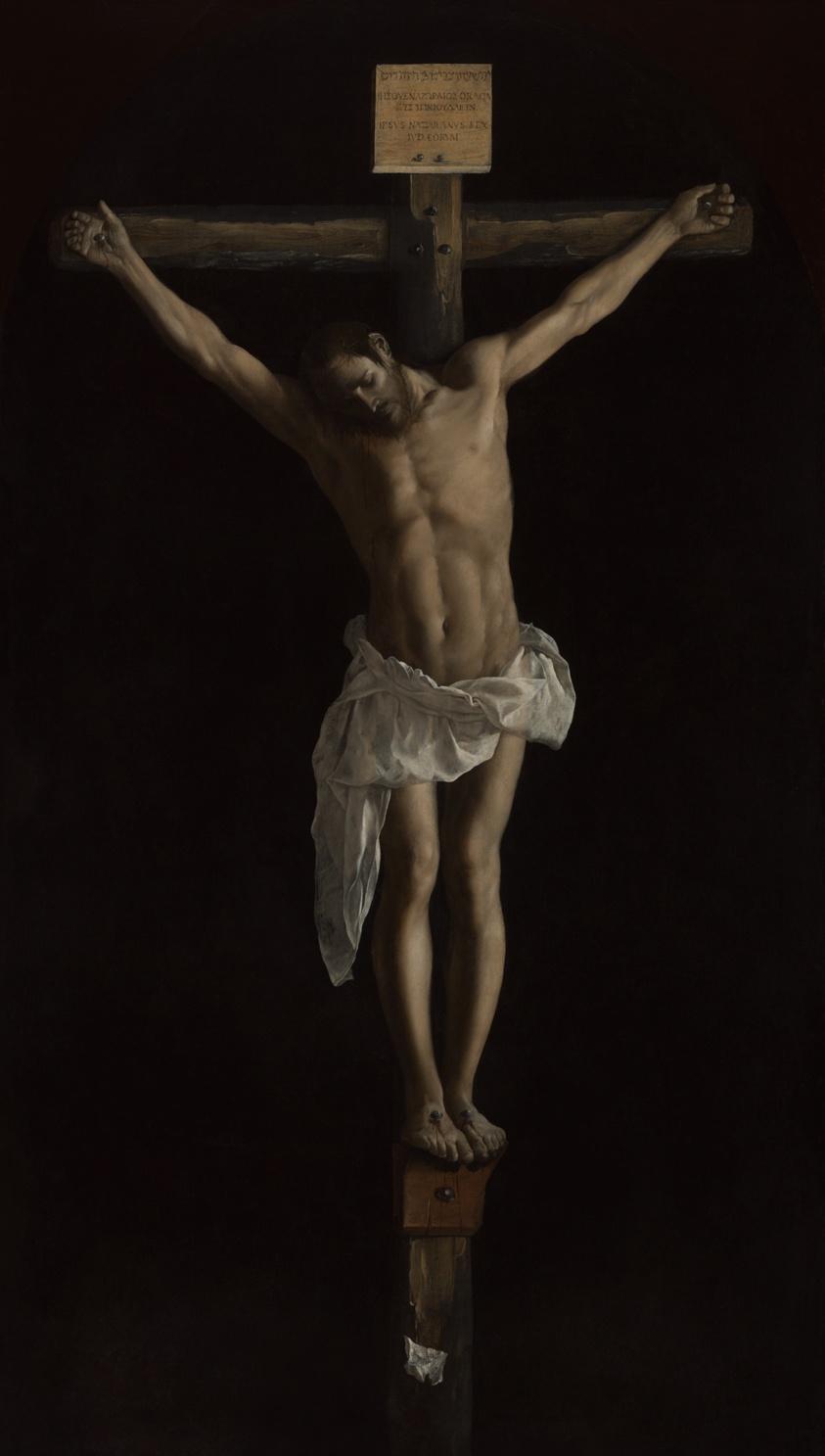
The Crucifixion
Francisco de Zurbarán
1520 likes90 comments
Paintale uses cookies for essential site functionality and, where enabled, to serve relevant advertising via Google AdSense. You can accept all cookies or reject non-essential ones. See our Privacy Policy for details.
Now viewing
Crucifixion
María Josefa Sánchez
Period
1600-1650
Theme
Tragedy & Death
Medium
Oil on panel
Current Location
Art Institute of Chicago, Chicago
The Story
This small, painted crucifix is exceptional not only for its artistry, but also because it is signed by a woman artist: María Josefa Sánchez. Sánchez worked roughly from 1639 to 1649, probably in Castile, Spain, but little else is known about her. Women rarely worked as professional artists in seventeenth-century Spain, where laws and customs discouraged them from entering professions. Laws also prohibited women from serving as apprentices or signing official documents.
The few women who became artists usually trained in their fathers’ workshops. Some women artists of the period, Sánchez included, might have been nuns who produced devotional works within monastic communities. Sánchez depicted Jesus alive on the cross, an iconographic type known as Christus triumphans. His graceful pose contrasts with his agonized expression, and carefully rendered drops of blood spill from his hands and feet.
Executed in Oil on panel, measuring 63 × 39 cm (24 13/16 × 15 3/8 in.), the surface rewards close looking. María Josefa Sánchez builds the composition through layered glazes and a tightly controlled palette, letting cool shadows recede so that the warm, lit passages step forward.
Look closely and the painting opens up. Objects you might pass over — a folded letter, a half-drawn curtain, the angle of a glance — were placed to be read. The composition slows the eye down at exactly the moment it would rather look away, which is the point.
Housed at Art Institute of Chicago in Chicago, the painting has passed through the hands of collectors, dealers, and institutions before reaching public view — a provenance that is itself part of the object's story.
“A silence so complete it becomes its own witness.”
This small, painted crucifix is exceptional not only for its artistry, but also because it is signed by a woman artist: María Josefa Sánchez. Sánchez worked roughly from 1639 to 1649, probably in Castile, Spain, but little else is known about her. Women rarely worked as professional artists in seventeenth-century Spain, where laws and customs discouraged them from entering professions. Laws also prohibited women from serving as apprentices or signing official documents. The few women who became artists usually trained in their fathers’ workshops. Some women artists of the period, Sánchez included, might have been nuns who produced devotional works within monastic communities. Sánchez depicted Jesus alive on the cross, an iconographic type known as Christus triumphans. His graceful pose contrasts with his agonized expression, and carefully rendered drops of blood spill from his hands and feet. The orbs near his hands represent the sun and moon, a reference to an eclipse at the moment of Christ’s death by crucifixion. At the foot of the cross, Jesus’s mother, Mary, portrayed as a young girl wearing white and blue robes, is crowned with stars and standing atop a crescent moon. These attributes identify her as the Virgin of the Immaculate Conception, an atypical subject for a Crucifixion image.
C. Harker and Mae Svoboda Rhodes Acquisition Fund
Technique: oil painting, panel painting, painting techniques, painting (image making), painting.
Inscriptions: Signed and dated, bottom: D. Josepha Sanchez / faciebat 1646.
Private collection, United Kingdom by the 1960s [email from Jaime Eguiguren of Arte y Antigüedades to Rebecca Long, January 15, 2018]; acquired by Jaime Eguiguren Arte y Antigüedades, Buenos Aires, Argentina in 2017.
Art Institute of Chicago, Chicago. View on the museum’s official page.
See more works at Art Institute of Chicago or browse the full María Josefa Sánchez collection.
A restrained palette and sculptural lighting create a solemn geometry. The wooden crate and letter anchor the narrative with journalistic precision.
Sources
Keep Exploring
More paintings like this
Francisco de Zurbarán
Peter Paul Rubens
Francisco de Zurbarán
Jacques Louis David
Caravaggio
Guido Cagnacci

Sandro Botticelli

Sandro Botticelli