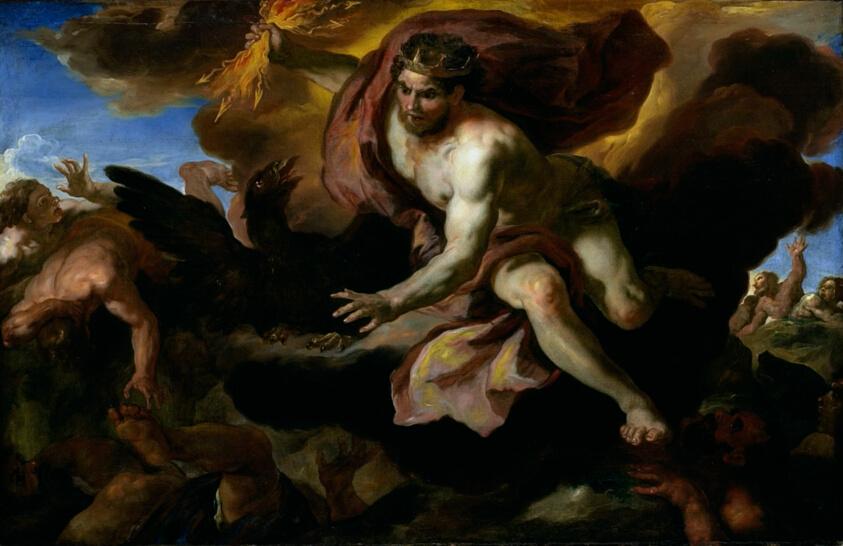
Jove Casts His Thunderbolts at the Rebellious Giants
Johann Michael Rottmayr
498 likes28 comments
Paintale uses cookies for essential site functionality and, where enabled, to serve relevant advertising via Google AdSense. You can accept all cookies or reject non-essential ones. See our Privacy Policy for details.
Now viewing
Diana and Endymion
Johann Michael Rottmayr
Period
1650-1700
Theme
Portrait
Medium
Oil on canvas
Current Location
Art Institute of Chicago, Chicago
The Story
Johann Michael Rottmayr's scenes from Greek and Roman mythology in the collection of the Art Institute may have belonged to a series of seven paintings, each representing a celestial body. Here, the lunar goddess Diana, wearing a crescent moon headpiece, delicately embraces her beloved shepherd Endymion. Her rich blue cloak flies out behind her as if caught in a cosmic wind and her shining eyes fix on the cherub behind him who reminds her to keep quiet. In fact, there is no need to worry, as she has placed Endymion in an eternal sleep so that she can gaze lovingly upon him each night.
Created in 1690 during the 1650-1700 period, this work belongs firmly within the portrait tradition. Johann Michael Rottmayr worked at a moment when the rivalry between Catholic Baroque drama and Protestant restraint reshaped what a painting could mean. Every gesture, fabric, and gleam of light was decoded by contemporary viewers like a private language.
The physical object — Oil on canvas, 81.3 × 125.2 cm (32 × 49 1/2 in.) — carries its own history of handling and restoration. Johann Michael Rottmayr's brushwork here moves between exacting description and looser, more suggestive passages, a balance typical of Baroque studio practice.
Look closely and the painting opens up. Objects you might pass over — a folded letter, a half-drawn curtain, the angle of a glance — were placed to be read. The sitter is constructed: clothes, pose, and attributes were chosen to project status, virtue, and lineage.
Today the painting is held by Art Institute of Chicago in Chicago, where it remains a touchstone for understanding Johann Michael Rottmayr's contribution to Western art. It has been studied, copied, restored, and argued over for centuries — proof that great paintings keep generating new readings long after their creators have gone.
“A silence so complete it becomes its own witness.”
Johann Michael Rottmayr's scenes from Greek and Roman mythology in the collection of the Art Institute may have belonged to a series of seven paintings, each representing a celestial body. Here, the lunar goddess Diana, wearing a crescent moon headpiece, delicately embraces her beloved shepherd Endymion. Her rich blue cloak flies out behind her as if caught in a cosmic wind and her shining eyes fix on the cherub behind him who reminds her to keep quiet. In fact, there is no need to worry, as she has placed Endymion in an eternal sleep so that she can gaze lovingly upon him each night.
Gift of Jacob S. Sherman
Technique: oil painting, painting techniques, painting (image making), painting.
Unknown Illinois banker; given by banker to Jacob S. Sherman, Chicago, during the 1930s as collateral for a loan that was never repaid [according to Robert Parker Sherman, son of Jacob S. Sherman, telephone conversation with Martha Wolff, 23 July 2003, transcribed in curatorial file]; given by Jacob S. Sherman (died 1961) to the Art Institute, 1961.
Art Institute of Chicago, Chicago. View on the museum’s official page.
See more works at Art Institute of Chicago or browse the full Johann Michael Rottmayr collection.
A restrained palette and sculptural lighting create a solemn geometry. The wooden crate and letter anchor the narrative with journalistic precision.
Sources
Keep Exploring
More paintings like this
Johann Michael Rottmayr
Johann Michael Rottmayr
Johann Michael Rottmayr
Johann Michael Rottmayr
Gerard ter Borch the Younger
Guercino
Gerard van Soest
Felice Ficherelli