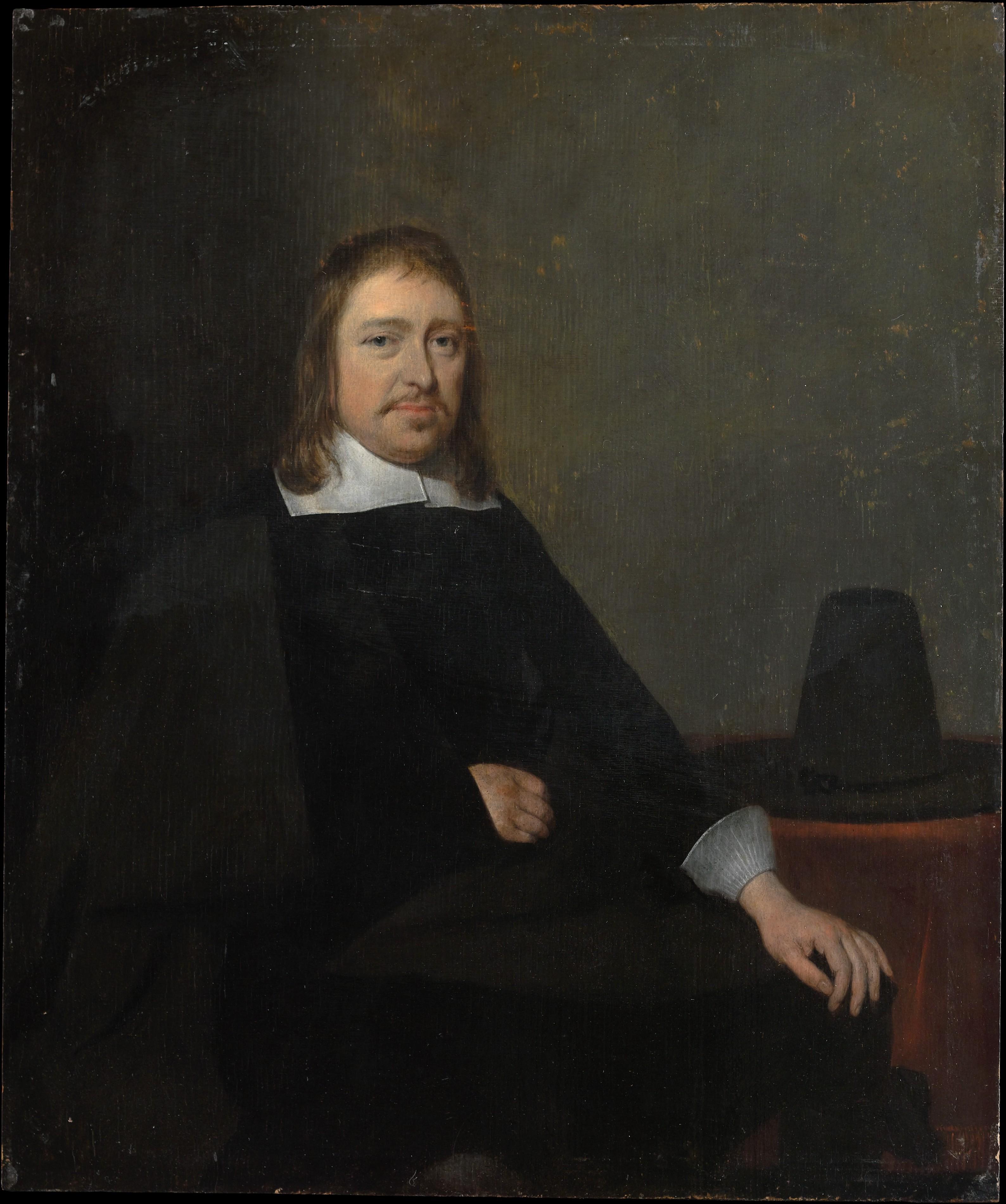
Portrait of a Seated Man
Gerard ter Borch the Younger
600 likes70 comments
Paintale uses cookies for essential site functionality and, where enabled, to serve relevant advertising via Google AdSense. You can accept all cookies or reject non-essential ones. See our Privacy Policy for details.
Now viewing
The Music Lesson
Gerard ter Borch the Younger
Period
1650-1700
Theme
Portrait
Medium
Oil on canvas
Current Location
Art Institute of Chicago, Chicago
The Story
In this small-scale scene of everyday life, a woman plays the double-headed lute as her companion marks the tempo. He is presumably her music instructor, but the similarity in their ages and the presence of the bed in the background make the precise relationship of the figures tantalizingly ambiguous. Gerard ter Borch the Younger painted many images like this one, featuring military officers and elegant young women in shimmering satin conversing, making music, or exchanging letters.
Created in 1665 during the 1650-1700 period, this work belongs firmly within the portrait tradition. Gerard ter Borch the Younger worked at a moment when the rivalry between Catholic Baroque drama and Protestant restraint reshaped what a painting could mean. Every gesture, fabric, and gleam of light was decoded by contemporary viewers like a private language.
As Oil on canvas (63.6 × 50.4 cm (25 × 19 7/8 in.); Framed: 84.8 × 70.8 × 6.4 cm (33 3/8 × 27 7/8 × 2 1/2 in.)), the work shows the tool marks and layering choices typical of Gerard ter Borch the Younger's output in this period — decisions about ground, underpainting, and glaze that a photograph can only partly convey.
Look closely and the painting opens up. Objects you might pass over — a folded letter, a half-drawn curtain, the angle of a glance — were placed to be read. Every prop in a portrait like this is a decision — jewelry, fabric, and hand position were negotiated between painter and patron to shape how the sitter would be remembered.
Art Institute of Chicago in Chicago now holds the work, where conservators and historians continue to revisit its condition and attribution. Each generation of scholarship adds a layer to how Gerard ter Borch the Younger's output from this period is understood.
“A silence so complete it becomes its own witness.”
In this small-scale scene of everyday life, a woman plays the double-headed lute as her companion marks the tempo. He is presumably her music instructor, but the similarity in their ages and the presence of the bed in the background make the precise relationship of the figures tantalizingly ambiguous. Gerard ter Borch the Younger painted many images like this one, featuring military officers and elegant young women in shimmering satin conversing, making music, or exchanging letters.
Gift of Charles T. Yerkes
Technique: oil painting, painting, painting (image making), painting techniques.
Possibly sold Amsterdam, October 1, 1738, no. 19 for 200 florins [according to Gudlaugsson 1960; see Gerard Hoet, Catalogus of naamlyst van Schilderyen (The Hague, 1752), p. 556]. Probably Johan Pieter Wierman, Leyden; his sale, Amsterdam, August 18, 1762, no. 34 to Diemen [price and buyer according to an annotated sale catalogue in the Rijksbureau voor Kunsthistorische Documentatie, The Hague; although the provenance of this painting and the Getty example have been confused in the past, the AIC view was probably in the Wierman collection because the music master is described as beating time with a – strykstok – or bow]. Probably Jan Jacob Brants (died 1813); sold his sale Pieter Yver, Amsterdam, April 20, 1813, lot 30 for 275 florins to Jer. deVries [price and buyer according to an annotated sale catalogue in the Rijksbureau voor Kunsthistorische Documentatie, The Hague; although the provenance of this painting and the Getty example have been confused in the past, the AIC view was probably in the Brants collection because the music master is described as beating time with a – strijkstok – or bow]. Possibly John Fairlie, Esq. [according to Smith 1833]; possibly his sale, 1830, for 130 gs to Michael Peacock [sale information according to Smith 1833]; possibly Michael Peacock (died 1843), London; possibly sold his sale Foster and Son, February 28, 1844, lot 12. Presumably Prince Anatole Demidoff, Villa San Donato, near Florence (died 1870); by descent to his nephew Prince Paul Demidoff (died 1885), San Donato; offered for sale Florence, Pillet, Le Roy and Mannheim, March 15-April 10, 1880, no. 1049, bought in; by descent to Princess Demidoff (formerly Princess Lise Troubetzkoi), 1885; sold through Durand-Ruel, Paris, June 1890, as part of a group of Dutch and Flemish paintings, many from the Demidoff collection, with funds advanced by Martin A. Ryerson and other trustees of the Art Institute [annual report 1891]; the cost of 1891.1 was re-imbursed by Charles T. Yerkes.
Art Institute of Chicago, Chicago. View on the museum’s official page.
See more works at Art Institute of Chicago or browse the full Gerard ter Borch the Younger collection.
A restrained palette and sculptural lighting create a solemn geometry. The wooden crate and letter anchor the narrative with journalistic precision.
Sources
Keep Exploring
More paintings like this
Gerard ter Borch the Younger
Gerard ter Borch the Younger
Gerard ter Borch the Younger
Guercino
Johann Michael Rottmayr
Johann Michael Rottmayr
Johann Michael Rottmayr
Gerard van Soest