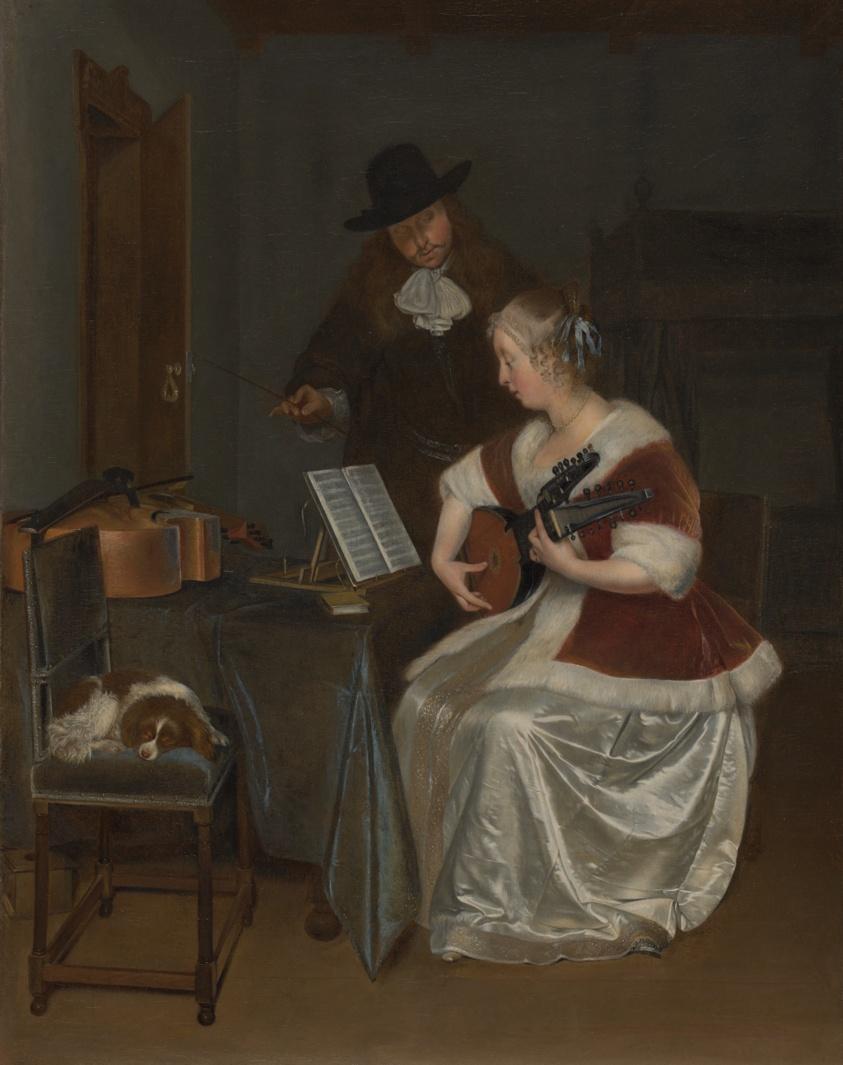
The Music Lesson
Gerard ter Borch the Younger
878 likes128 comments
Paintale uses cookies for essential site functionality and, where enabled, to serve relevant advertising via Google AdSense. You can accept all cookies or reject non-essential ones. See our Privacy Policy for details.
Now viewing
Portrait of Thomas Bulwer
Gerard van Soest
Period
1650-1700
Theme
Portrait
Medium
Oil on canvas
Current Location
Art Institute of Chicago, Chicago
The Story
Like many Dutch artists working in late 17th-century England, Gerard Soest catered to members of the upper social classes and aristocracy. The subject of this portrait, Norfolk gentleman Thomas Bulwer, likely hired Soest because of the painter’s ability to convey a sitter’s authority with directness and simplicity. Here, Soest depicted Bulwer clutching a scroll to signal his intellectual interests and influence. Likewise, the subject’s hand poised on the chair’s armrest suggests that he is about to rise, an indication of his active nature.
The inscription and date, which were uncovered during cleaning, were added in the 18th century.
As Oil on canvas (101.7 × 86.7 cm (40 1/16 × 34 1/8 in.); Framed: 113.4 × 97.2 × 6.4 cm (44 5/8 × 38 1/4 × 2 1/2 in.)), the work shows the tool marks and layering choices typical of Gerard van Soest's output in this period — decisions about ground, underpainting, and glaze that a photograph can only partly convey.
Look closely and the painting opens up. Objects you might pass over — a folded letter, a half-drawn curtain, the angle of a glance — were placed to be read. The sitter is constructed: clothes, pose, and attributes were chosen to project status, virtue, and lineage.
Today the painting is held by Art Institute of Chicago in Chicago, where it remains a touchstone for understanding Gerard van Soest's contribution to Western art. It has been studied, copied, restored, and argued over for centuries — proof that great paintings keep generating new readings long after their creators have gone.
“A silence so complete it becomes its own witness.”
Like many Dutch artists working in late 17th-century England, Gerard Soest catered to members of the upper social classes and aristocracy. The subject of this portrait, Norfolk gentleman Thomas Bulwer, likely hired Soest because of the painter’s ability to convey a sitter’s authority with directness and simplicity. Here, Soest depicted Bulwer clutching a scroll to signal his intellectual interests and influence. Likewise, the subject’s hand poised on the chair’s armrest suggests that he is about to rise, an indication of his active nature. The inscription and date, which were uncovered during cleaning, were added in the 18th century.
Alexander A. McKay Fund
Technique: oil painting, painting techniques, painting (image making), painting.
Inscriptions: Inscribed top center: Thomas Bulwer: 1654.
Rippon Hall, Hevingham, Norwich, by 1910 [according to Singh 1923, who visited Rippon Hall on July 29, 1910]. Lever Galleries, London, by 1937 [according to a letter from Leggatt Brothers to Ilse Hecht dated October 3, 1977, in curatorial file]; sold to Leggatt Brothers, London, 1937 [according to the letter cited above]; sold to Reginald H. Leon, The White House, Denham, Buckinghamshire, 1937 as Portrait of John Bulwer [date according to the letter cited above; title according to a letter from Leggatt Brothers to Ilse Hecht dated October 25, 1977, in curatorial file]; his sale, Knight, Frank & Rutley, The White House, Denham, Buckinghamshire, May 9, 1961, lot 49 as Portrait of John Bulwer for £260 to Agnew & Sons [price and buyer according to annotated photocopy of the sale catalogue, in curatorial file]; Agnew Brothers, London; sold to the Art Institute, 1962.
Art Institute of Chicago, Chicago. View on the museum’s official page.
See more works at Art Institute of Chicago or browse the full Gerard van Soest collection.
A restrained palette and sculptural lighting create a solemn geometry. The wooden crate and letter anchor the narrative with journalistic precision.
Sources
Keep Exploring
More paintings like this
Gerard ter Borch the Younger
Guercino
Johann Michael Rottmayr
Johann Michael Rottmayr
Johann Michael Rottmayr
Felice Ficherelli
Anonymous
Albrecht Dürer