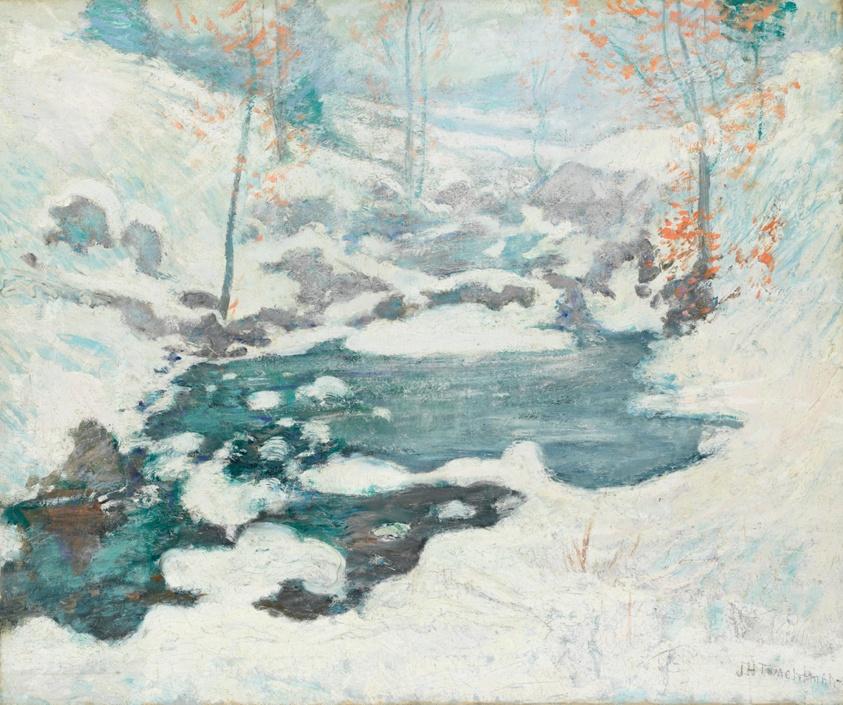
Icebound
John Henry Twachtman
1222 likes72 comments
Paintale uses cookies for essential site functionality and, where enabled, to serve relevant advertising via Google AdSense. You can accept all cookies or reject non-essential ones. See our Privacy Policy for details.
Now viewing
The White Bridge
John Henry Twachtman
Period
1871-1900
Theme
Daily Life
Medium
Oil on canvas
Current Location
Art Institute of Chicago, Chicago
The Story
The White Bridge depicts Horseneck Brook, which traversed John Henry Twachtman's Connecticut property. The artist painted at least six versions of the bridge over the course of six years; however, its shape is slightly different in each work. Twachtman may have altered the actual bridge or simply changed its appearance in each painting. Loosely rendered with feathery brushstrokes of green and rich brown, and incorporating expanses of unprimed canvas, this scene captures the rapid growth and verdant blossoming of spring.
Created in 1895, this work belongs firmly within the daily life tradition of American painting. John Henry Twachtman worked at a moment when the young republic was still deciding what its own art should look like — how much to borrow from Europe, how much to invent from its own landscape and daily life. Every gesture, fabric, and gleam of light was pitched at an audience learning to take American subjects seriously.
The physical object — Oil on canvas, 75 × 75 cm (29 1/2 × 29 1/2 in.) — carries its own history of handling and restoration. John Henry Twachtman's brushwork here moves between exacting description and looser, more suggestive passages, a balance typical of 19th-century American studio practice.
Look closely and the painting opens up. Objects you might pass over — a folded letter, a half-drawn curtain, the angle of a glance — were placed to be read. The apparent casualness is staged — objects and gestures are arranged to read as a moment caught rather than composed.
Housed at Art Institute of Chicago in Chicago, the painting has passed through the hands of collectors, dealers, and institutions before reaching public view — a provenance that is itself part of the object's story.
“A silence so complete it becomes its own witness.”
The White Bridge depicts Horseneck Brook, which traversed John Henry Twachtman's Connecticut property. The artist painted at least six versions of the bridge over the course of six years; however, its shape is slightly different in each work. Twachtman may have altered the actual bridge or simply changed its appearance in each painting. Loosely rendered with feathery brushstrokes of green and rich brown, and incorporating expanses of unprimed canvas, this scene captures the rapid growth and verdant blossoming of spring.
Mr. and Mrs. Martin A. Ryerson Collection
Inscriptions: Signed, lower left: "J. H. Twachtman".
Alexander Morton, New York, by 1916; American Art Galleries, New York, 1916; Macbeth Galleries, New York, 1916; sold to Martin A. Ryerson (1856–1932), Chicago, 1916; by descent to his wife Carrie Hutchinson Ryerson (1859–1937), Chicago, 1932 [<em>Last Will and Testament of Martin A. Ryerson, Died August 11, 1932</em>, copy in Institutional Archives, Art Institute of Chicago]; bequeathed to the Art Institute of Chicago, 1937.
Art Institute of Chicago, Chicago. View on the museum’s official page.
See more works at Art Institute of Chicago or browse the full John Henry Twachtman collection.
A restrained palette and sculptural lighting create a solemn geometry. The wooden crate and letter anchor the narrative with journalistic precision.
Sources
Keep Exploring
More paintings like this
John Henry Twachtman
Jules Bastien-Lepage
Maxime Maufra
Georges Seurat
George Inness
Charles Gifford Dyer
Mary Cassatt
William Merritt Chase