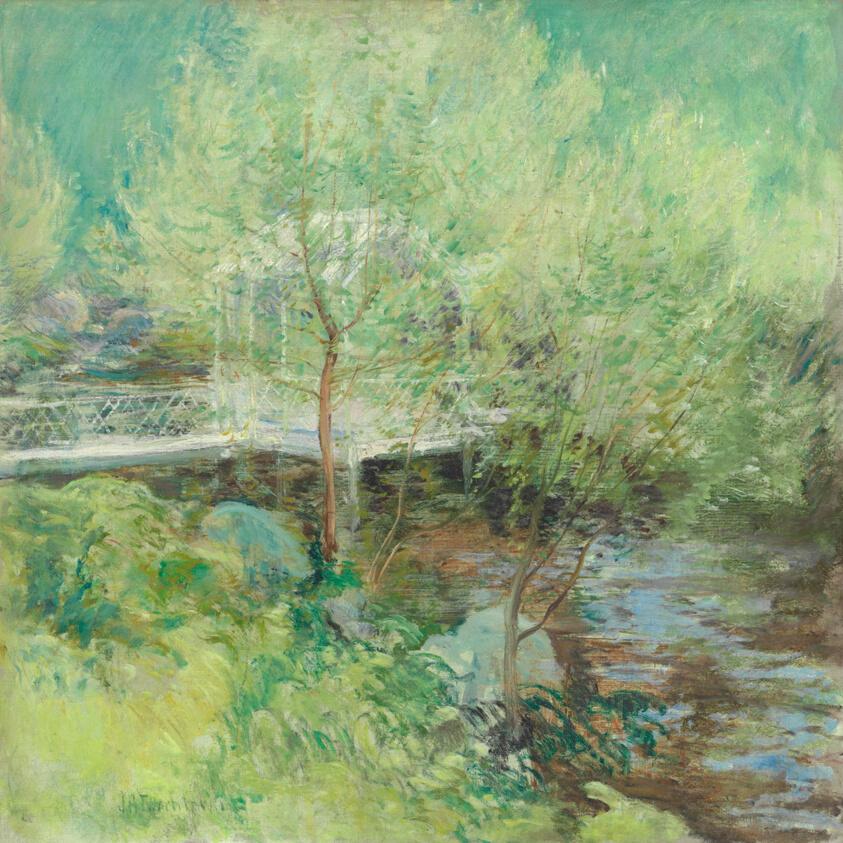
The White Bridge
John Henry Twachtman
436 likes66 comments
Paintale uses cookies for essential site functionality and, where enabled, to serve relevant advertising via Google AdSense. You can accept all cookies or reject non-essential ones. See our Privacy Policy for details.
Now viewing
Icebound
John Henry Twachtman
Period
1871-1900
Theme
Love & Romance
Medium
Oil on canvas
Current Location
Art Institute of Chicago, Chicago
The Story
During the last decade of his life, John Henry Twachtman frequently painted views of the landscape surrounding his home in Greenwich, Connecticut. In a departure from typically barren images of winter, he enjoyed depicting the beauty of the frozen terrain, believing that it was conducive to contemplation and regeneration. The dense layers of paint in Icebound mimic the accumulation of snow on frozen ground, and the sinuous curves that define the snow and ice against the water suggest movement in an otherwise tranquil environment.
Created in 1889, this work belongs firmly within the love & romance tradition of American painting. John Henry Twachtman worked at a moment when the young republic was still deciding what its own art should look like — how much to borrow from Europe, how much to invent from its own landscape and daily life. Every gesture, fabric, and gleam of light was pitched at an audience learning to take American subjects seriously.
The physical object — Oil on canvas, 64.2 × 76.6 cm (25 5/16 × 30 3/16 in.) — carries its own history of handling and restoration. John Henry Twachtman's brushwork here moves between exacting description and looser, more suggestive passages, a balance typical of 19th-century American studio practice.
Look closely and the painting opens up. Objects you might pass over — a folded letter, a half-drawn curtain, the angle of a glance — were placed to be read. Small objects scattered through the composition — a ring, a glance, a half-open door — carry the emotional plot.
Today the painting is held by Art Institute of Chicago in Chicago, where it remains a touchstone for understanding John Henry Twachtman's contribution to Western art. It has been studied, copied, restored, and argued over for centuries — proof that great paintings keep generating new readings long after their creators have gone.
“A silence so complete it becomes its own witness.”
During the last decade of his life, John Henry Twachtman frequently painted views of the landscape surrounding his home in Greenwich, Connecticut. In a departure from typically barren images of winter, he enjoyed depicting the beauty of the frozen terrain, believing that it was conducive to contemplation and regeneration. The dense layers of paint in Icebound mimic the accumulation of snow on frozen ground, and the sinuous curves that define the snow and ice against the water suggest movement in an otherwise tranquil environment. Almost square in format, the painting’s harmonious composition exemplifies Twachtman’s opinion that “never is nature more lovely than when it is snowing.”
Friends of American Art Collection
Technique: oil painting, painting (image making).
Inscriptions: Signed recto, bottom-right, on snowy ground, in grey paint: "J. H. TWACHTMAN"..
John Forsythe, Esq., New York, by 1913; sold, Clarke Auction Rooms, New York, Forsythe sale, Nov. 6-7, lot 119 [as "Snowbound"], to Montross Gallery, New York, 1917; sold to Paul Schulze Sr. (1864–1943) and Ida Schulze (1871–1956; born Ida Johl), Chicago, 1917; sold to the Friends of American Art, Art Institute of Chicago, 1917; given to the Art Institute of Chicago, 1917.
Art Institute of Chicago, Chicago. View on the museum’s official page.
See more works at Art Institute of Chicago or browse the full John Henry Twachtman collection.
A restrained palette and sculptural lighting create a solemn geometry. The wooden crate and letter anchor the narrative with journalistic precision.
Sources
Keep Exploring
More paintings like this
John Henry Twachtman
Sanford Robinson Gifford

Vincent van Gogh
Caravaggio

Sandro Botticelli

Sandro Botticelli
Michele Desubleo

Hieronymus Bosch