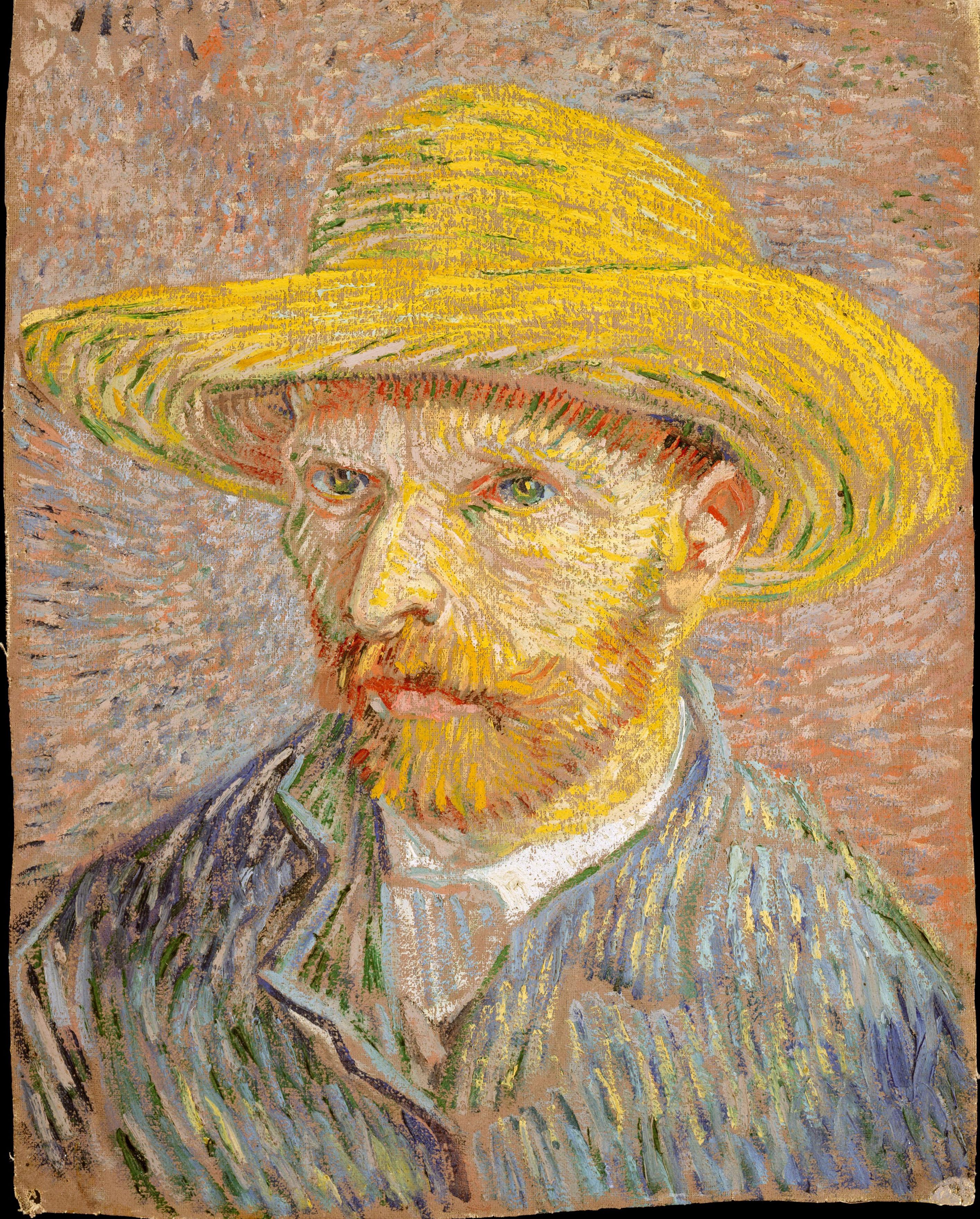
Self-Portrait with a Straw Hat (obverse: The Potato Peeler)
Vincent van Gogh
1472 likes142 comments
Paintale uses cookies for essential site functionality and, where enabled, to serve relevant advertising via Google AdSense. You can accept all cookies or reject non-essential ones. See our Privacy Policy for details.
Now viewing
The Bedroom
Vincent van Gogh
Period
1871-1900
Theme
Love & Romance
Medium
Oil on canvas
Current Location
Art Institute of Chicago, Chicago
The Story
Bedroom in Arles (French: La Chambre à Arles; Dutch: Slaapkamer te Arles) is the title given to three similar paintings by 19th-century Dutch Post-Impressionist painter Vincent van Gogh. Van Gogh's own title for this composition was simply The Bedroom (French: La Chambre à coucher). There are three authentic versions described in his letters, easily distinguishable from one another by the pictures on the wall to the right.
The painting depicts Van Gogh's bedroom at 2, Place Lamartine in Arles, Bouches-du-Rhône, France, known as the Yellow House. The door to the right opened on to the upper floor and the staircase; the door to the left was that of the guest room he held prepared for Gauguin; the window in the front wall looked on to Place Lamartine and its public gardens. This room was not rectangular but trapezoid with an obtuse angle in the left-hand corner of the front wall and an acute angle at the right.
Executed in Oil on canvas, measuring 73.6 × 92.3 cm (29 × 36 5/8 in.); Framed: 88.9 × 108 × 8.9 cm (35 × 42 1/2 × 3 1/2 in.), the surface rewards close looking. Vincent van Gogh builds the composition through layered glazes and a tightly controlled palette, letting cool shadows recede so that the warm, lit passages step forward.
Look closely and the painting opens up. Objects you might pass over — a folded letter, a half-drawn curtain, the angle of a glance — were placed to be read. Cupids, mirrors, and flowers are not decoration; they signal desire, vanity, and the swift passage of beauty.
Housed at Art Institute of Chicago in Chicago, the painting has passed through the hands of collectors, dealers, and institutions before reaching public view — a provenance that is itself part of the object's story.
“A silence so complete it becomes its own witness.”
Arles.
Perhaps the most famous depiction of a bedroom in Western art history, this vibrant painting documents Vincent van Gogh’s sleeping quarters in his beloved “Yellow House” in Arles, France. The composition exists in three versions, the first of which Van Gogh conceived in October 1888, a month after he moved into the home. In a letter to his brother Theo, he described having painted “the walls pale lilac, the floor in a broken and faded red, the chairs and the bed chrome yellow, the pillows and the sheet very pale lemon green, the bedspread blood-red, the dressing table orange, the washbasin blue, the window green.” With its bold colors, thick and broken brushwork, and sharply receding lines, the picture might suggest a nervous energy. But the artist understood it as a calming and restful image. The painting in the Art Institute’s collection is Van Gogh’s second version of the scene, made nearly a year after the first, in September 1889. He produced a third, smaller version at the same time as a gift for his mother and sister.
Helen Birch Bartlett Memorial Collection
Materials: oil paint, canvas.
Technique: oil painting, painting, painting techniques, painting (image making).
The artist; sent to his brother, Theo van Gogh (died 1891), Paris, Dec. 18, 1889 [Letter 829 from Vincent van Gogh to Theo van Gogh, Dec. 19, 1889, notes that The Bedroom was sent the day before]; by descent to Johanna van Gogh-Bonger (died 1925), the Netherlands, 1891; sold to Jos Hessel, Paris, by 1901 [Paris 1901]. Carl Reininghaus, Vienna, by 1909, to at least 1914 [Vienna 1909; Berlin 1914]. Paul Rosenberg, Paris and New York, by 1926; sold to Frederic Clay Bartlett, Chicago, Dec. 1926 [receipt and correspondence in curatorial object file]; given to the Art Institute of Chicago, 1926.
Art Institute of Chicago, Chicago. View on the museum’s official page.
See more works at Art Institute of Chicago or browse the full Vincent van Gogh collection.
A restrained palette and sculptural lighting create a solemn geometry. The wooden crate and letter anchor the narrative with journalistic precision.
Sources
Keep Exploring
More paintings like this
Vincent van Gogh

Vincent van Gogh
Sanford Robinson Gifford
John Henry Twachtman
Caravaggio

Sandro Botticelli

Sandro Botticelli
Michele Desubleo