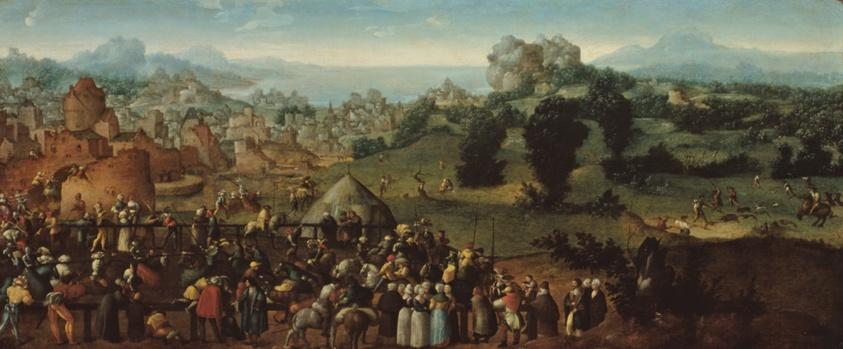
Landscape with Tournament and Hunters
Jan van Scorel
1458 likes128 comments
Paintale uses cookies for essential site functionality and, where enabled, to serve relevant advertising via Google AdSense. You can accept all cookies or reject non-essential ones. See our Privacy Policy for details.
Now viewing
Adoration of the Magi
Jan van Scorel
Period
1500-1550
Theme
Power & Politics
Medium
Oil on panel
Current Location
Art Institute of Chicago, Chicago
The Story
One of Jan van Scorel’s earliest known works, this image of three kings from distant lands paying tribute to the newborn Jesus incorporates elements of northern and southern European visual traditions. The refined landscape, intricate costumes, and individualized faces of the figures attest to lessons the artist likely learned from his Netherlandish predecessors. The elaborate architectural carvings, on the other hand, recall ancient Roman wall decoration.
Van Scorel likely made this work while traveling to study in Italy: the panel on which it is painted is made of fir, a wood rarely used in the Low Countries but one he might have encountered on his way across the Alps. Van Scorel was praised by the first biographer of Netherlandish artists as the “lantern bearer” who brought the Italian Renaissance style back to Northern Europe.
The physical object — Oil on panel, 44.4 × 55.2 cm (17 1/2 × 21 3/4 in.); Framed: 62.6 × 75 × 5.8 cm (24 5/8 × 29 1/2 × 2 1/4 in.) — carries its own history of handling and restoration. Jan van Scorel's brushwork here moves between exacting description and looser, more suggestive passages, a balance typical of Renaissance studio practice.
Look closely and the painting opens up. Objects you might pass over — a folded letter, a half-drawn curtain, the angle of a glance — were placed to be read. Scale and setting do political work here, elevating the subject above the room it would have hung in.
Art Institute of Chicago in Chicago now holds the work, where conservators and historians continue to revisit its condition and attribution. Each generation of scholarship adds a layer to how Jan van Scorel's output from this period is understood.
“A silence so complete it becomes its own witness.”
One of Jan van Scorel’s earliest known works, this image of three kings from distant lands paying tribute to the newborn Jesus incorporates elements of northern and southern European visual traditions. The refined landscape, intricate costumes, and individualized faces of the figures attest to lessons the artist likely learned from his Netherlandish predecessors. The elaborate architectural carvings, on the other hand, recall ancient Roman wall decoration. Van Scorel likely made this work while traveling to study in Italy: the panel on which it is painted is made of fir, a wood rarely used in the Low Countries but one he might have encountered on his way across the Alps. Van Scorel was praised by the first biographer of Netherlandish artists as the “lantern bearer” who brought the Italian Renaissance style back to Northern Europe.
Wilson L. Mead Fund
Technique: panel painting, oil painting, painting, painting (image making), painting techniques.
Probably a member of the Khuen von Belasy family [based on the coats of arms formerly on the picture]. Von Ferstel collection, Vienna, until 1920 [according to Friedländer 1923, p. 606]. Camillo Castiglioni, Vienna, from 1920; sold, Frederick Muller, Amsterdam, November 17–20, 1925, no. 47. Dr. Tietje, Amsterdam, by 1929 [lent by him to 1929 exhibition]. Paul Cassirer and Co., Amsterdam; sold to the Art Institute, 1935.
Art Institute of Chicago, Chicago. View on the museum’s official page.
See more works at Art Institute of Chicago or browse the full Jan van Scorel collection.
A restrained palette and sculptural lighting create a solemn geometry. The wooden crate and letter anchor the narrative with journalistic precision.
Sources
Keep Exploring
More paintings like this
Jan van Scorel
Moretto da Brescia

Correggio
Lucas Cranach the Elder
Lucas Cranach the Elder
Fra Bartolommeo
Jacob Cornelisz. van OostsanenWorkshop of Jacob Cornelisz. van Oostsanen
Anthony van Dyck