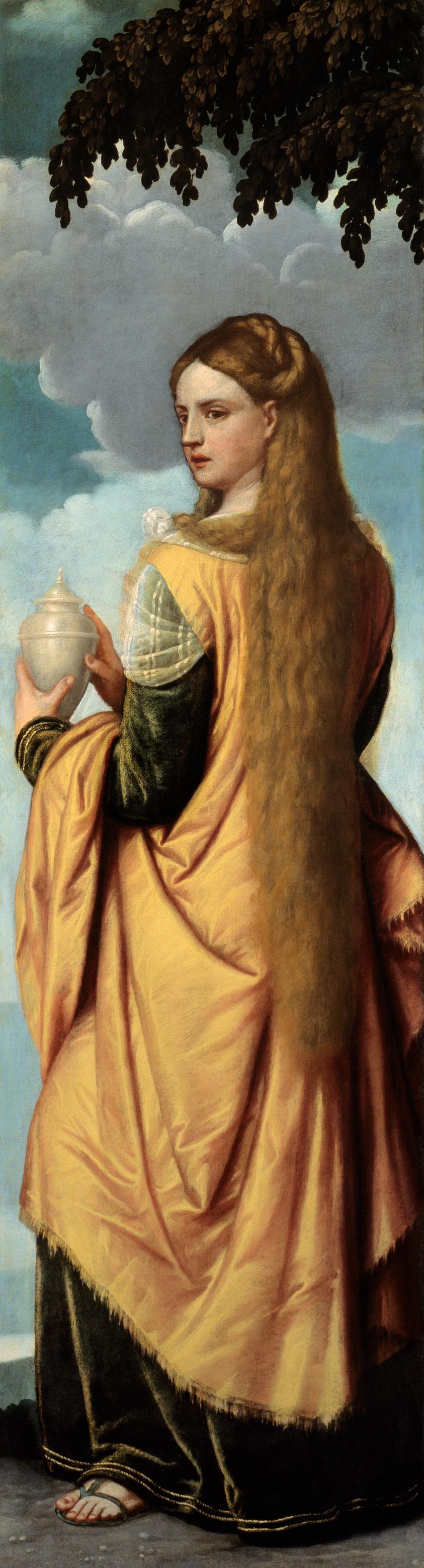
Mary Magdalene
Moretto da Brescia
1134 likes104 comments
Paintale uses cookies for essential site functionality and, where enabled, to serve relevant advertising via Google AdSense. You can accept all cookies or reject non-essential ones. See our Privacy Policy for details.
Now viewing
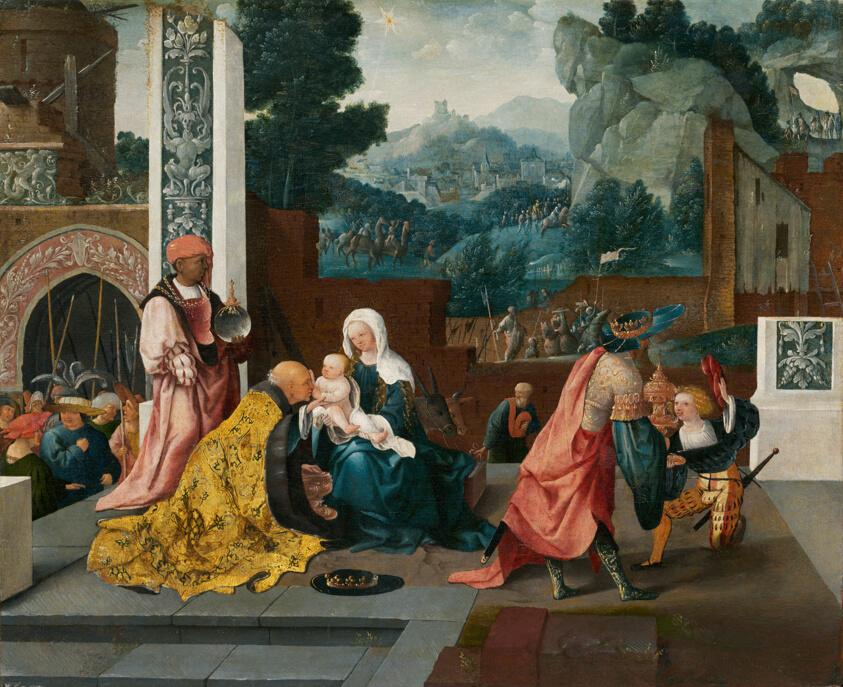
The Adoration of the Christ Child
Jacob Cornelisz. van OostsanenWorkshop of Jacob Cornelisz. van Oostsanen
Period
1500-1550
Theme
Power & Politics
Medium
Oil on panel
Current Location
Art Institute of Chicago, Chicago
The Story
In this joyous imagining of Jesus’s birth, choirs of angels—each with a different musical attribute—fill the stable with celebratory music. The artist elaborated the setting with luxurious red porphyry and green marble architectural features adorned with floral designs called grotteschi. These organic yet fantastical decorative motifs were inspired by the recent excavation of the Domus Aureus, Emperor Nero’s grand, first-century palace in Rome.
Here, these details are likely meant to evoke the tradition that Christ’s birth took place in a stable constructed in the ruins of the biblical king David’s palace.
Working in Oil on panel at 98.5 × 76.3 cm (38 3/4 × 30 1/16 in.); Framed: 108 × 86.4 × 9.6 cm (42 1/2 × 34 × 3 3/4 in.), Jacob Cornelisz. van OostsanenWorkshop of Jacob Cornelisz. van Oostsanen constructs depth through value contrast rather than outline, letting figures emerge from darkness the way they would under candlelight or through a shuttered window.
Look closely and the painting opens up. Objects you might pass over — a folded letter, a half-drawn curtain, the angle of a glance — were placed to be read. Crowns, columns, and heraldry quietly insist on legitimacy — this is a painting working hard on behalf of a patron.
Today the painting is held by Art Institute of Chicago in Chicago, where it remains a touchstone for understanding Jacob Cornelisz. van OostsanenWorkshop of Jacob Cornelisz. van Oostsanen's contribution to Western art. It has been studied, copied, restored, and argued over for centuries — proof that great paintings keep generating new readings long after their creators have gone.
“A silence so complete it becomes its own witness.”
In this joyous imagining of Jesus’s birth, choirs of angels—each with a different musical attribute—fill the stable with celebratory music. The artist elaborated the setting with luxurious red porphyry and green marble architectural features adorned with floral designs called grotteschi. These organic yet fantastical decorative motifs were inspired by the recent excavation of the Domus Aureus, Emperor Nero’s grand, first-century palace in Rome. Here, these details are likely meant to evoke the tradition that Christ’s birth took place in a stable constructed in the ruins of the biblical king David’s palace.
George F. Harding Collection
Technique: panel painting, oil painting, painting (image making), painting techniques.
Spanish Art Gallery, London, by 1914 to at least 1916 [Steinbart 1922, p. 72; and Conway 1921]. Dr. John E. Stillwell, New York, by 1922[Steinbart 1922, p. 72]; sold, American Art Association, Anderson Galleries, New York, Dec. 1–3, 1927, no. 217, to Clapp and Graham as agent for Harding, for $10,250 [Art News 1927, p. 12]; George F. Harding, Jr. (d. 1939), Chicago; bequeathed to the George F. Harding Museum, Chicago; offered for sale, Sotheby’s, New York, Dec. 2, 1976, no. 210, withdrawn; ownership transferred to the Art Institute, 1982; accessioned, 1983.
Art Institute of Chicago, Chicago. View on the museum’s official page.
See more works at Art Institute of Chicago or browse the full Jacob Cornelisz. van OostsanenWorkshop of Jacob Cornelisz. van Oostsanen collection.
A restrained palette and sculptural lighting create a solemn geometry. The wooden crate and letter anchor the narrative with journalistic precision.
Sources
Keep Exploring
More paintings like this
Moretto da Brescia

Correggio
Lucas Cranach the Elder
Lucas Cranach the Elder
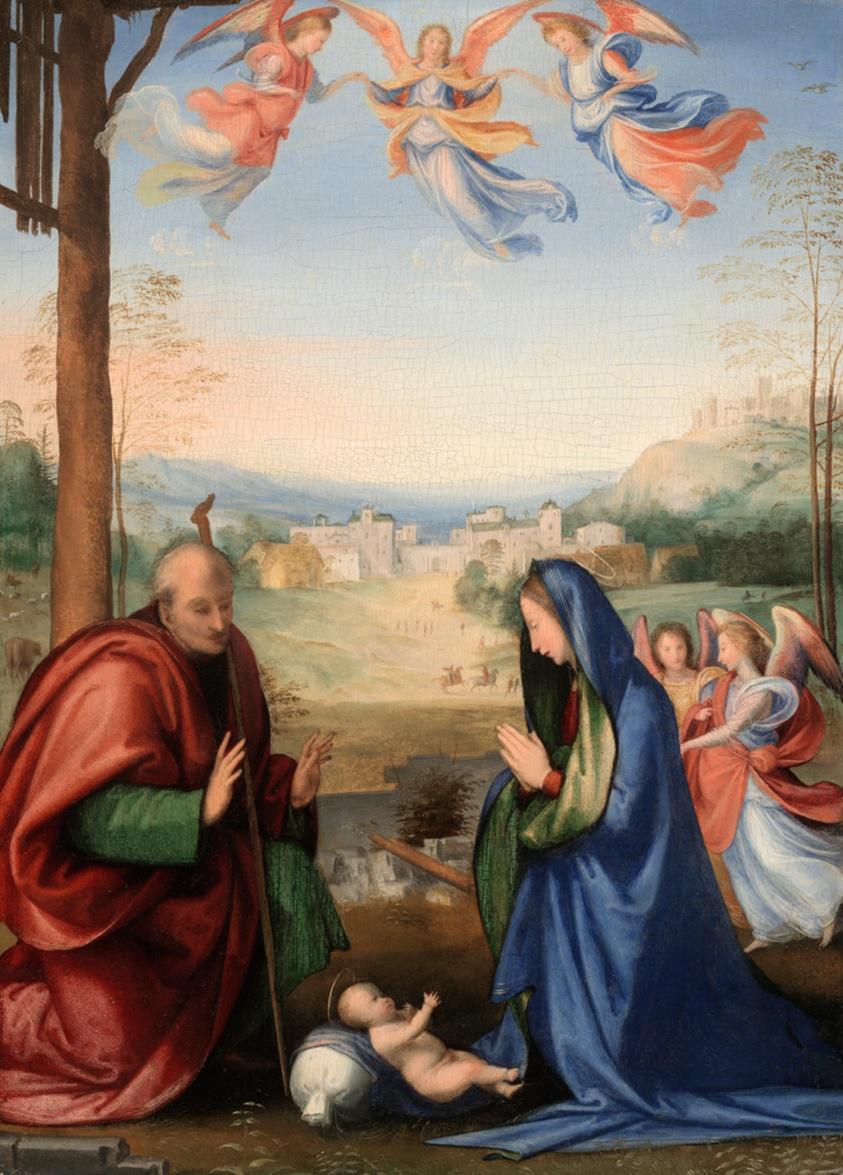
Fra Bartolommeo
Jan van Scorel
Jan van Scorel
Anthony van Dyck