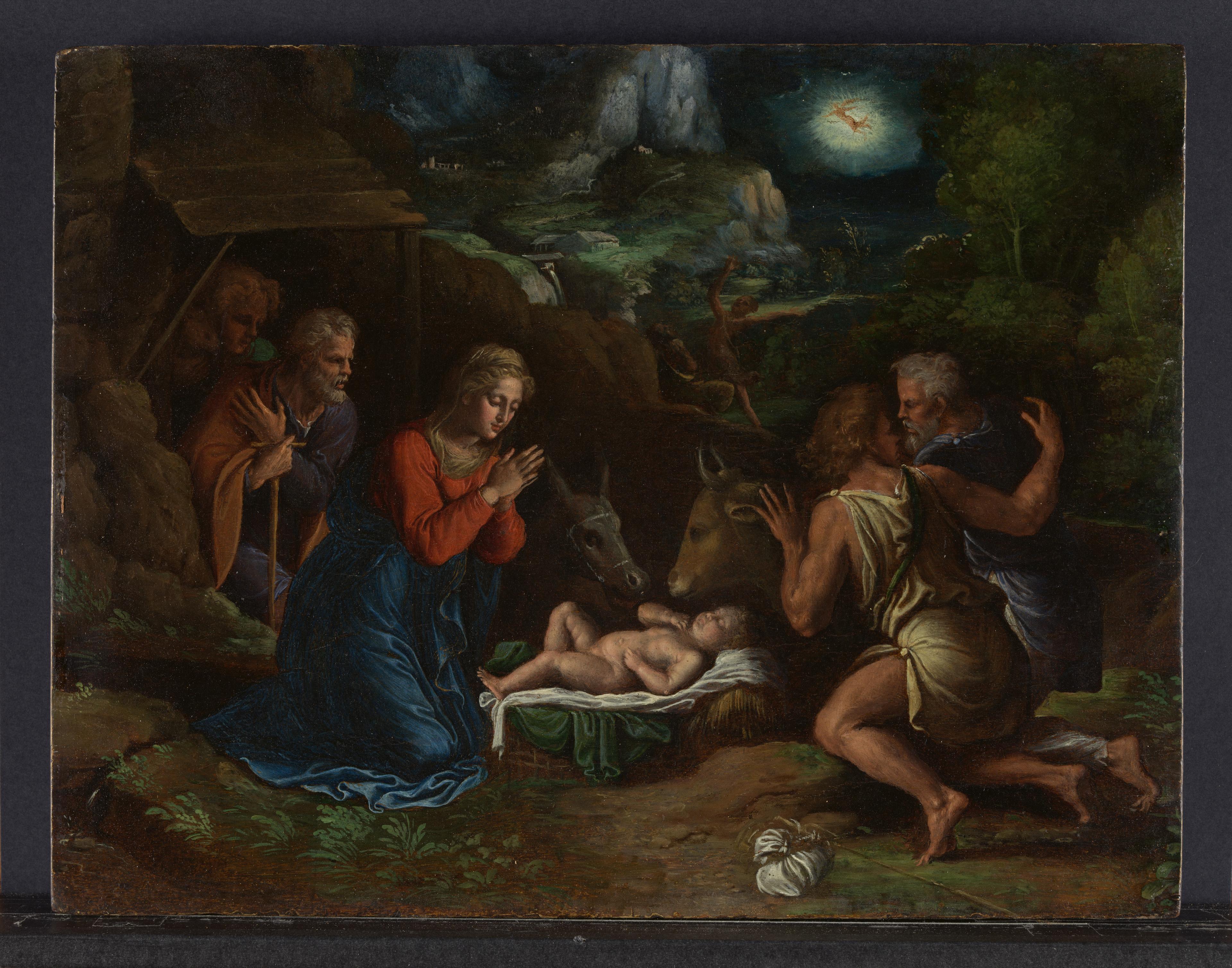
The Adoration of the Shepherds
Girolamo da Carpi
1578 likes48 comments
Paintale uses cookies for essential site functionality and, where enabled, to serve relevant advertising via Google AdSense. You can accept all cookies or reject non-essential ones. See our Privacy Policy for details.
Now viewing
Saint Luke Drawing the Virgin and Christ Child
Girolamo da Carpi
Period
1500-1550
Theme
Tragedy & Death
Medium
Oil on panel
Current Location
Art Institute of Chicago, Chicago
The Story
Girolamo da Carpi painted this intimate work for the Este family of Ferrara, Italy; it adorned the oratory chapel of their palace. The painting shows Saint Luke drawing the Virgin Mary and the infant Jesus while Joseph watches from a doorway. The infant appears agitated, as if he possesses foreknowledge of his death: He is reacting to the spear-like yarn winder, an attribute of the Three Fates from Greek mythology and a symbol of death in Christian contexts as well. The painting’s distinguished history extends beyond the Estes.
It later came into the possession of two Roman cardinals, two Roman princes, the English Duke of Westminster, Baron Alfred de Rothschild, and the Earl of Carnavon, who famously financed the excavation of King Tutankhamen’s tomb.
Executed in Oil on panel, measuring 47 × 34 cm (18 9/16 × 13 7/16 in.); Framed: 69.6 × 57.2 × 5.8 cm (27 3/8 × 22 1/2 × 2 1/4 in.), the surface rewards close looking. Girolamo da Carpi builds the composition through layered glazes and a tightly controlled palette, letting cool shadows recede so that the warm, lit passages step forward.
Look closely and the painting opens up. Objects you might pass over — a folded letter, a half-drawn curtain, the angle of a glance — were placed to be read. Grief here is choreographed: hands, drapery, and gaze are arranged to guide sympathy rather than simply record a scene.
Art Institute of Chicago in Chicago now holds the work, where conservators and historians continue to revisit its condition and attribution. Each generation of scholarship adds a layer to how Girolamo da Carpi's output from this period is understood.
“A silence so complete it becomes its own witness.”
This painting features documented symbols with their own dedicated meaning in art history:
Girolamo da Carpi painted this intimate work for the Este family of Ferrara, Italy; it adorned the oratory chapel of their palace. The painting shows Saint Luke drawing the Virgin Mary and the infant Jesus while Joseph watches from a doorway. The infant appears agitated, as if he possesses foreknowledge of his death: He is reacting to the spear-like yarn winder, an attribute of the Three Fates from Greek mythology and a symbol of death in Christian contexts as well. The painting’s distinguished history extends beyond the Estes. It later came into the possession of two Roman cardinals, two Roman princes, the English Duke of Westminster, Baron Alfred de Rothschild, and the Earl of Carnavon, who famously financed the excavation of King Tutankhamen’s tomb.
Purchased with funds provided by the Old Masters Society
Technique: panel painting, oil painting, painting, painting (image making), painting techniques.
Lucrezia d’Este (died 1598), Duchess of Urbino, Ferrara, by 1592, when it was recorded in the oratory of the Palazzo d’Este, Ferrara, as “…San Luca che ritrae la Madonna con Nro Sigre in brazzo di mano di Girolamo da Carpi” [see Della Pergola 1959, p. 343 and Della Pergola 1960, p. 440, no. 42, and Della Pergola 1963, p. 85, no. 312; Lucrezia had probably inherited it from her father Duke Ercole II d’Este (died 1559) or her uncle Cardinal Ippolito II d’Este (died 1572)]; bequeathed by her to Cardinal Pietro Aldobrandini (died 1621), Rome and Frascati, listed in 1603 Aldobrandini inventory as by Raphael, “San Luca, che sta ritrando la Madonna, di Raffaelle da Urbino” [see D’Onofrio 1964, Part I, p. 20, no. 61 and Part II, p. 159, listed under no. 89, as no. 61]; by descent to his nephew Cardinal Ippolito Aldobrandini (died 1638), Rome and Frascati, no. 42 in 1626 Aldobrandini inventory, “Un quadro con S luca che sta ritrahendo la Mad.a di mano di Raffael d’Urbino del n. 61” [Della Pergola 1960, p. 429]; by descent to his niece Olimpia Aldobrandini (died 1682), Rome and Frascati, in 1682 inventory as no. 312, “Un quadro in tavola con San Luca che sta ritrahendo la Madonna, alto pmi uno e tre quarti, con cornice nera di mano di Raffaele d’Urbino…”[Della Pergola 1963, p. 74]; probably by descent to her son Prince Giovanni Battista Pamphili (died 1709), Rome; probably by descent to his son Prince Girolamo Pamphili (died 1760), Rome. Acquired in Rome by Richard Dalton about 1763 for Sir Richard Grosvenor, 1st Earl Grosvenor, London, as by Raphael [according to Young 1820, no. 56 and Grosvenor House Catalogue 1876, p. 24, no. 69]; by descent to Hugh Richard Arthur Grosvenor, 2nd Duke of Westminster, until at least 1903 [Berenson 1903]. Baron Alfred de Rothschild (died 1918), London [according to the 1925 sale catalogue of his daughter’s collection]; by descent to his daughter, Almina, Countess of Carnarvon; her sale, Christie’s, London, May 22, 1925, lot no. 89, to Douglas [according to annotated copy of sale catalogue in Ryerson Library; copy in curatorial file]; R. Langton Douglas, London and Fiesole, 1925 [this and the following provided by Michael Tollemache acting as agent for the Gronau family]. Georg Gronau (died 1938), Fiesole, by 1930; by descent to his son, Hans-Dietrich Gronau (died 1951), London and Florence; his widow, Carmen Gronau (died 1999), London and Florence; by descent to her grand-daughter, London; sold to the Art Institute of Chicago with Michael Tollemache Fine Art, London, as agent.
Art Institute of Chicago, Chicago. View on the museum’s official page.
See more works at Art Institute of Chicago or browse the full Girolamo da Carpi collection.
A restrained palette and sculptural lighting create a solemn geometry. The wooden crate and letter anchor the narrative with journalistic precision.
Sources
Keep Exploring
More paintings like this
Girolamo da Carpi
Tintoretto
Lucas Cranach the Elder
Jacques Louis David
Caravaggio
Guido Cagnacci

Sandro Botticelli

Sandro Botticelli