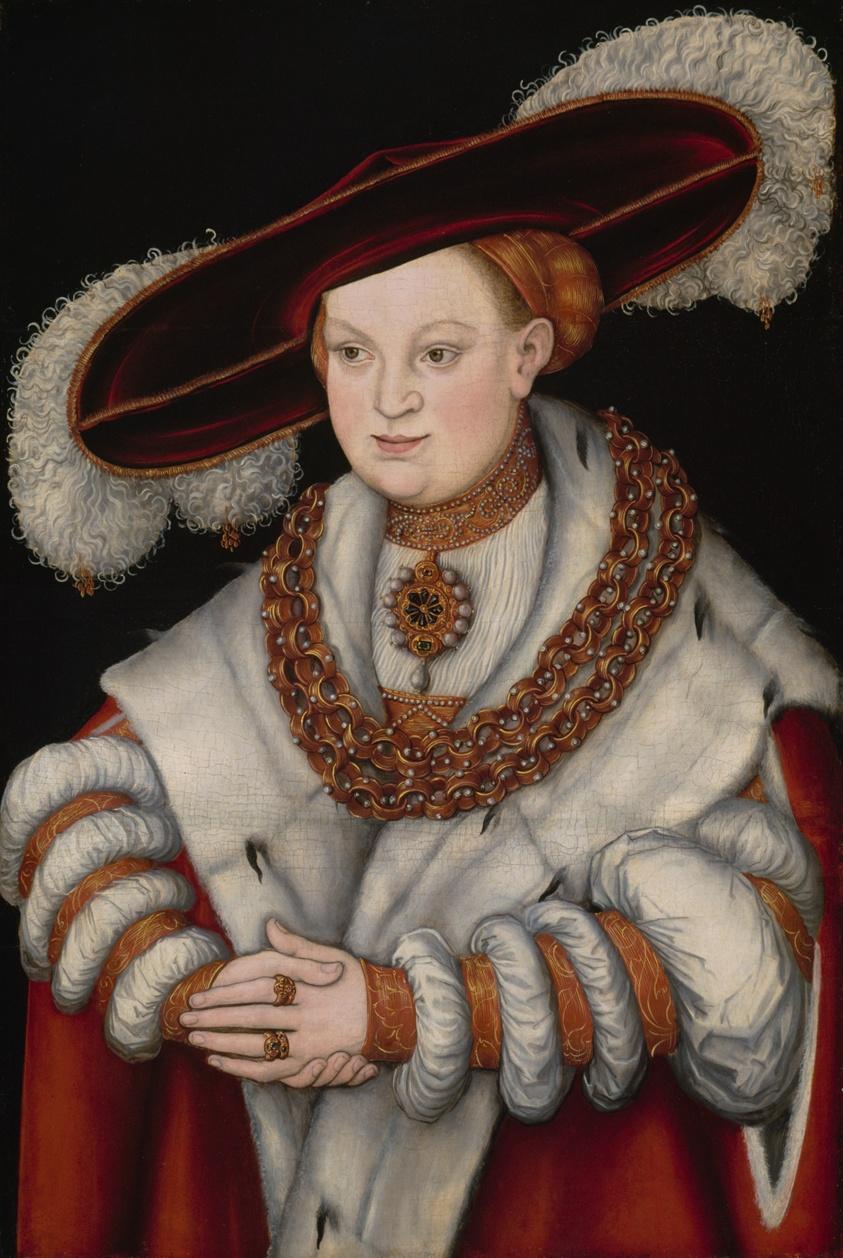
Portrait of Magdalena of Saxony, Wife of Elector Joachim II of Brandenburg
Lucas Cranach the Elder
1122 likes72 comments
Paintale uses cookies for essential site functionality and, where enabled, to serve relevant advertising via Google AdSense. You can accept all cookies or reject non-essential ones. See our Privacy Policy for details.
Now viewing
The Crucifixion
Lucas Cranach the Elder
Period
1500-1550
Theme
Tragedy & Death
Medium
Oil on panel
Current Location
Art Institute of Chicago, Chicago
The Story
In this crowded scene, traditional vignettes from the Crucifixion story surround the central figure of Jesus Christ on the cross. Jesus’s mother, the Virgin Mary, swoons amid a group of believers in the lower left corner. On the other side of the cross are Christ’s condemners and the cynics who rejected him, among them the soldiers who cast dice to divide up his clothing.
Cranach was a good friend of the Protestant reformer Martin Luther, and though the Crucifixion was a subject more strongly associated with Catholics, Cranach included details that reinforce the Protestant emphasis on the power of faith and individual responsibility—for instance, the figure of the young boy learning from an older man at the foot of the central cross.
Executed in Oil on panel, measuring 121.1 × 82.5 cm (47 3/4 × 32 1/2 in.); Framed: 147.4 × 109 × 7.7 cm (58 × 42 7/8 × 3 in.), the surface rewards close looking. Lucas Cranach the Elder builds the composition through layered glazes and a tightly controlled palette, letting cool shadows recede so that the warm, lit passages step forward.
Look closely and the painting opens up. Objects you might pass over — a folded letter, a half-drawn curtain, the angle of a glance — were placed to be read. Light hardens into edge, drapery becomes shroud, and the body is staged like an argument about mortality.
Art Institute of Chicago in Chicago now holds the work, where conservators and historians continue to revisit its condition and attribution. Each generation of scholarship adds a layer to how Lucas Cranach the Elder's output from this period is understood.
“A silence so complete it becomes its own witness.”
In this crowded scene, traditional vignettes from the Crucifixion story surround the central figure of Jesus Christ on the cross. Jesus’s mother, the Virgin Mary, swoons amid a group of believers in the lower left corner. On the other side of the cross are Christ’s condemners and the cynics who rejected him, among them the soldiers who cast dice to divide up his clothing. Cranach was a good friend of the Protestant reformer Martin Luther, and though the Crucifixion was a subject more strongly associated with Catholics, Cranach included details that reinforce the Protestant emphasis on the power of faith and individual responsibility—for instance, the figure of the young boy learning from an older man at the foot of the central cross.
Charles H. and Mary F. S. Worcester Collection
Technique: panel painting, painting, painting (image making), painting techniques.
Inscriptions: Inscribed: [device of serpent with lowered wings] / 153[8] (on cross).
Sir Fairfax Cartright (d. 1928), Aynho Park, Banbury [according to letter from Robert Langton Douglas to Charles Worces-ter, Nov. 25, 1928, in curatorial file]. Julius Böhler, Munich, 1928 [according to receipt and other records in the registrar’s office.]; sold to Charles H. Worcester, Chicago, Sept. 1928; on loan to the AIC from 1928; given to the AIC, 1947.
Art Institute of Chicago, Chicago. View on the museum’s official page.
See more works at Art Institute of Chicago or browse the full Lucas Cranach the Elder collection.
A restrained palette and sculptural lighting create a solemn geometry. The wooden crate and letter anchor the narrative with journalistic precision.
Sources
Keep Exploring
More paintings like this
Lucas Cranach the Elder
Lucas Cranach the Elder
Lucas Cranach the Elder
Lucas Cranach the Elder
Lucas Cranach the Elder
Girolamo da Carpi
Tintoretto
Jacques Louis David