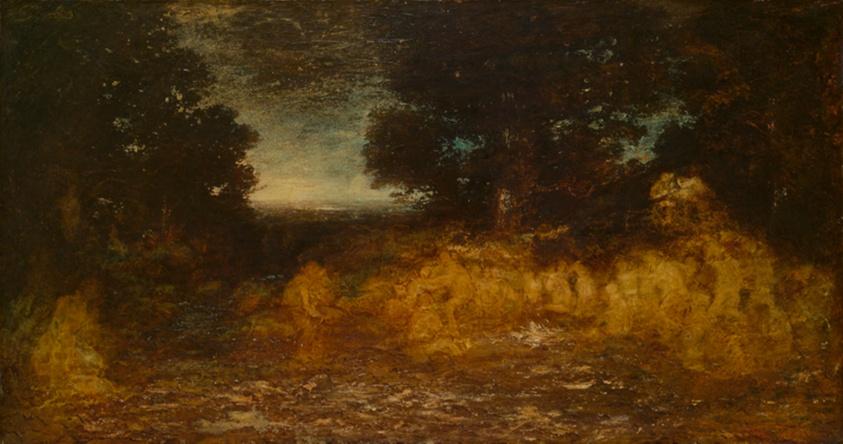
Ghost Dance (The Vision of Life)
Ralph Albert Blakelock
863 likes73 comments
Paintale uses cookies for essential site functionality and, where enabled, to serve relevant advertising via Google AdSense. You can accept all cookies or reject non-essential ones. See our Privacy Policy for details.
Now viewing
Arrival of the Normandy Train, Gare Saint-Lazare
Claude Monet
Period
1871-1900
Theme
Religion & Mythology
Medium
Oil on canvas
Current Location
Art Institute of Chicago, Chicago
The Story
Arrival of the Normandy Train, Gare Saint-Lazare, also known as The Railway Station of Saint Lazare in Paris, is a c. 1877 oil-on-canvas painting by Claude Monet. It is in the permanent collection of the Art Institute of Chicago. The Impressionist painting depicts a steam train from Normandy arriving at the Gare Saint-Lazare railway station in Paris, with crowds of people waiting amid the steam and smoke under the vaulted iron and glass vault of the station's train shed. It was painted en plein air, at the station.
6 in) and is signed and dated in the lower left corner, "Claude Monet 77". The painting is one of 12 works by Monet depicting a scene at the station, and it was also one of eight that he exhibited at the Third Impressionist Exhibition in Paris in April 1877. It was sold to Ernest Hoschedé in March 1877, but was in the possession of Georges de Bellio the following year. On his death in 1894, it was inherited by de Bellio's daughter Victorine and her husband Ernest Donop de Monchy.
The physical object — Oil on canvas, 60.3 × 80.2 cm (23 3/4 × 31 1/2 in.); Framed: 80.7 × 100.4 × 10.2 cm (31 3/4 × 39 1/2 × 4 in.) — carries its own history of handling and restoration. Claude Monet's brushwork here moves between exacting description and looser, more suggestive passages, a balance typical of 19th-century American studio practice.
Look closely and the painting opens up. Objects you might pass over — a folded letter, a half-drawn curtain, the angle of a glance — were placed to be read. What looks like straightforward narrative is layered with typology: episodes chosen and staged to rhyme with older stories the original audience already knew.
Art Institute of Chicago in Chicago now holds the work, where conservators and historians continue to revisit its condition and attribution. Each generation of scholarship adds a layer to how Claude Monet's output from this period is understood.
“A silence so complete it becomes its own witness.”
Gare Saint-Lazare, steam locomotive.
This painting features documented symbols with their own dedicated meaning in art history:
One of the most avant-garde aspects of the Impressionists was their choice of subject matter, which frequently included scenes derived from modern, industrial Paris, from iron bridges to exhibition halls to train sheds. The train station at Saint-Lazare would have been a familiar, meaningful sight to Claude Monet in the 1870s. The terminal linked Paris to Normandy, where the artist developed his technique of painting outdoors in the 1860s. It was also the point of departure for the towns and villages west and north of Paris that the Impressionists frequently visited. Monet completed eight of his twelve known paintings of the Gare Saint-Lazare in time for the third Impressionist exhibition, in 1877, probably displaying them in the same gallery. Monet chose to focus his attention here on the glass-and-iron train shed, where he found an appealing combination of artifi cial and natural effects—the rising steam of locomotives trapped within the structure and the daylight penetrating large, glazed sections of the roof, for instance. Monet’s depictions of the station inaugurated what was to become for him an established pattern of painting a specific motif repeatedly in order to capture subtle and temporal atmospheric changes, as in his famous series of stacks of wheat. But the Saint-Lazare paintings also represented his last attempt to capture urban life: from this point on in his career, Monet largely devoted himself to landscapes.
Mr. and Mrs. Martin A. Ryerson Collection
Materials: oil paint, canvas.
Technique: oil painting, painting techniques, painting, painting (image making).
Inscriptions: Inscribed lower left: Claude Monet 77.
The artist (d. 1926); sold to Ernest Hoschedé, Paris and Montgeron, Mar. 1877 [this and the following per Wildenstein 1996]. Georges de Bellio (d. 1894), Paris, 1878; by descent his daughter Victorine (de Bellio) Donop de Monchy and son-in-law Eugène Donop de Monchy, Paris, 1894 [per Niculescu, Paragone 249 (Nov. 1970)]. Bernheim-Jeune, Paris, around 1899 [this and the following per Wildenstein 1996]. Paul Rosenberg, Paris, by Oct. 13, 1911; sold to Durand-Ruel, Paris, Oct. 13, 1911, for 13,000 francs [per Durand-Ruel, Paris, stock book for 1901 (no. 9749, as La gare Saint-Lazare, le train de Normandie), as confirmed by Paul-Louis Durand-Ruel and Flavie Durand-Ruel, Durand-Ruel Archives, to the Art Institute of Chicago, Oct. 5, 2010, curatorial object file]. Durand-Ruel, New York, by Dec. 16, 1911 [this and the following per Durand-Ruel, New York, stock book for 1904–24 (no. 3502, as Paris la gare Saint-Lazare), as confirmed by Paul-Louis Durand-Ruel and Flavie Durand-Ruel, Durand-Ruel Archives, to the Art Institute of Chicago, Oct. 5, 2010, curatorial object file]; sold to Martin A. Ryerson (d. 1932), Chicago, Dec. 16, 1911, for $7,000; bequeathed to the Art Institute of Chicago, 1933.
Art Institute of Chicago, Chicago. View on the museum’s official page.
See more works at Art Institute of Chicago or browse the full Claude Monet collection.
A restrained palette and sculptural lighting create a solemn geometry. The wooden crate and letter anchor the narrative with journalistic precision.
Sources
Keep Exploring
More paintings like this
Ralph Albert Blakelock
Hans Thoma

Claude Monet
George Inness
Andrea Sacchi
Anthony van Dyck

Leonardo da Vinci

Leonardo da Vinci